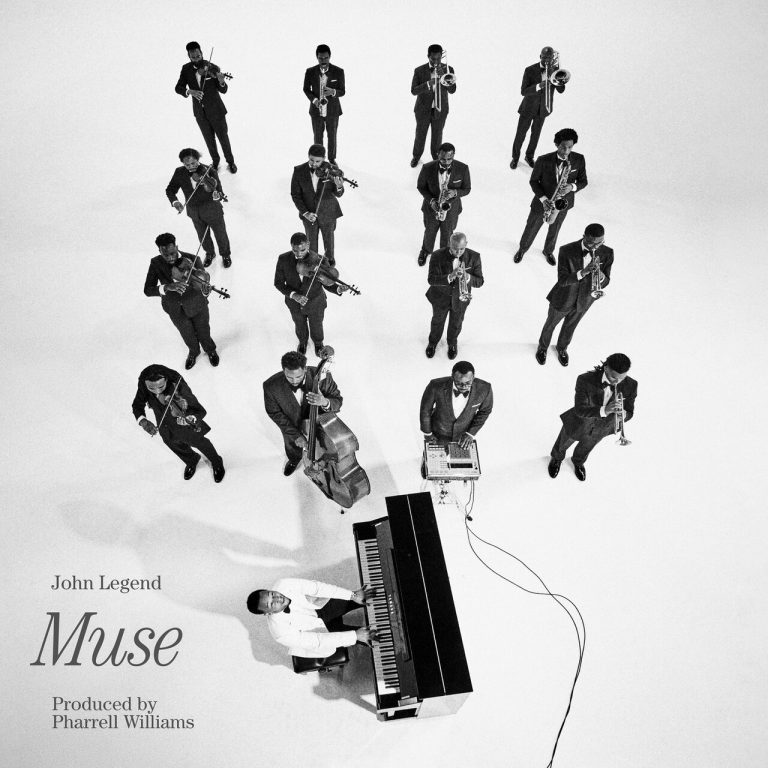

John Legend explained the delay himself, the day before the record came out, and he did it without a trace of defensiveness. He and Pharrell Williams have been friends for more than two decades. They had never made an album together. The reason, Legend said, was that Kanye West executive-produced all his records, so handing a whole project to another producer would not have made sense at the time. Then came the line that recasts everything around it: he is more of a free agent now.
That is a mild way to describe 22 years. Legend was the first artist signed to GOOD Music. Get Lifted arrived in December 2004 with West as executive producer and manager, and it won three Grammys, Best New Artist among them. Everything after it, 11 albums through last year’s My Favorite Dream, functioned as a slow argument that the voice came with its own ideas attached. He wrote. He played. He produced. The catalogue was built on the premise that he was its author.
Muse is what he does with the freedom. The first thing he does is give it away.
Pharrell produced all 16 tracks and co-wrote them. The two started in January 2025 at Pharrell’s studio inside Louis Vuitton’s Paris headquarters, where he runs menswear, and the work began because Legend sang on Clipse’s “The Birds Don’t Sing” and Pharrell decided there was a whole record in that voice. Legend has said, plainly, that some of these songs were written for him entirely by Pharrell, which he almost never allows. The album is called Muse. A muse does not make the thing. A muse is what the thing gets made about.
Which is why the shape of this record is the most interesting decision on it. Legend’s last proper album, the self-titled double from 2022, ran 81 minutes across 24 songs with something close to 30 producers attached, and it reached number 59 on the album chart. Muse is 42 minutes. Thirteen songs, three introductions, one producer. After a record that tried to be everything, this one has the discipline of a man who got the note.
It opens on the title song, a piece of fiction about a man and the woman he cannot stop writing about, and the production lays out its terms immediately: live-sounding drums, close vocals, a lushness that never tips into gloss. Pharrell’s stated idea was a Black James Bond with a modern backbeat, which is funnier and more accurate than it sounds. “Pray For Ya” has swagger and a joke at its centre, the woman who does not want saving, and it is the loosest Legend has sounded on his own record in years. “Daylight”, the single, was performed first on a network football broadcast and comes with a Paul Hunter video of Legend at a piano in a half-lit room while dancers circle him. It is the most conventional thing here and it does its job.
Then the record gets uncomfortable, which is where it gets good. “Are You OK?” and “Under The Bridge” are a pair, and they work as a single argument: a man asking a question he already knows the answer to, then forgiving what he has just confirmed. “Under The Bridge” is the best song on the album, and the reason is the mismatch. The groove is warm and the writing is not. It swings while the narrator decides, again, to believe something he does not believe. Legend has made a long career out of singing about love that works. He has rarely sung about love that is being managed.
“Bodies On The Floor” is preceded by a bugle call. Taps, the thing played over military graves, sits in front of a Clipse feature, and Pusha T and Malice are among the album’s credited writers. Whatever you make of the gesture, it is not the move of a man protecting his brand.
“Fireflies” is where the whole arrangement shows itself. Pharrell wrote it and sings on it. Its subject is poverty and the violence that travels with it, and the video puts the song inside a housing project with an orchestra behind Legend’s piano. Legend has described what Pharrell asked him to do with his voice there: less singing, more speaking, closer to oration than melody. So the most serious song on John Legend’s album was written by somebody else, about a world Legend left, and delivered in a voice he was coached into. It is also one of the three or four best things in his catalogue. Those two facts do not cancel each other out, and the record is stronger for refusing to pretend otherwise.
Where it slackens is in the middle of its own goodwill. “Get Back” and “Doing Me” are competent and forgettable, and Legend’s pull toward the tasteful reasserts itself across roughly half the running time. The three introductions are a problem too. On a 42 minute album they read as structure standing in for substance, and two more written songs would have served better. The strongest material, the social writing and the uneasy love songs, arrives late and in a hurry. “Everything” and “Sail Off” then close on a gentleness the back half has not quite earned.
The authorship question never resolves either. Pharrell features on six of the 13 songs. The line between a producer with a loud signature and a co-headliner gets thin, and the phrase “produced in full by Pharrell” sits beside a credit list running to nine writers, Samm Henshaw and Wayne Hector among them. A collaboration has been framed as a surrender, and the framing is doing some work the music does not entirely support.
Legend is 47. He has the EGOT, a first original stage score heading for The Shed in New York, and a film role as Harry Belafonte waiting. He had no reason to do this. Jay-Z once told him he was our voice, a line Legend repeats with obvious pride. On Muse he lends that voice out, and what comes back through it is sharper than most of what he has written for himself lately. The humility is the achievement. It is also, unavoidably, the limitation.