
In Minnesota, Charlie Parr’s current home and native state, around 80% of low-income rental households spend more than 30% of their income on housing. There are only 41 available homes for every 100 extremely low-income renters. (See here for other Minnesota statistics.) In fact, no state in the United States has an adequate supply of affordable rental housing for lowest-income renters (see this map). These high living costs force low-income individuals to skip meals, skimp on healthcare, and struggle to carry out their lives in a way that any human being has an inherent right to.
There is no doubt Parr is well aware of this current crisis. He himself lived in a rooming house in Minnesota in the 1980s where he met a slew of interesting characters whose stories influenced his newly released record from Smithsonian Folkways.
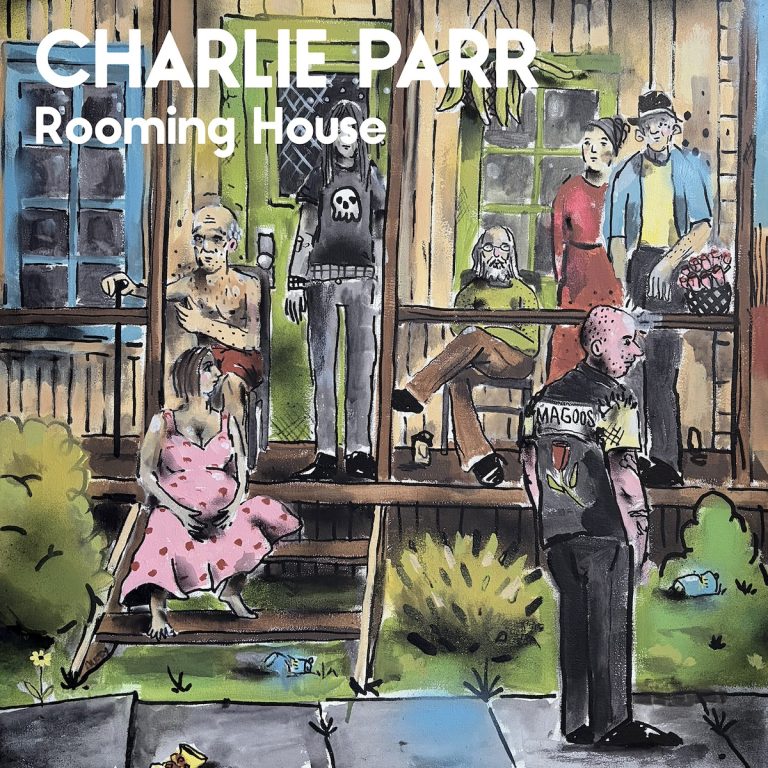
Enter the Rooming House, Parr’s pertinent and poetic tale of an old man named John, and the various lives of everyday Minnesotans who cohabitate in a town house in Duluth. The house is rented out by John, who has never left his childhood room, where his mother left him at a young age. Over the years, John allowed others to move into his childhood home so as to help him pay the bills, quietly hoping that his mother may one day return. Along the way, together with drummer Dave King (of The Bad Plus), Parr plucks his resonator as he always has, brimming with fiery prose and bluesy poise, and sings tales of survival with his own signature sort of lilting as heard throughout his long and impressive career as a folk artist.
Overwhelming devastation saturates every track on Rooming House. On the title track, Parr recounts a seemingly pleasant memory of the roommates frying a fish one of them caught earlier in the day. Later, we learn this fish gives them all food poisoning, and that this is the start of John’s terminal illness.
On “Bank Robber”, we hear another anecdote about John, who hands a note to a customer saying that he has a gun and that he’s “sick and tired and only wants some peace”. His goal is not to rob the bank, but to purposefully get arrested so that, in prison, he can get the treatment he cannot afford as a free man. Elsewhere on “Mother Sara”, Parr shares the heartbreaking story of a single mother struggling to raise her child on a closed-in porch in the crammed house.
In every nook, hallway, or closet lies sorrow and despair. Occasionally, Parr’s voice will sound fatigued and his resonator hollow, resembling the creaking structure of the old wooden house. Miraculously, however, Parr still finds spaces for his hallmark lightheartedness and comedic undertones. “(what’s so funny about) Universal Healthcare” is, sonically, a much needed break from the devastation. Parr does his best Red Sovine impression as he and King play free-flowing and rag-like melodies. Yet the lyrics still evoke the record’s focus on economic hardship and paralyzing reality. Not since Hank Williams’ “Everything’s Okay” have I heard a folk-country song so depressing and comedic at the same time.
Parr’s characters in Rooming House have been abandoned, dejected, pushed into attics and basements. They mix different types of wine in the same glass. They are thirsty. Their bags are always packed. The hallways outside their bedrooms are not their home. They have no home. Frying fish is the most entertaining event of the month. They long for security, warmth, and food. They are hungry. They get sick from the food they eat. They have no money and few aspirations.
The final track “Lilliput Park 2026”, perhaps the saddest song of the year thanks to Jacquelin Ultan’s featured cello, finds a dying John being taken to his favorite local park by his roommates (now evictees), as they return home to close John’s childhood door one final time.
“This is one song, really” Parr explains in the liner notes, “This house could be anywhere. These things could happen to anyone.” The point of this record, I think, is more than just a call for action; these realities are already known by the majority of the population in the United States. The true focus of this record is the even more devastating fact that people are now getting used to these tragedies. 82% of people in the United States believe that housing affordability is a problem. Nearly 70% think that housing shortages are a direct cause of homelessness. Nothing is changing. Mortgages are getting more expensive, and salaries are not matching the growth. Rooming House could have centered on thousands of different people, with thousands of different tales, but the result would have always been the same: a short and bitter snapshot of today’s housing crisis, not hyperbole but stark reality.