
Ivan Pavlovich has a figure he keeps coming back to, and it is worth sitting with for a second. Rockstar’s vice president of music says there are over 800 in Grand Theft Auto VI right now. To get them, his team licensed something like three times that many and threw the rest away. For a single station, one that plays international covers of Western pop, somebody at Rockstar spent part of the last few years chasing down rights holders in Thailand and in Vietnam. Twenty-one music stations. Two talk stations. Podcasts you can carry around on a phone in the game, which the series has never done before.
That work is the thing Rockstar has always been better at than anybody, and it is not what this album is.
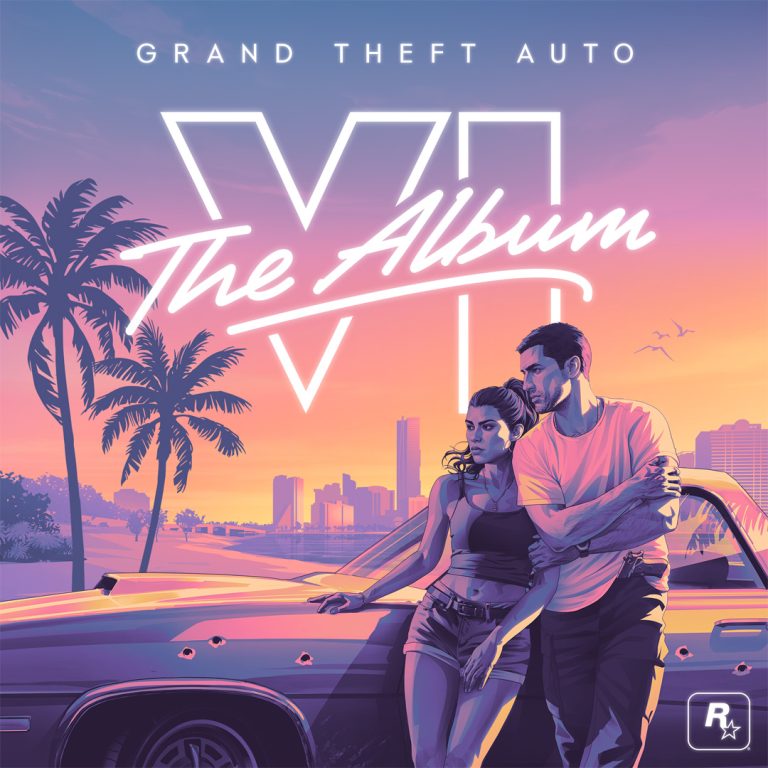
Grand Theft Auto VI: The Album arrived on 19 November alongside the long-awaited game with 34 original songs, written to order, assembled with Atlantic Records over roughly three years. Four days later a deluxe edition added 23 more, bringing it to 57. None of it is the in-game radio. None of it is Justice’s score, which gets its own release on 11 December. This is a separate commercial object, sold on its own, and it represents another step in a journey the series has been making for 24 years.
Follow that road and the shape of it is clear enough. Vice City in 2002 simply licensed hits, and worked because those songs already carried their own freight; you heard them and you remembered where you were the first time. San Andreas partnered with Interscope and hired Chuck D, George Clinton and Axl Rose to play disc jockeys. GTA IV brought in DJ Premier and Green Lantern and began making a little music of its own. GTA V commissioned the series’ first original score. Every stage moved an inch further from borrowing and an inch closer to manufacturing. The Album is arguably where the road runs out.
The problem with ordering music in is not quality. It’s provenance. A licensed song shows up with a past attached, and a game that places it well gets all that past for free. A commissioned song has to invent a past, which means asking a professional to write convincingly about a state that does not exist. Some of them can. Most of them write a brief.
The split falls along a line nobody at Atlantic appears to have drawn deliberately, and it is the most interesting thing on the record. The songs that work belong to artists for whom Florida and the Caribbean are not a mood board.
Rauw Alejandro grew up on these games, and his contribution “Macacoa 2000” is old-school reggaetón with sound effects pushed into it, played by a man who sounds like he is enjoying himself rather than completing a task. Fuerza Regida’s “Suzuki” welds regional Mexican to a reggaetón pulse and never once asks for credit. Jhayco’s “X” and Kali Uchis and Helado Negro’s “Lárgate” do the same job from different angles, the latter riding a spring reverb so dated it loops back around to being correct. And JT, out of Miami, delivers the one song here that does not seem to be winking at anything. The record spends a great deal of effort gesturing at a place. She just sounds like she is from it.
Now the other column. Dua Lipa’s “Go Easy” is well made and would fit anywhere, which is the whole complaint. Zara Larsson’s “Fast Emotion” is Eurodance with the serial numbers filed off. Gunna’s “Count Up” sounds like a demo somebody passed on. Burna Boy’s “Bigger” rides its one idea into the ground. These are not bad songs. They are placeless ones, and placelessness is a real failure on a record whose entire pitch is a place.
Lana Del Rey is the strangest case. “Crazy for You” is, by most accounts, a song she recorded years ago and shelved, and you can hear that it predates the assignment. It is gorgeous, hazy, built out of the same materials as her mid-2010s records, and it belongs to a different album entirely. Which is to say: the most convincingly atmospheric track on a soundtrack of commissions is the one that was not commissioned. Rockstar borrowed it. Old habits.
Then there is the part of this that almost nobody is talking about, and it reframes everything. The most American fantasy in entertainment has been held together by a handful of French dance producers. Justice wrote the score and appear twice on the album as artists, opening it with “Starting From Zero” and landing its biggest song in “Flower in a Hurricane,” which pulls SZA, Tame Impala and King Gizzard & The Lizard Wizard into one five-way collision that has no business cohering and does. Guy-Manuel de Homem-Christo, half of Daft Punk, produced Travis Scott’s “RHYNO,” the most unhinged three minutes here and far too short. Étienne de Crécy turns up on “Sexy Magic” alongside PinkPantheress, Fred again.. and Ca7riel & Paco Amoroso. Gesaffelstein is on the score.
That is not a coincidence, and it explains why the pastiche lands when it lands. The French house scene has spent 25 years making records about an America its makers learned from records — a secondhand, overbright, slightly wrong America assembled from disco samples and FM radio. Vice City is the same object built out of film. The two fictions were made by the same method, which is why Justice can write an opening-credits song for a crime epic, hand it to Michael McDonald, and have it work.
A lot of listeners have found that choice absurd. Yacht rock over the opening of a game about running drugs through Florida. I think it is the sharpest decision on the album. McDonald in 2026 is not a punchline; that voice has become one of the most loved textures in pop, and putting it at the top of this thing is a joke about sunshine and brochures and the distance between how Florida looks and what happens there. Justice understood the assignment better than most of the people who were given it.
The other old man here earns his place too. Keith Richards is 82 and his contribution is a cover of Jimmy Reed’s “Bright Lights, Big City,” which reads as random until you remember that the Rolling Stones cut that same song in 1963. He is not doing pastiche. He was there. On a record where everyone else is performing a memory of the 20th century, one man is just playing something he has played before, with a guitar and some drums and nothing else, and the effect is startling.
And then the deluxe edition does something I am fairly sure was an accident. After Travis Scott, Slayyyter, Offset, 21 Savage, Latto, Denzel Curry and the rest of the bonus material, the last five tracks belong to Overmono, the Welsh duo who supplied additional score alongside Justice. Among their contributions to the game is the pause music. So this 57-song commercial juggernaut, the one that sold more vinyl and physical product in 24 hours than anything in Atlantic’s history, ends with the music written for the moment you stop playing. Nobody was asked to make a hit out of it. It is the best stretch on either edition.
Which brings the reservations, and there are real ones. Fifty-seven tracks is not an album, it is a catalogue, and no human being is going to sit through it twice. The sequencing on the base record lurches without purpose. A dozen of these songs exist because a label had a roster and a deadline. The physical rollout is its own small comedy: liquid-filled vinyl that sold out instantly and turned up on resale sites at several times its price, while the game itself ships as a download code in a box. The soundtrack got the artefact. The game got a QR code.
But something genuine happened here, and it happened at the edges. Ask a hundred stars to imagine Florida and most of them hand back a competent guess. Ask four French producers who have built careers on loving America from a distance, one 82-year-old who played the blues in 1963, a few Latin artists who actually live in that weather, and a pair of Welshmen writing music for an empty screen, and you get something that occasionally stops performing and starts meaning. The album does not know which of its songs are the good ones. That is fine. It is long enough that you can find out yourself.