
Some history comes sudden. On the 31st of July 1932, the German NSDAP suddenly, shockingly, counted the second highest amount of votes during the German federal election. Gaining over 18%, the party was only overtaken by the social democrats, and sat above the communist party numbers. Just two years prior, they had counted a mere 2.6%, with citizens, the press and even the NSDAP party heads themselves considering this the zenith of their ambitions. The Weimarer Republic had, at that point, recuperated its standing as intellectual and economic heavyweight on the international stage, with German researchers, artists and engineers being considered as leads of worldwide progression.
This sudden, unmitigated leap in popularity is thoroughly researched, but has been subject to revisionist analysis recently. Based on thorough analysis of historical documentation and contemporary reports, there wasn’t a glorious rise, as has been taught in schools and constructed from internal claims. The myth of chic, modernist, expansive populism was merely an assumption based on post-factum propaganda narratives. In reality, nobody saw it coming.
And now, a hundred years later, we are observing history repeating itself. Financial crises and unempathetic leaders seem totally ignorant both as to the needs of their constituents and the danger lurking in the bleachers. Fascism is being rendered presentable and normalised by the press, as billionaire media owners mould public consciousness according to their will. And nobody can imagine just how bad things will get.
Almost exactly three years ago, I wrote a piece about the burgeoning musical art movement deemed Futurismus, and argued that these bands – Mandy, Indiana; Model/Actriz; Naked Lungs; Gilla Band – were punk-rock Cassandras, chroniclers of political tensions that could discharge into something much worse if we didn’t heed the warning signs. The piece released not even three weeks before October 7th, one month before Elon Musk would take over Twitter and roughly one year before Donald Trump would be voted into his second term. It’s not that there are historical parallels: the now reenacts exactly what happened then. As the world stage grew more grim and brutal, Futurismus went on to define the sound of this decade: Mandy, Indiana have released what could be this year’s frontrunner for best album and Model/Actriz collaborate with Miley Cyrus, while new groups – from Prostitute to Nerves – carry the sound onward.
A major part of the sub-genre’s evolution has been Dan Fox’s work. The bassist and by all means ‘sound engineer’ of Gilla Band worked with and produced multiple of the acts producing Futurismus records. His tendency for abstract, industrial-tinged sound collage is thoroughly unique in the contemporary music landscape. As he moulded some of decade’s most vital acts, guitarist Alan Duggan meanwhile released an EP best described as “progressive noise techno” under the monicker Null Club. Vocalist Dara Kiely meanwhile fully engrossed himself in his newfound passion for painting.
Yet with all this output, their main venture kept shrouded in shadows. Were they preparing something that could outclass Most Normal, their excellent claustrophobic third record? How to follow a work that hard edged and cubist? Another band would see it as ‘career suicide’, as last uproar against the waning creativity to piss off the flailing market – a farewell note to a faltering era. How else to respond to the unacceptable but to burn it all down?
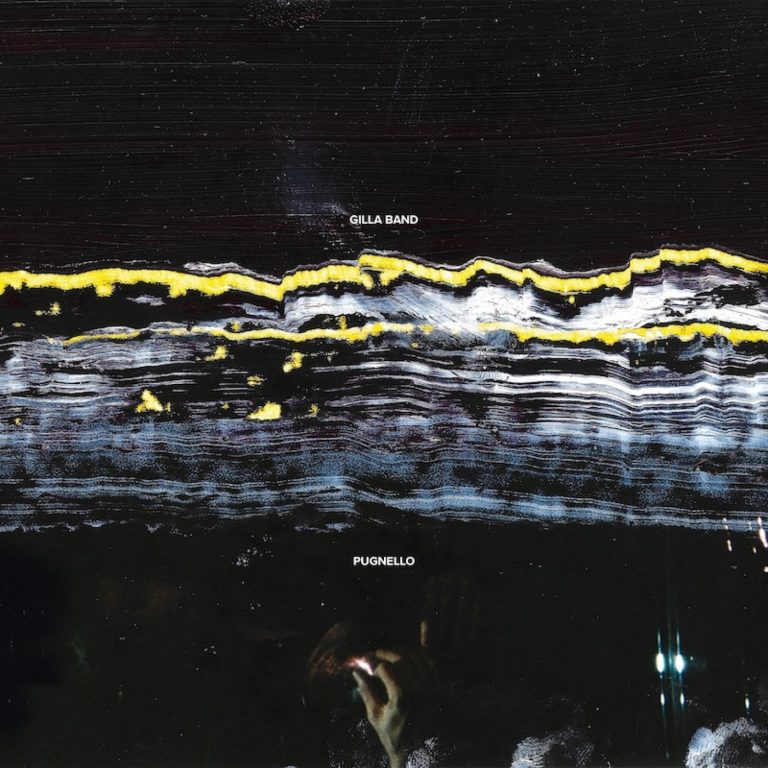
To say that Gilla Band have outdone themselves is an understatement. Pugnello escalates everything that made Most Normal transgressive. It is, in many ways, a harsh work of dadaism, a mad, angry, carnal, disfigured art piece – the sort classified by Kid A, Merriweather Post Pavilion, Metal Box, White Light/White Heat. It’s an album that sounds like no other record before it, but also digests all of rock and electronic music within its construct.
Pugnello sounds like a disjointed techno club night, but also retains the air of a modern art piece that only exists as static unit. It is a frightening piece of cyber-horror, as if Burroughs’ junk-pierced brain was given reign to catalogue and collage tweets and reels into a mass of cannibalistic poetry. Somewhere, in the future, our genocides all fed to AI, spat out as horrific pieces of mad cow brain disease inducing cacophony: the hammering of guns and screams of a thousands shall make us laugh and dance! Pugnello sounds like the last sane man observing this and committing witness on tape.
If this sounds mad, maybe we all are. Pugnello gives Kiely room to reflect on living with a schizophrenia diagnosis – something immensely frightening, but also eerily comforting. The industrial-blues of opener “Alogia” finds him accessing the condition as a means of hyper-awareness, in stark contrast to what most would deem a normal life: “Often / Fantasise what it’s like to be accountants / A steady structure, routine and purpose / That kind of life would be so perfect / Especially cos I’m a Schizophrenic”. His protagonist finds resolve – and happiness – in dance: constant, libidinal movement, that ejects expression. This is where the comfort comes: if an artist can exist besides such struggle, find a means of articulation beyond the norm, then maybe we, too, hold the strength to survive this mad tide of our times.
Still, Kiely often seems unable to hold it together and uses instability as a tool. He dives into sudden screams, as if the sight of this world forces him to claw at his eyes, lulls his words like a drunk, arranges a choir of eerie murmurs; constant, unrelenting chaos – yet he always makes sense.
In “Placeholder”, he imagines an environment dominated by fear and conformity: “I’m injecting a lethal dose of nothing / I’m blaring a dangerous amount of Coldplay / Dad rock already / Sleeping with your teddy / Pissed the bed lately / At home”. The album’s industrial drenched quasi-techno single finds connections between the current age of device addiction to the sheer nonsense of pre-9/11 consumerism: children can only imagine their future as Power Rangers, their body morphed into the shape of a Teletubby, heralding the wisdom of Crazy Frog.
“Phoneroticaddiction” becomes a striking, cronenbergian neologism: maybe we all want to fuck our devices now; make love to screens and all we see. The Power Rangers return on “The Megazord”: the titular creature, an amalgam of mutliple smaller Zords, seems a stand-in for the horrors that come with not fitting in to society, and how this allows the release of abuse. “I should dye my hair grey / I should be put away / I should be happy / I should be dead!” The song’s complex industrial patterns suggest the stark contrast between machine and the human existence, that our minds and bodies are gelatinous and mutable, hacked at by complex constructs we barely understand. A terror trip of body horror.
“Computer Sadness” transforms this notion into the horrific sound of wetware techno. Oh, not self explanatory, my apologies – wetware is a term coined by cyberpunk writer Bruce Sterling, and has since become synonymous with the idea of human flesh, and brains, merging with computer technology as horrific bio-cybernetic hybrid. This song is not as fully relatable on a lyrical level, but opening on the echoing hum of electronic machinery, moving into an artificial heartbeat and finally presenting an endlessly stuttering mechanical Kiely, gives way to strange imagery of boxed in bodies within Gigerian factories: is this what Xenomorphs dance to? There is sadness here in the total absence of all things humanoid, the purely mechanical sounds of Skynet’s unsexy armies.
And still, Gilla Band find a way to take it further: closer “The Gallop” removes all remnants of human perspective and presents itself as the horrified monologue of a mechanical protagonist: “Make it Stop / Make it Numb”, the robot voice begs, monotonously. It’s a striking piece, and one deceivingly personal: here, Kiely digests the death of his father – a fellow musician, absent for most of his life. In a recent interview, Kiely revealed the fantasy of purchasing his father’s highly collectible, pricey vinyl records, and at a meeting, passing them over to him as a healing gesture. But Kiely’s father passed before the moment could occur. “The Gallop” imagines the dialogue of the two over a mechanical dub, all humanity removed from the sonics and shifted into the barely recognisable lyrics: “You should learn from me / I’m so grateful that / You’re so hateful”. The final line, buried under pummelling beats: “Your dad is dead.”
“Jacobsons” removes all arabesques, concentrating on a cracked techno beat and occasional guitar bursts, the music giving way to the grief Kiely experiences. At times, his delivery sounds as if he’s attempting to find words while sobbing, only to then shriek “I should be more sad”, or to wonder “Where do you go when you’re told / To fuck off?” It’s a naked performance, interrogating a specific kind of impostor syndrome, once more expressing the inability to fuse the immediate response of our brain to how we are supposed to emote: “.I never miss you yeah yeah yeah / I never think of you yeah yeah yeah / I never thanked you yeah yeah yeah / For what?” For Kiely, grief is the anchor of generational divide and paternal alienation that oscillates between the personal and the political – between the living room and the world stage, the latter projected to us from our small screens. When he sings of medial horrors – of sappy music, of vulgar TV – then these come as generational markers: dad rock, kids show. Between these two poles, communication is impossible, only imagined through the cold metal larynx of cyborgs.
Meta-textually, this collision is best expressed in the exhilarating standout “Crisp Pop”: referencing the chants from “Sympathy for the Devil” (“Wooh-Wooooh”) before delving into an uneasy mixture of clattering rhythms and muffled voices, Kiely seems to count down, then diving into culinary imagery over a demented synth line and broken guitar chords. It’s the most evidentiary no wave song on the album, connecting with Arto Lindsay’s brilliant innovations during DNA – but it also crashes one of the key musical moments of the 60s with the iconoclastic, mechanical brutality of Futurismus.
This is where the group’s Dadaist tendencies become most clear: they have no interest in mere homage, but in a total deconstruction of value, the defacing of nostalgia, of pathos, of icons – as proclaimed by the Dadaists! “We hope something new will come from this,” Tristan Tzara wrote in 1920, “being exactly what we no longer want, determinedly less putrid, less selfish, less materialistic, less obtuse, less immensely grotesque.”
And there are plenty of musical comparisons: The Residents had done similar things to the Stones on their equally political The Third Reich ‘n Roll, merging “Sympathy…” with “Hey Jude”, declaring meaning through utter absurdity and absence of all logic. And then there was Mark E. Smith, the mad mancunian precog whose societal critique came all true. He briefly comes around during the inverted disco-banger “Giraffe”, when Kiely – very Smith’ee – bends language to express his jester-like hyper awareness: “The eel that wants to squeal / A daft giraffe telling tall tales / He may be a paragraph behind but he’s Dara-graph ahead / Right on the lid and on the left-side of the bed”.
The song again toys with the almost revisionist battle between generational obsessions (“Now McCartney is cool / That also means Wings”) and the universal inability of correct pattern recognition: when Kiely sings “Don’t say the C word, you can’t”, the “can’t” sounds exactly the way you think it does! We can’t trust our brains to untangle information correctly! “If you’re gonna do it wrong, do it right / That’s the difference between shit and shite”, Kiely suggests, before taking the hit: “Like saying “like” too much / Copying The Fall and getting caught”. There’s also the brilliant coda, which can stand for so many toxic dynamics of the current day, where care is only expressed through acts of harm: “She chased me out the door with a hairbrush / Demanding that I would wear a suitable jacket”.
The song’s modus, of unmasking the absence of meaning by contrasting the meaningful with its empty inversion, returns with “Angelus”. Titled after the prayer meant to open and conclude the work day, the song’s insane mixture of drone and D’n’B has Kiely recite a list of idioms mixed with his own creations. “The cat’s pajamas” is nonsensical, until we collectively accept attributed meaning to it – but where does that leave Kiely’s own creations? Are they the words of a madman because we don’t understand them, collectively? Just when things seem to fall into place, the song bursts into blistering noise, and Kiely shrieking.
“Three Hands Clapping” finally extends this spatially: his voice echoing (a reference to the architecture of Dublin, from which the singer moved recently?), Kiely likens his life to the fourth season of a TV show, where he can’t follow his former friends and is left wondering what’s happening. The disorienting, brutalist track almost feels like Gilla Band attempting a form of sinister ambient, puzzling over the sudden shock of a world that’s turned inside out. The fourth season of Community comes to mind, later on referred to as “gas-leak-year”.
But it is not gas that leaks from Pugnello. The maw of society is gobbling up much stranger things today. Gilla Band have, again, characterised this seismic societal shift we all are witness to – but unlike so many artists that struggle with an appropriate response, or even a courageous minor one, they face it with meaningful madness. They are fully lucid as the terror, anger and grief washes in, and all coherence is tossed out.
Pugnello is, in many ways, a revolutionary work: defiant, radical, offensive, revealing, violent. It’s a record like a manifesto: demanding and archaic, but also deeply honest in its earnestness and self-awareness. The final moments of cosmic horror literature come to mind: the Lovecraft protagonist, who is confronted with something so unspeakably garish, defying the sane mind in form and size, that frenzy and madness follow.
But within this strangeness is something horrifically sublime: anyone who listens to the album won’t just hear the music, but witness something truly unique, brave and innovative – maybe at times even divine, when it reaches for the expression of limit-experiences. Where Most Normal was a warning in light of how bizarre our daily life had become, Pugnello is the pained scream of terminal realisation that all is too late. Grief, denial, horror taking over, as our bodies are crumpled inside of human made machines, now meant for us. Where Remain in Light chronicled Cold War anxiety as psychedelic disco, Pugnello reveals the paranoid nightmare of living in the era of mecha-fascism. Futurismus is the only language to counter this madness: our last call for a revolution!
92%