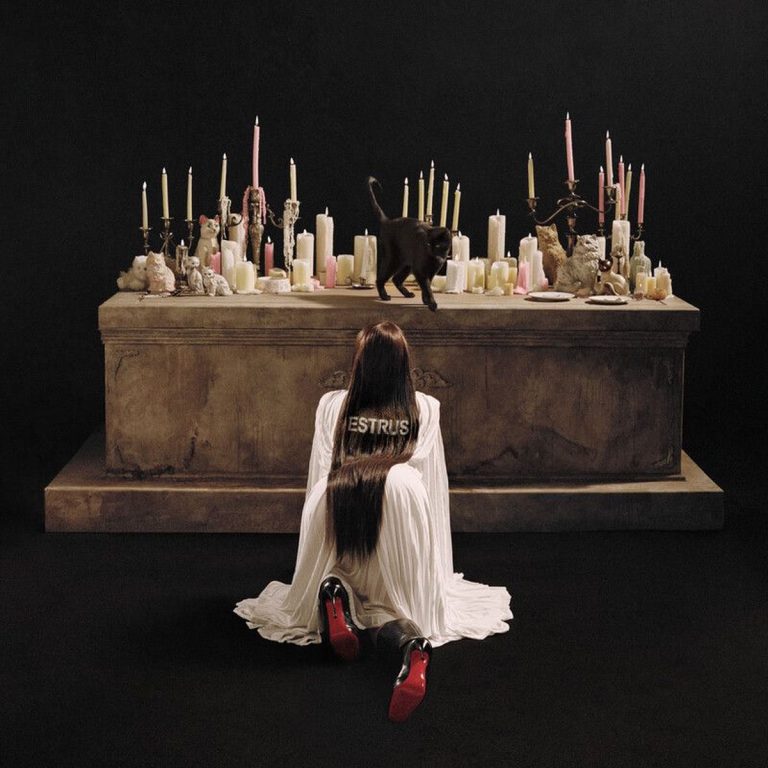

Everyone is reading “Estrus” as a synonym for horny, but it is also the part of the cycle when an animal can conceive, and the record knows it.
Most of the coverage has taken the title at its first meaning. Tove Lo has described estrus as an animal in heat; primal, her mind and body wanting different things at once. The singles have obliged: club tempos, bad nights, a song whose initials stand for drunk and horny. All true. But estrus is not just the phase when an animal wants sex. It is the phase when she can get pregnant. For a singer a month short of 39, married, who spent a whole song on her last album asking what would happen if she changed her mind about children and then found she couldn’t have them, that second meaning is not a coincidence. It is the album.
That song was “Suburbia”, from Dirt Femme in 2022, the record on which she left her major label, set up her own imprint, Pretty Swede, and sang about a marriage she never expected to want. ESTRUS, her sixth album and her first full-length since, picks up the thread and pulls it tighter. It closes with “source of life”, which brings fertility, motherhood and mortality into direct collision, and once you have heard it, the preceding half hour of nights out reads differently. The recklessness is not only recklessness. Some of it is a clock.
She made the record in Los Angeles, Stockholm, Stromae’s studio in Brussels, and Torekov, the small fishing village on the Swedish coast where she spent childhood summers. She has said the place holds a lot: depression, her eating disorder, breakups, family trouble, loss. Most of it was made with Ludvig Söderberg, who produces as A Strut and whom she calls the second half of herself creatively. They have been working together since “Habits (Stay High)” made her a star in 2014, and his production here is the most direct it has been in years: hard, compact, built for rooms that are already hot.
That history matters for a less comfortable reason. Tove Lo was writing messy, honest, frankly chemical pop a full decade before the summer of Brat made it fashionable. ESTRUS arrives into a landscape that caught up with her, and it recruits Elvira Anderfjärd and Luka Kloser, who have worked with Addison Rae, for “F.A.M.T”, the one track without Söderberg’s hand on it. There is a real risk of the originator sounding like she is chasing her own imitators. For the most part she avoids it, because nobody else writes quite like this.
The 50-second opener, “a lot of feelings, no solutions”, states the terms and gets out. “I’m your girl right?” is the most kinetic thing she has released since 2016’s Lady Wood, the question in the title doing all the anxious work underneath a bright synth line. “DNH” is part complaint and part love letter to a friend who ruins every night out and remains a best friend regardless. “des fleurs”, with Stromae singing in French, is the most unexpected track here and one of the best, his mournful cadence sitting beautifully against her flatter delivery. “I’m the cake” is ridiculous, sexual and very funny, with a hook that improves every time it comes round.
The songs that matter most are quieter. “the bad one” turns on the idea that two opposite things can be equally true, which is as close as the record gets to a mission statement. “roomie” is about sharing a flat with someone you love, the routines and irritations of it, and it carries a writing credit for Charlie Twaddle, her husband. A song about domestic life co-written with the person she lives it with is a small, telling detail, and it gives the ending the ground it needs.
The limitation is length, and a certain unwillingness to finish thoughts. Thirteen tracks run 32 minutes, and several of them feel like excellent openings rather than complete songs. “if I could I would” is gone in barely two minutes. The middle stretch of bravado is fun and thin in roughly equal measure. And “no solutions” is an honest premise that occasionally works as an alibi: an album that refuses to resolve anything sometimes sounds like one that has not decided.
Then “source of life” arrives and makes a strong case that the refusal was the point. She has always been best at sounding fearless while the doubt stays visible, and here the doubt is bigger than a bad night. Four years ago she wondered aloud whether she would want children. On ESTRUS she has given the question a biological name and a dance floor, and left it open. It is the most grown-up record she has made, and it still sounds like 3am.