
There’s not many occasions of a single work becoming such a monolith that it retroactively lifts an obscure band into mainstream recognition. Usually, cult albums remain just that: a small jewel that goes on to inspire many, but retains its mystery. The rare Velvet Underground, Joy Division or Slowdive occur just about once or twice a decade – partially because most obscure music is not compatible with pop sensibilities, and part because the mainstream business is rigged against the small creators.
Yet Sleep got lucky: their one-track riff-odyssey Dopesmoker survived a mandatory truncation, the death of alternative rock, the nu-metal trend and critical ‘death of Rock’-fad. Somehow, it grew from being a minor entry in the stoner rock landscape of the late 90s into a key work of the doom metal genre. The growing popularity finally led to a full fledged comeback, with 2018’s The Sciences proving the group were still residing among the very best of metal.
Hempispheres couldn’t come at a better moment: Zoomers just woke up to 90s metal such as Crowbar thanks to TikTok memes, while Agriculture, Chat Pile, Imperial Triumphant and Blood Incantation connect with larger audiences worldwide. Metal had diverted between goofy pop rock and somewhat of an anti-social, reactionary genre by 2000, but is now both gaining respectability and reimagining itself as creative melting pot.
Yet Sleep’s fifth album enters with the caveat of cataclysmic sea change. Besides drummer Jason Roeder leaving to concentrate on the reformed Neurosis, founding guitarist Matt Pike exited, leaving only vocalist and bassist Al Cisneros from the original line-up. While the group had always been Cisneros’ vision, the loss of the uniquely brilliant Roeder and Pike – whose talent is equal in expressive, exploratory style – hurts. Cisneros fills this gap with two veterans of heavy music: Dale Crover of Melvins – one of doom’s most respected percussionists – and Bubba Dupree of Void. On paper, a brilliant line-up.
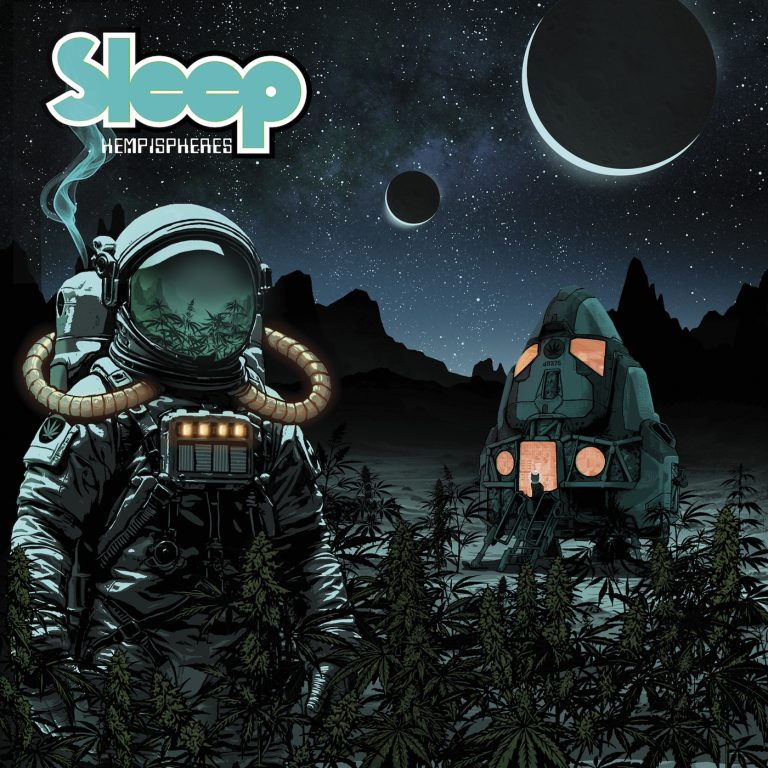
Hempispheres also comes with an equally nifty artwork – always an important aspect in metal mysticism. Our ‘Marijuanaut’ of The Sciences seems to have found a home planet that allows for growth of space-weed, and he’s even got a cat-companion in a space suit! Like Cisneros, he seems to have found reliable company and stability in life and work.
It’s fitting for an album that verges into space rock immediately: “Have Spacesuit Will Travel” employs synthesised guitar tones to introduce cosmic vastness, while Cisneros admires the depth of space and praises recreational qualities of weed. It’s a nice, moody Black Sabbath emulation, rising above a fairly dull mix that sidelines the guitars a little. The psychedelic “The Morrisist” slows the tempo down even further, and might be the album’s best song: with its ominous intro, hissing hi-hats, quasi Arabic melodies and dense mood, it’s the most nocturnal and inspired song of the album.
But sadly, something strange happens after: the three remaining songs just settle on the same compositional blueprint, with just very little emotive or expressive playing. The title track is an extension of the first two, but all instruments just stick to fairly tired and monotone movements – when the tempo switches, nothing much is achieved or said and Dupree’s guitar vanishes in the mix, with his solo feeling like an early rehearsal instead than a grand statement. At almost eight minutes, “Hempispheres” feels like a warm-up session jam.
“Arrival of the Industry Ships” slows down the tempo considerably, making for the record’s most conducive track in terms of a weed high. For long stretches, it seems to go nowhere, until shortly before the five minute mark, Dupree lays down some stray notes, returning to Cisneros soon after. The overall impression is that of a phlegmatic track that harnesses a brief idea of an Iommi-like guitar exploration, but it’s just being hinted at, while the bass and guitar just trudge through the same movement. Crover is allowed some variety, but just as with the bass and downtuned guitar riffs, it’s really not at all impressive or emotive work – nothing here warrants the 11 minute runtime. On top of that, the somewhat dull, dry production of the opening track now truly hinders the once thundering dynamics of Sleep to shine. For a record by one of stoner metal’s most brutal sounding groups, this all sounds incredibly timid.
“Whole Wheat Mountain / Well Baked” effectively functions as two fused tracks. The opening section is a little more inspired than its predecessor, giving Crover some much needed variety in his style. Yet the dull production does no favour to the charming guitar riff that should lead the song: it’s confined to the background. Dupree’s solo here is maybe his most emotive on the album, but so far removed it can barely connect, as the song enters its second stretch: an instrumental variation of Sabbath’s “Hand of Doom” verse. There’s a xylophone that enters near the end, adding necessary atmosphere and… then it’s just over. The song, the record, the journey just ends there. Barely crossing the 38 minute mark, Hempispheres closes without ever finding a climax or identity.
It’s an odd experience to hear a Sleep album that is this listless, this underwhelming and removed from itself. After introducing space rock textures and some ominous flourishes during the first two songs, the record just abandons all energy, attitude or inspiration, focusing on some very generic movements. How three so seasoned veterans of heavy music could only agree on what feels more like warm-up session material is disappointing and it truly gives me no joy to announce this as Sleep’s most superfluous album. Why the group didn’t focus on the dark ambient or foreboding space rock they hint at in brief moments is mystifying. The dry, vacuous production removes all semblance of heaviness, only leaving pondering dirges where The Sciences and Dopesmoker soared – the angry, muscular punch of Sleep’s Holy Mountain is totally absent.
There’s little nuance and no palpable motivation on Hempispheres. It all goes up in smoke. I hope Cisneros can learn from this lesson – no matter who his collaborators will be going forward, he should concentrate on what he’s passionate about and dare to venture forth with the brevity and ecstasy the Marijuanaut on the project’s artwork. This sadly is a one-way street.