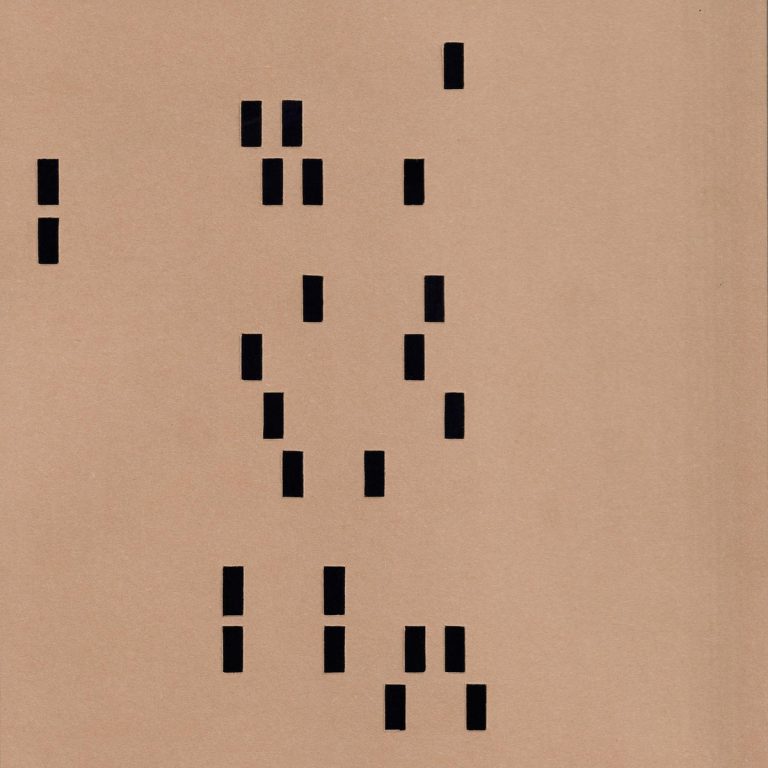

Typo loving misfits Formal Sppeedwear produce angular, wonky indie pop that playfully eschews pattern and structure. Quite frankly, they’re a glorious mess, but one that has design at its centre. Across their debut album’s 12 tracks, the Stoke-on-Trent trio turn post-punk, synth-pop and avant-garde experimentation into something playful, restless and surprisingly danceable. It’s music that sounds carefully constructed and slightly out of control at exactly the same time. They are oxymoronic, disorientating, and delightful in equal measure, but it’s also an annoying record. The frantic immediacy of Punch Card is also partially its downfall as there’s no respite from their quirky onslaught which can often get too much.
Formal Sppeedwear’s 2024 self-titled EP introduced a band indebted to the sounds of Japan, DEVO, and Speaking in Tongues-era Talking Heads with elastic basslines, Bowie-esque cut-up technique lyrics, all undercut with a ferocious groove. Punch Card takes those same ingredients and gives them considerably more room to mutate and breathe. Rather than settling into a single aesthetic and rhythm, the album keeps shifting its centre of gravity – sometimes pleasingly, often frustratingly. A familiar groove can suddenly acquire an awkward guitar figure; a pop melody might be interrupted by some obtuse electronic texture; a seemingly straightforward song can veer somewhere considerably more peculiar. It’ll keep you on your toes, for sure, as each song vies for your focus like an attention starved child.
Both “Hit ‘n’ Run” and “Who Needs Spain Ball?” use the same trick of jittery verses that feel hesitant and ungainly before they smooth out and a stride is found. Both tracks deny the listener a musical intro to get into the swing of things, hitting us immediately with lyrics that are hard to decipher over contorted rhythms that are difficult to discern. There are unmistakable echoes of late-70s and early-80s experimental pop here, but Formal Sppeedwear don’t sound like a band attempting to recreate the past. Their approach is closer to collage: take the parts that interest you, collide them, and see what happens.
“Indecent” is another example of the band’s instinct for immediacy. It has a nervous, physical energy that contorts with the vibrancy of Bauhaus knocking about ideas with Tears for Fears; a sense of claustrophobia to the fore that gets increasingly uncomfortable as the song continues. Elsewhere, “The Ballad of DCB” finds room for jangling guitars and melodic momentum, while the album’s high point “Wait (Hatchet Gets a New Hide)” feels like a miniature history of the band’s own sound, assembled from ideas that stretch back to their earliest days.
The one significant gripe with Punch Card is that there’s little respite from the juddering quirkiness of it all. “Wait (Hatchet Gets a New Hide)” is genuinely a contender for indie song of the year, but by the time it lands near the close of the record your patience may well be wearing thin with all of the charming eccentricity of the album as a whole. It’s what I imagine being trapped in a lift crammed with Wes Anderson clones feels like with them all patting one another on the back about how wildly excellent and “out there” Wes Anderson films and his wide-collared shirts are when you’re the only one who feels suffocated by it all. Punch Card is a collection of (often excellent) songs rather than a flowing body of work – a minor distinction, maybe, but an important one. The cultural reference points that Formal Sppeedwear lean into all knew how to construct albums that ebbed and flowed beautifully (i.e. Quiet Life by Japan), whereas this record often feels like an attempt to make the listener surrender rather than fully immerse themselves in the ride. The album feels like its parts don’t gel together as might be expected, but maybe that’s the point.
The lyrics are equally resistant to expectations. Beck Clewlow’s words often operate through association rather than narrative, creating images that feel dreamlike, funny and occasionally unsettling on those occasions when the lyrics can actually be understood. “Fleas” constructs a surreal sequence of floating furniture and strange visual fragments rather than offering an obvious story. The effect is less about deciphering a message than allowing the words to become another texture within the music.
There is an emotional range to Punch Card which feels a little smothered on the first few listens, and this becomes clearest toward the end of the album. “Friedrich Backs Up Nothing” is markedly more atmospheric than much of what comes before it, with manipulated cello and an unusual sense of melancholy for a record that on the whole feels more visceral than ruminative. Its reflections on how history might respond to the present give the record a surprisingly weighty conclusion. After all the rhythmic jolts and mischievous detours, the band leave you with something to contemplate.
There’s no doubt that Formal Sppeedwear have made a debut that feels genuinely their own: awkward without being inaccessible, experimental without becoming self-important, and catchy without surrendering its peculiarities. In a musical landscape increasingly comfortable with nostalgia, that sense of curiosity is refreshing for a band that sounds less interested in fitting into a scene when they can just invent their own strange little corner to inhabit instead.