
It would have been too bitter, too evidently ironic if Chat Pile had released Who Loves The Sun one week after its official release date. Their third album (or fourth, depending how you count) would then have graced the ears of its audience on the 25th anniversary of September 11. What a fitting date it would have been for the Oklahoma quartet: 9/11 in many ways ended the American imperial century – symbolically, geopolitically, financially and culturally. The attacks would set in motion a chain of events that reverberated, echoed into the future, like dominos falling. If you find it hard to trace these movements analytically, observe this occasion of Donald Trump calling in live on FOX 5, saying Wall Street 40, aka the “Trump Building”, just became the tallest building in New York City. There couldn’t be a more transparent moment to chart the great nation’s path to ruin, from capitalism into neo-feudalism, verging on fascism, bookended by the fall of two towers and the decline of a vain narcissist.
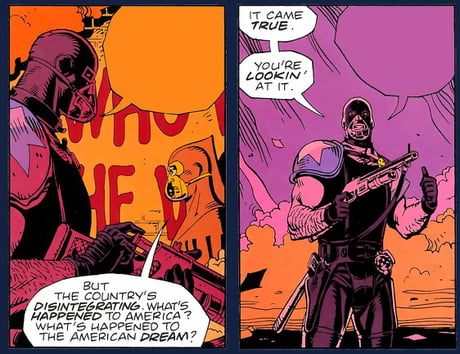
There had been prophets, of course, that traced the movements of fascism, ready to leap to action and betray its collaborators, long ago. In 1986, Alan Moore had The Comedian deliver the grim verdict to a struggling Dan Dreiberg: “What’s happened to the American Dream?” “It came true. You’re looking at it.” Every supremacist figures himself the crown of existence. But behind the shot-gun toting, gimp-masked super soldier, Moore portrayed inevitable entropy and decline. As the deportation of Milo Yiannopoulos has shown us: every foot soldier is dispensable. Ultimately, Edward Blake doesn’t fail – he simply breaks when he realises his own insignificance in the eyes of a mad, corporate emperor content with sacrificing millions in his project for global equilibrium. As Watchmen turns 40 years old, September 11 has taught us that every project to globally assess imperial power, to enforce ‘peace through strength’, will cannibalise all of our structures.
“Well, me, I kinda like it when things get weird, y’know? I like it when all the cards are on the table.” Blake’s words could be right from Raygun Busch’s mouth! The vocalist of Chat Pile has fashioned a sublime alter ego to front his band. An avid cineast, his surreal, humorous lyricism charts the landscape of the U.S. through projects of the great American nightmares. Serial killers, snuff films, drug-induced psychosis, mass shootings. His live presence of a shirtless, moustached drunk who cruises through film trivia with his audience is not so much satire as it is meant to defy public conceptions of the working class. Chat Pile clearly hold deep admiration for the working people, and in their narratives trace them as more sensitive and clever than the media or upper class permits them. There is genuine sympathy in the perspective of kids that stumble over snuff tapes as an echo of war crimes broadcast via social media, or of Pamela Voorhees mourning her son, which becomes a stand-in for all the expendable young men throughout American history. All the micro-moments become echoes of greater macro-projects.
Who Loves the Sun observes the meaninglessness in the presence of these poles. The album’s title alludes to the Velvet Underground song, which traces depression in a confrontation of elemental forces with heartbreak: “Who loves the sun? / Who cares that it makes plants grow? / Who cares what it does since you broke my heart?”
The artwork similarly speaks of triviality, when it puts Oklahoma’s Devon Tower next to the tent of homeless people and a burnt-out building. And it’s a more meaningful image still, as the owner – the Devon Energy Company – is set to move to Houston, potentially vacating a massive structure that is only barely inhabited by a total of four companies. Arise, impress, abandon: it could be the American motto! Raygun knows this: on the 10 songs that comprise Who Loves the Sun, Chat Pile conjure an apocalyptic image that, in every way, eclipses their prior albums in bleak, oppressive certainty. The end is inevitable!
“Creature” uses tough noise rock and magical images to condemn the ignorance of climate change. With the howling sarcasm of a Big Black song and the mechanical precision of Killing Joke, Raygun turns into a snarling demon during the track’s chorus: “Every creature / Led to slaughter / Every city / Underwater”. Even though this is a very rational topic, when he delves into cosmic imagery, his words almost channel mad prophets: “Please be still, the ants are dreaming / Please be quiet, the skull is speaking / and the wind will blow away your paper crown / and the lonely sun and moon will still shine down”.
“Family Funeral” reverses this movement of the cosmic interfering with small humans, by extending the struggle of an individual to cosmic proportions. Tapping into the Medea myth – via Pier Paolo Pasolini’s (or Lars von Trier’s?) feminist reading – Raygun takes the perspective of a wife and mother. When her husband leaves, the betrayal leads to inevitable tragedy: “I sent our sons to your new bride / With poisoned gown and coronet / She wore them to her father’s room / And everything they touched preceded death / And though you’ve come to save your sons / The blood on this knife should reveal my pain / Chariot of the sun now will take me / And our dead children far away”. The ancient myth transforms into an observation of true crime horror, as the economical and mental decline of the modern world leads to resurgences in filicide. The track, a sludgy dirge with immense, mechanically chiming guitars, forces Raygun into a stellar, harrowing vocal performance, that cuts just as he screams in pain over blistering noise: Medea consumed by the flames.
But these occasions, of global entropy and child murder, are still extremes in our world. So some of the most challenging and harrowing songs here are the most commonplace. The sardonically titled “PEN I S MALL” charts the maddening grind of the repetitive physical work as a mall maintenance man as a rage-inducing battle, with Raygun sounding like a rabid monster. His voice is distorted to harrowing, gurgling screams, as the band pummels itself through a pure metal performance, charting the group’s heaviest track to date. It’s hard to find any other song that holds as much hatred towards work: “This was mine but the world is full / Of hallowed halls of degradation / Hard to think that your whole life can pass / As a series of acts of subordination”. When, in the middle of the song, somebody suddenly takes a bong rip and coughs, it briefly seems like the song devolves to a piss take, but then it grinds itself through a final, sludgy section that unloads nothing but bile.
The sludgy “Christabel ’26” takes a more metaphorical approach, making use of “body snatchers”-like images to condemn the mass surveillance that comes with social media. The vampiric consumption of blood and the replacement of those you love could easily hold conceptions of conspiracies, but Raygun cleverly uses paranoia as a cypher: the exploitation of our safe spaces has become much too universal to seem far-fetched fantasy. Likewise, the title could stand for an exploited person and their age, or an application name and its release date. The name itself becomes a cypher – which returns to one of the band’s favourite metaphors.
Chat Pile have used masks often throughout their work; one could assume they see the symbol as a key factor of the American subconsciousness. Its presence in slasher films leads to the birth of the modern American boogeymen – Leatherface, Jason, Ghostface. But the modus of identity concealment also encloses a violent truth: that the constructed mask is more personal than the face we are born with. Multiple horror films play with the notion of a protagonist putting on a mask and finding themselves unable to remove it again.
“Deep Blue” charts this experience: “Feel the skin on your face melt down / And feel all the best parts of yourself drown / And let the mask become a part of your life / Let them know that they’ve chosen the right guy”. Like “PEN I S MALL”, “Deep Blue” toys with the notion of work identity, but Raygun here creates a vortex of strange images that pirouette around a maelstrom of life-wasting bed rot. At one point, he cites Kafka (“Might be a bug now but I still gotta get to work”) and later he charts the diversion from work into virtual spaces (“But that could never be / You move deeper into screens / Into the deep blue sea”): we all become flailing insects staring at ADHD delivering depravity.
Aesthetically, Who Loves the Sun is an interesting division: on one hand, the record is the group’s most sludgy, most merciless and violent release – but on the other, it is deeply indebted to memorable pop structures and even features a few genuine ballads, which re-connect with the gentle poetry of the underrated masterpiece In the Earth Again. There’s also a clear inspiration by Killing Joke on much of the album, especially with Luther Manhole’s guitar leads, which are reminiscent of Geordie Walker’s chiming tone and spidering melodies – but also the at times filtered vocals of Raygun and crushing rhythms of Stin and Ron.
“Same Rules”, one of the few gentler moments on the record, is a good example of this: as the protagonist already figures himself in their grave, the group creates a strangely elegant structure that marks their most British, most post-punk song to date. The groovy “Shrine” is its logical continuation in tone and storytelling: after the narrator of “Same Rules” dies, some occult power arrives at the crypt, and beckons the ghost to rise: “Bring the ghost out of the grave / Don’t lеt them tell you no one will miss you”. The track also utilises another recurring image on the album: a speaking skull – “Don’t lеt them tell you no one will miss you / Forget what you know and let the skull teach you”. It can be found in “Creature” (“Please be quiet, the skull is speaking”) and later in “Influence” (“Appear! The skull, appear / And open up the sky”). The image seems inherently cinematic, yet can’t really be traced to one iconic occurrence. It’s an interesting hypothesis to read the skull as a Christian chimera: the vision of a dead god where the sun used to be, who speaks without tongue and whose face is but bone. This way, the image becomes stand-in for all control given to man-made powers held divine and allowed control over us.
“Influence” is especially poignant to support this reading: a mean pigfuck anthem, the song describes the process of observing genocidal violence on social media: a baby is torn apart on video, only for the observer to swipe to the next story. The imbalance of control shifts, as a demonic creature is in full control, and religious terminology of the apocalypse invades: “Scrolling past the screaming, you raise the threshold high / ‘Hark! the wings are clipped’, The rough beast replies”. It’s an especially interesting song, as it likens the social media drive of violent images to induced self harm as a means to force-feed the illusion of lacking control: “That’s what it looks likе / Losing all control / That’s what it feels like / To lose your fuckin soul / Razor blade / Not afraid / Bed is made / Razor blade”.
That this struggle of control becomes more insidious and subversive and re-connects with the image of the American boogeyman is traced in “Intruder”. Potentially the most Killing Joke influenced of all the tracks here and aided with a fantastic, memorable chorus, Raygun uses the song to provide insight into a villainous perspective: the serial killer becomes protagonist, a consequence of his environment more than active participant. “Dreaming ’bout a life that’s fair and true / Cause there’s no difference between me and you / Except all of the pleasant sights you see / Of which the piper also promised me”, he howls, “Made me the intruder / Past present and future / But here I am, I never lеft / And behind which door you’ll never guеss”. There’s a cold obsession, but it morphs slowly into desperation and devastation, as Raygun’s voice travels through a myriad of extremely expressive emotions, until the villain is reduced to a victim: “Could have hid here my whole life / You and me, your kids, your wife / What I need is a fresh start / All my life I feared the dark”. It’s a standout track on the record, merging a brutal performance with singalong melodies.
If this makes Who Loves the Sun sound like a pessimistic, at times nihilistic listen, then the album’s closer can provide a bit of relief: “October All the Time” is a ballad that finds a comforting coda: “Everything will be fine / The sun will continue to shine / Everything will be fine / October all of the time”. Raygun posits that the end of the world is not the biblical apocalypse, which will divide our souls to heaven and hell in the afterlife. It’s merely a collapse of order, or humanity – the cosmos doesn’t care. As calm as the song seems, there is a thinly veiled razor blade in that: autumnal October is the month of (pagan) Halloween, thus – in Chat Pile’s universe – of Michael Myers. Comfort, excitement, horror and fear all co-exist – maybe, the American landscape has always been an eternal Halloween, and the occasion in October is but a public demarcation of this cycle. It’s a fitting rumination to end this album on.
There’s no question that Who Loves the Sun is a fantastic record. But what makes Chat Pile’s new album into a monolith that could mark it as a contender for the best album this year has seen is its psychological complexity. Like Mandy, Indiana’s Urgh and Neurosis’ An Undying Love for a Burning World (its most serious competitors for the coveted album of the year in my mind), it functions as compass to a progressively deranged environment.
When 9/11 occurred, almost 25 years ago to the day of the album’s release, it felt like a nightmarish shock to the system – we that saw the images on TV that day could quite literally not believe what we were seeing. Twenty-five years later, we have acting far right national security ministers posting A.I. videos of horrifying concentration camp fantasies, wrapped in ‘big chungus’-online-nihilism. Genocide is reduced to a meme, while the worldwide media is policing its language, and the highest and most respected office in the United States is held by a declining narcissist. The reality has become so shifted and unreal that it, progressively, feels situated somewhere between the grim satires of Robocop and The Three Stigmata of Palmer Eldritch.
Where Chat Pile previously aimed to provide a sort of encyclopedic digest of the symptoms of this broken world, they now strike for a deeper, cosmic imbalance that controls these horrors – as if demonic, otherworldly forces have conjured these systems for our torture, to drink in our pain… only that these are all too man made horrors, still. The vocals are more inhuman, the rhythms more enforced, the guitar riffs more complex and alien. Yet within all this darkness, beauty still resides: you want to sing along to every track of this journey towards eternal human autumn.
90%