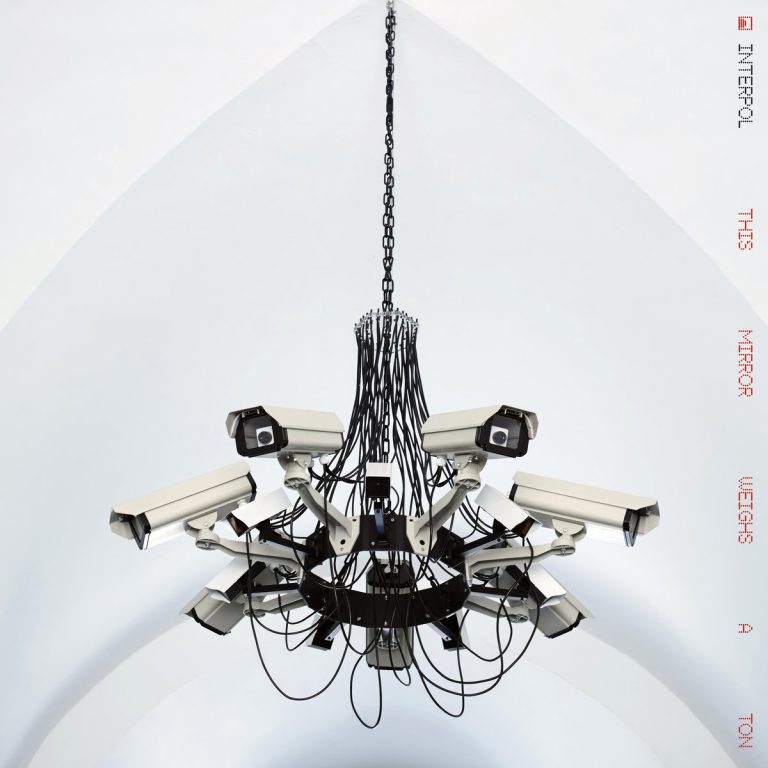

There’s one particular moment from many years ago that I can never quite get out of my head: during a fantastic Berlin show, Interpol‘s frontman Paul Banks introduced the entire band, by name – except touring keyboarder Brandon Curtis. As the band left the stage, Curtis was clearly upset, with drummer Sam Fogarino quickly rushing to the front, to bellow his name into the microphone, and making a slight grimace, as the rest didn’t even seem to notice, before waving and equally exiting.
Now, anyone familiar with how sensitive and caring Banks is can probably guess that he must have felt a little awful about forgetting Curtis once it was brought to his attention, but it also magnified something all too clear: ever since figurehead and style icon Carlos D. had left the band after the recording of their self-titled album, Interpol had been slightly imbalanced. The quartet was down to a trio, with Banks composing and playing bass parts on the albums, leading to a core focus that lacked an invisible counter-weight. As difficult as Carlos D. might have been, Banks admitted in recent years that he was a “total genius”, whose instincts, aesthetics and compositional talent added to the success of their iconic early work. Down to a trio, Interpol would focus on slick, glammed-up post-punk, often more interested in accessibility than the labyrinthine guitar interplay of their first three albums. In the process of that, the group lacked the democratic tension that comes with additional perspectives.
The fact that the trio expanded itself to a quintet for This Mirror Weighs a Ton is immensely poignant. First of all, it allows Banks to definitively correct his brief lapse of memory, allowing Curtis (whose work in The Secret Machines is an important piece of U.S. Indie history) to become a full part of the band’s storied history. But then, it also finally cements the group’s long-time live bassist Brad Truax as studio member and co-writer. Yes: Truax, who also played in Iggy Pop’s band among other gigs, finally took the spot vacated by Carlos D., and went on to write and record all the bass parts on This Mirror Weighs a Ton.
Even with Curtis not joining the group in the studio this time, Interpol’s eighth album is unmistakably a group effort. This is, in many ways, a new iteration of the band: moving away from aesthetic of their previous three albums, which focused on Daniel Kessler’s lead melodies, This Mirror Weighs a Ton at times seems to banish Kessler to the role of a rhythm player, as Truax and Fogarino find immaculate rhythms, orchestral compositions push themselves into the foreground and nuanced pianos and keyboards provide elaborate tapestries. Well, fair, some of that was surely written by Kessler – and he even suddenly appears as a lead vocalists during certain sections of specific tracks – but his role as constant focal point has shifted: Interpol are now an even playing field of co-composers and performers. There’s even a surprising, recurring appearance of Paul’s wife Juliet Seger-Banks, who provides soulful background vocals!
A lot of this might have to do with the group enlisting Andrew Wyatt as producer. Known for his work with mainstream pop artists (Charli xcx, Flume, Miley Cyrus, Rosalía) and long-term friend of the band, Wyatt is listed as co-composer and key-player, providing additional fresh perspectives.
After the one-two-punch of Flood and Dave Fridmann on their last two records – two producers known for conjuring rough, unfiltered live-sound – the collaboration with Wyatt initially seemed ill-fitting: were Banks and Kessler looking to deliver arena rock and win a Grammy? Considering Interpol’s standing among their contemporary peers (many of which have moved into the avant-garde or become semi-retired), it’s all the more ironic that Wyatt guided This Mirror Weighs a Ton to be both the band’s most accessible and most experimental venture in many years. No, this is not their “pop record”, even if it sometimes sounds like one.
Let’s start with the easiest signifier: Interpol still sounds like Interpol. There’s a few respectable rockers here that utilise the dynamic between Banks and Kessler to amazing effect. There is lead single “See Out Loud”, pushing forward mercilessly in typical Interpol fashion: muscular, slightly glam-infused, tinged in red light as Banks performs the urban dandy. But then, Kessler suddenly takes over, singing the second verse, and the formula is somewhat broken. This minor alteration, just before the bridge kicks in and the track builds tension, is enough to make the song immensely exciting. It also continues the trend of the immensely strong, surrealist lyricism that Banks managed on The Other Side of Make-Believe: “5am, teeth-mark skin / I can see out loud and I know / I start to feel pixelated / As we get buried in the sound”. It’s a little Bowie how Banks aligns contradictions to create intuitive imagery and maybe even comes across a little less fractured than the work on the previous album.
“Wake Up” is a nervous disco track, which starts out with Kessler seemingly interpreting the riff of “Layla” into his aesthetic. A fairly simple melody is driven by bongo drums and busy percussion, before the group suddenly meanders into a complicated guitar interplay for the second part, the string players alternating with multiple instruments, nuances and rhythms – it comes across as a much, much more successful attempt at the style that made up the group’s self-titled.
“Wings On Fire” is a brief return to the burnt-out aesthetic of Marauder; Banks’ distorted vocal echoing before the guitars suddenly drift into a roaring build up that – all classic Interpol – cuts to dissolve just as it seems to explode. The sinister “Ever the Actor” benefits massively from Truax intuitive bass lines and Wyatt’s flawless instinct of inserting brief moments of ambience or noise – what could have been a fairly standard mid-tempo track for the band is projected into a menacing, sinister anthem.
But then there is another side to this album, one where Interpol burst forward into unfamiliar territory. Here it becomes clear that Wyatt didn’t so much set out to give the group their “pop record”, than he wanted to clean up their ideas, refocus the core. Opening track “This Mirror Weighs a Ton” shifts into a shoegaze ballad, ca. Souvlaki, all echoing drums, reverberating bass and hazy female background vocals. The guitars sound perfumed and Banks’ longing vocal performance communicates endless melancholia: “If we want to plug in / The hardness, the feeling / To turn into silence / Then we won’t survive”. It also includes what might be my favourite lines on the entire album: “All the kings are gone / But the maniac in your head / Still sleeps in archways / Alone as an act of faith”. The climactic finish is nothing but breathtaking.
“Enemy” is its distant sibling, a nocturnal piano ballad that recalls the aristocratic grace of Ultravox’ Vienna. While the song is not far from “Wrecking Ball” in terms its writing and development, it’s more emotive and vulnerable, especially aided by Seger-Banks’ voice, the charismatic percussive work by Fogarino and an incredibly fragile orchestral section near the end. The more robust and rhythmic “Iron City” makes great use of almost clerical elements and daytime ambience, conveying the sense it was recorded in an ancient dome that sits in the middle of Central Park.
And then there’s the mercurial pop song “So Rides the Reindeer”, with its chirping digital artefacts that sound like an alien pet purring, its icy acoustic guitar and electronic drum beats. There’s a hint of Bowie’s Blackstar crossed with the Smashing Pumpkins’ CYR here, a deep existentialism rooted in an alien understanding of sonics. It’s in no way contemporary, but contrasts burgeoning styles we associate with futuristic aesthetics – stuck in sci-fi we have yet to conceive. During the chorus, Banks sounds so defeated that when he sings “I don’t want to die”, the “don’t” becomes but an imperceptible whisper.
Even though it was one of their best records in a long time, The Other Side Of Make Believe suffered from an ending stretch that just fell short: “Big Shot City” and “Go Easy (Palermo)” sounded like outtakes, B-Sides, mid-album tracks, unfit to send off an album. Maybe that was why the record was received lukewarm by some, as the final moments are usually where definitive perception comes in.
The group learned from this for This Mirror Weighs A Ton, as “Bird and the Serpent” and “Sudden” are powerful, climactic moments. The former is a mini-epic in two-parts: where the first returns to the muscular rhythms of Antics, the second returns to the nocturnal minimalism of Turn On the Bright Lights, trusting Kessler’s intuitive and sensual playing, Fogarino’s stomping rhythm and an especially charismatic use of woodwinds and strings to generate a very unique atmosphere.
For the closer, “Sudden” goes to devastating territory, charting the movements of a failing relationship with brutal defeatism: “Try to ask a question / Say I’m holding you back / Open conversations that just open a gap / I know we’re changing sounds / I know we’re changing now / So long, we’re facing out”. Banks in dialogue with his own, muffled self, as if he addresses his own shadow, and Kessler finally entering, like the braver inner voice, that is able to speak what the protagonist cannot face: “Go then, hold them / Know them, sigh / Go, then die / Show them, cry”. In its fragile, almost unfinished state, the song is immensely powerful.
So much of This Mirror Weighs a Ton benefits from Interpol opening themselves up to a more democratic approach. The group had always been collaborative, but now it feels as if any member is allowed to take centre stage and lead, where usually the entity would conceive a concrete, brutalist structure. It’s clear that Wyatt was a brilliant choice as collaborator for this appraoch, as he seems content to introduce a wide variety to the mixing and production, which the group last attempted when Carlos D. was still with them. Ambience, which both Flood and Fridmann re-introduced after the clean-cut self-titled and El Pintor, permeates every track, leading to cinematic moments to manifest as familiarity sinks in. Where The Other Side Of Make Believe succeeded in its abstract, dark expressionism – the most Berlin any of their work ever sounded – This Mirror Weighs a Ton feels distinctly more British. Where the former marked the flaws of its direct predecessor, this new album actually somewhat improves Interpol’s era as a trio, peeling away held conceptions: many of the successfully realised ideas here open songs from Marauder up for re-assessment, as they now sound like punk-prototypes.
Interpol have always been a band that lived as a document of work in progress. Turn On the Bright Lights was famously re-recorded partially, Antics existed as petri-dish of leftover ideas and patchwork concepts, the self-titled was never fully realised and Marauder turned from arena-album to no-frills punk record! A part of what makes this band so compelling is equal to the esoteric charm of David Lynch’s works: compositions suddenly progress into surreal territory, tenderness meets sudden bursts of violence, idyllic scenery explodes into nightmarish horror. Everything is unstable, oneiric, fragmented.
The fact that This Mirror Weighs a Ton is the most clean cut realisation of this same approach, at least aesthetically, allows for the less lucid, more diffuse works of the past to stand as valid contrasts in their own right. To somebody who hasn’t quite gotten Interpol in the last 20 or so years, this new album will likely function as a sudden shock, a burst of brilliance.
To the seasoned Interpol fan, however, This Mirror Weighs a Ton might sound a little confusing at first. The sheer amount of genre diversions, of moods and micro-nuances this record showcases has been absent from the group’s recent work, which was often homogenous, brutalist and hard edged. Yet there is not a single bad song here, no awkward moment or overtly familiar riff, as time allows for minor details to suddenly step forward, and the songs blossom beautifully in consequence. This seems by design. When Antics came out in 2004, the record was anything but accessible – it took weeks, or months, for many to understand the strange and potent mixture the band had composed. Now, transformed into a quintet and moving into a new day, Interpol have repeated this motion without retreating their past steps.