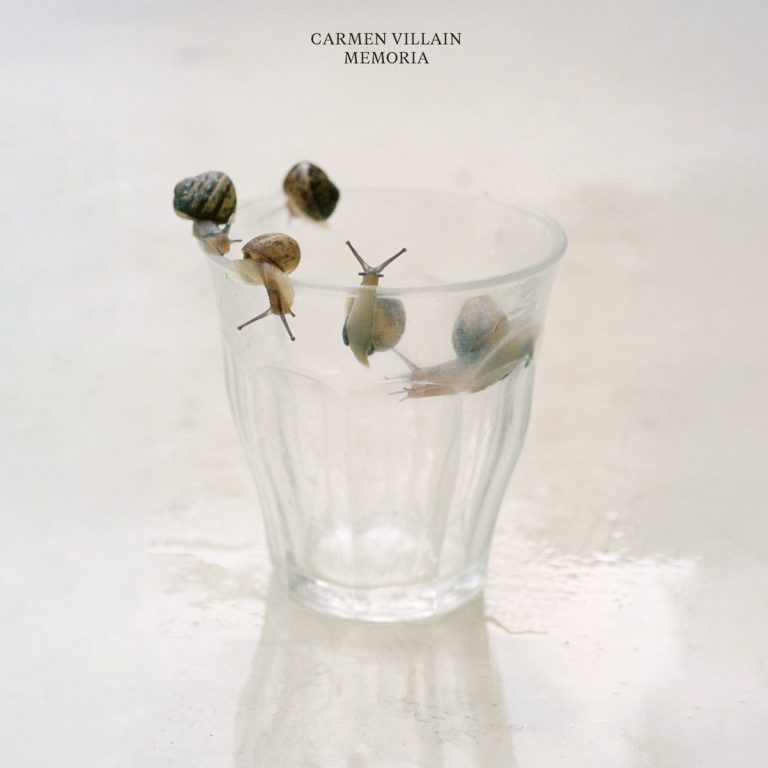

Norwegian-Mexican musician Carmen Villain has always been reaching for that something else, trying to scratch the itch of evolution and understanding of her art. Her music has always been moving forward, growing and developing in ways it has not always been easy to fully anticipate. Her 2022 standout album Only Love From Now On swirled all this creativity and promise into a marvellous document of beautiful, soothing, and textural ambience; it’s an album that, years on, still unfurls in magnificent ways, a high that will undoubtedly remain a point of comparison for many years to come.
On Villain’s new album, Memoria, we see her progressing further still, diluting the essence of her music to what feels like the barest of bones. Inspired by the writings of electronic musician Pauline Oliveros and the Apichatpong Weerasethakul’s 2021 film of the same name, Memoria deconstructs the elements of Villain’s music and builds them back from the ground up with the most sparing elements. It can feel like she is asking what components are needed to convey the intended message. There is no flair or excess here, and often it drifts by conspicuously, a weight to the surrounding air or a delicate perfume being gently blown out of the room.
Villain still uses her main skills as the foundations here. This is a textural record through and through; quiet hisses and soft percussion rumbling in the background. It’s a record that demands peaceful surroundings so as to allow yourself the opportunity to sink into it and actually hear the few layers slowly add up. There’s movement too, but pared down; rhythms move with an almost frugal manner. The spectral dub of “Entre Nosotros” burbles like a primordial soup, the beats groaning and lurching. Even the most substantial track here, “Blue”, still utilises its elements carefully, the moody beats rumbling like some distant cthulhu-esque creature through the far distant fog as flecks of electrical noise fritz like a supercomputer malfunctioning.
Like the Apichatpong Weerasethakul film, Villain asks for patience on Memoria and for the listener to meet her in the middle – which isn’t always an easy concession to make when there is so little to grasp onto. Similar to Tilda Swinton’s character in the movie, it’s like Villain is searching for that certain something, working in the fog of memory to conjure up a fleeting sound or feeling. This is music as disintegrating memory; strands will erode and decay while a lingering texture will remain. Comparisons to the Caretaker’s suite of declining memory aren’t amiss here. Processed noises churn and evolve into a loose rhythm on the album’s title track as swells of noise rise and then crumble, decaying like a spectral crash of waves. Final track “Omriss” flickers like a damaged tape reel playing out as a reassuring, soft, and calming glow rises and envelopes you. It’s an undoubtedly lovely sendoff, made more so because it feels fuller and more sonically different to what came before it.
Will Memoria offer the same kind of escape that Only Love From Now On did? If a listener were to take in Memoria under the right conditions or in short singular doses then there’s certainly the possibility, but the chances do feel more dimmed. Villain’s strength in texture is the main takeaway here, and there are a welcome handful of them here: the jittery uncurrent of wavering woodwind notes on “Hope Synapses” as shimmering notes glint like glass chimes in the sun; the soft mystical flourishes on “Blue”; the barely-there series of flickers and processed backwards effects on the abstract “Holding a Shape”, like a mic was set up to capture the tiny scurrying of mice in an empty warehouse.
Often it doesn’t feel like quite enough, though; repeated listens might eke out tiny details but it can be like translating a random and innocuous sign in the background of a film – fun to have the detail but not wholly rewarding. But it’s part of the evolution, the experimentation, and the onwards trajectory of Villain’s music. Meaning comes from reconsideration and Memoria may come to mean more in the coming years as it finds better context in Villain’s discography. For now, though, it’s a pared down exercise and exploration that makes the listener appreciate her skills – but more so when they are all combined to their best effect on her other records.