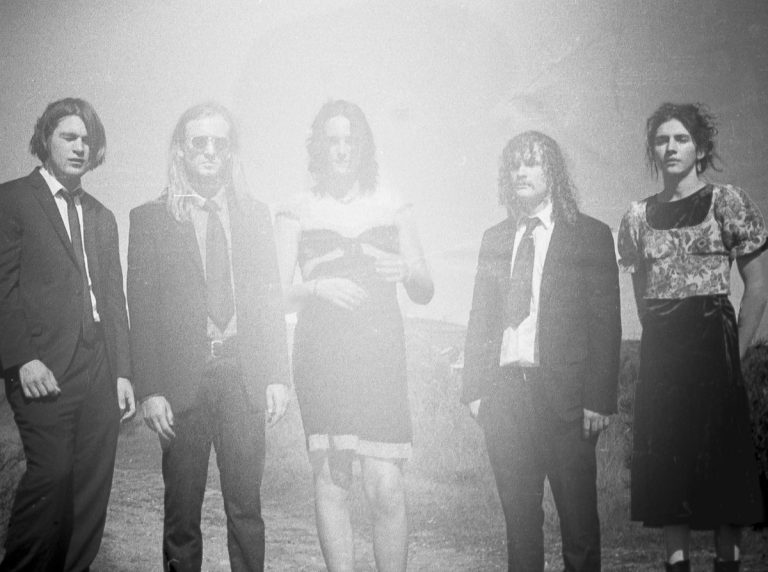

By now, it’s an almost mythical origin story! After my review of Sprain’s The Lamb as Effigy, I was contacted by vocalist Alex Kent. Mere days later, Sprain ceased existing.
While I won’t expand on the exchange, I do enjoy to refer to us as the “Tom & Jerry” of the BPM-verse – take your pick who is who.
Finally, during the band’s European tour, and following my review of Kent’s album Motherfucker…, now working with a new group of artists under the name Shearling, we met in person. Since, we have many times discussed having a proper conversation to broadcast to the world. Now, following the release of the group’s magnificent EP Don’t Look at Me the Way a Dog Might Look at Your Leg, we have finally managed to put the plan into action!
Online, Kent is often characterised as some sort of controversial figure – something that comes up during our exchange. In person, Kent is very different from the imagined, or narrated, version of himself: Alex strikes me as genuinely thoughtful, incredibly sensitive and empathetic. When speaking, his eyes dart around the room often, while he articulates himself in long, cohesive introspections. He’s immensely well read and intuitive about the emotional impact of art – other times, he’s concerned with how strangely egocentric the world we live in has become, and how it chastises artists who dare to break with social code. He’s legitimately invested and present, while his mind seems to process every element of the room.
We ended up talking for about two hours, a riveting conversation that touches upon our shared love for obscure – yet beautiful – birds, the value of transgression in art, the lasting harm of cultures centred around shame, the power of cosmic and religious imagery and almost every facet of the band’s latest record.
You have just released an EP that is the length of a “normal full length album” – this poses the question: why deem this an EP? In comparison to your other works, the record feels much looser and much more immediate – is that a factor?
I always just had an idea that I wanted to do, and put more music out, generally, between the last Sprain record and the first Shearling record, and also the one that we’re working on, the follow up. I think I was getting… not tired. But I used to have these pretty strict rules: okay, only the best of the best material is going to make it on these more long form records.
But I think we all just started to think it would be really cool to put more music out in general. There’s so much music that I would make and the rest of the gang would make that just wouldn’t make it to the primary records. So we almost thought about making other pieces of music that don’t necessarily fit into the… I don’t know what to call it, the main set of, or main series of instalments, the very serious statement Shearling records – or Sprain records. This is a very long winded answer, but we basically, just wanted to put more music out.
No, that’s a good way to explain it. Would you call yourself a perfectionist in the regard of your release philosophy?
Yeah, maybe. But also, I’m trying to get away from that a little bit more: trying to fight against those impulses because I don’t necessarily think that’s a good thing. Even if something isn’t the most perfect follow up statement to record A, B, or C, that doesn’t mean that it’s not valuable music. Sometimes it’s actually even better in a way, because it feels more vulnerable or less overwrought… maybe.
That’s interesting. I recently became aware of this blossoming subculture of Beatles fans, who present “alternate universe” Beatles records, a la “What if Sgt. Pepper’s was never completed and released a la Smiley Smile?” Seeing their curatorial choices in comparison to the actual albums magnified to me how the Beatles would record and release music very quickly, embracing imperfections. Their records have fillers, but these fillers add to the story! There’s now bands like The Strokes, who take six years for an album that ends up very divisive. Meanwhile The Beatles, or The Rolling Stones, just recorded and releases constantly! The fans don’t really seem to mind when there’s song’s that critics would regard as glaring flaws on the record: it’s still regarded as a masterpiece, maybe even because of these flaws. I find that a really interesting concept.
I do think a lot of that has to do with marketing and the way the music industry will interject what they want you to believe. I’m a Beatles fan. But calling them the greatest band indisputably is just a remarkable marketing propaganda. Yeah. A lot of people get a lot of success from those strategies, even if they’re really good artists. It’s interesting you bring this up: as I’ve gotten older, I’ve come to think there’s always three or four tracks on every Beatles record that just… fucking suck.
(laughter)
I love these records so much, and I agree with you, absolutely!
But I feel especially during those different eras – the psychedelic era or the pot era or their return to blues era – I feel a lot of those records could have just trimmed a few of the not so great songs and put them together, and still made pretty fucking amazing music. The band is really good – obviously, that’s not really a disputed thing at this point. But I think a lot of that had to do with the expectations and the way the industry operated back then, as opposed to the elasticity of it now.
That is also a question I wanted to ask you. Do you consider yourself a countercultural figure or an outsider to what is going on in music nowadays? Because I do feel that your release philosophy and also some of the creative choices you make certainly has aspects of counterculture, or the old countercultural approach that you saw in the arts of the 60s.
I definitely don’t see myself as any form of figure at all! In Shearling, I think that we just do what we want to do because we really love making this music. There’s not a whole lot of intention behind the way we do things. I definitely think the way we release music, and the music we make, is informed inevitably by the philosophies and values that we all have as musicians. But I wouldn’t say it’s reactionary to outside influences. There are things I feel that I would want to embody, in our art, that are not well represented in music today, for sure. But I don’t think that it’s this big reactionary stance against some things. Well, actually… I don’t know. I think less in terms of release philosophy, and more just in terms of what we do musically, or the what we write, if that makes sense. I could expand on that too.
Please! Because you said there are certainly things you want to do that are very unique in the current makeup of the music world. I’m curious what you mean with that.
I’m gonna limit what I’m saying right now to the world of rock music, because that’s my world. I think it’s not fair for me to comment too much on other things, at least in terms of being an artist in other genres or other worlds. But I do think rock music is super safe! I’m not trying to say that in an annoying way. I just think that rock music is… it’s extremely polite! It doesn’t really resemble what it used to be, which was that it informed, or was informed by, a countercultural movement. And in terms of pop music, a brutal… celebration of the counterculture, and sexuality. All sorts of things! Yet nowadays, there is a pretty intense pressure put onto artists to be very polite and kind of… bland. To put it in less pseudo philosophical terms, it would seem that now, rock music is for weaklings. I would say!
(laughter)
I think that. Anyone who doesn’t really do that is a legacy artist, an older artist that continues how it used to be. And I think that the general rituals of shame present on the internet, and the way that this has led to a homogenised modern culture, has had a detrimental effect on the kinds of things that people are willing to talk about, and the kinds of things that people are willing to express in their music – and I think some of what’s lost is really important. Actually, a common critique that Shearling would get is that it’s just ‘edge for the sake of edge’. That I’m a narcissistic person or such, that just likes to make people uncomfortable – these kinds of things. And maybe that reaction could be justified, to a certain degree. Yet it’s not exclusive to our zeitgeist, but I think it’s really prominent now.
In social media spaces, reddit or youtube commentary sections, there is a lot of mentions of you as an edgelord, or about the edge in Shearling. So my unfiltered question would be: do you see yourself as that, and how do you play with this notion of listeners?
I mean… I would see why someone would think that, but I wouldn’t say so. We do a lot of consideration, and put a lot of thought into the right and wrong way to implement elements that people would consider edgy into our music. And I think that sometimes, rather than it being considered edge lord music, it’s just singing about real life. In contrast, I think that edge lording would be to bring shit up for no real reason. A lot of the sources we’re pulling from is real things that I myself have experienced, or experienced through other people. Even if it’s not mass market material, it’s important stuff to discuss.
I also feel music has this politeness expectation that’s not super present in other genres of art. No one loses their mind when there’s a certain amount of gratuitous violence in any mainstream film! American film is super violent, and television is super violent too. But I think as soon as that exports into the music world, people start to have a certain reaction. So: no, I don’t think I would consider myself that. It’s not this intentional: “Oh, I want to say this stuff, so people get real freaked out.” That would be really hollow and shallow. There’s an intentionality behind all of it. I’m not really that in my day to day life either, you know.
(laughter)
I definitely do think that you toy with your audience, and also your social media presence, in regards to your perceived image – oftentimes within your lyricism as well. This is my interpretation, evidently, but a lot of Lamb had this really interesting dual narrative between the protagonist – the creator or artist – and the Lamb, which speaks in feedback, that, at least from my perspective, clearly is a stand-in for the feedback that you receive for anything you create and release into the world. This relationship is something that is very inherent to your work, so I’m very curious if this is even something that you ponder. A good example to that is the visual side of your online presence! As with your favourite animal, the Kākāpō parrot, there is a grotesque element that I feel is really intentional. You really are toying with the expectations of who you are with how you express yourself.
This is true of a lot of artists, or people that find themselves being talked about online, or in popular culture. There’s a lot of projection that people put on to me, and the band, that can’t really be sourced from anywhere. I have no idea where it comes from! I think the biggest one is probably that… I’m this insane, narcissistic, extremely pretentious… blah blah blah. (laughter) I mean, people have a right to feel the way they feel about any of the music, but, other than their reaction from hearing the art, I’m not exactly sure where a lot of that comes from. To be honest, if it just seems that if enough people start saying it, then that just becomes the scripture of my own lore. It was pretty hard to deal with at first: I wasn’t used to having that much attention, but the way of coping with it is just… letting it go, and identifying and acknowledging how stupid that is. Realising that it’s more of a projection of other people onto me than it is actually myself. Not that I don’t have my own egotistical tendencies… I mean, I’m a fucking rock and roll singer. (laughter)
At the end of the day, what I’m trying to say is that… it’s not based on anything. There’s never reviews or interviews cited that would point to the kinds of things that people said about me. I think it’s similar to my lyrics being interpreted: if enough people say what they think it is, because the lyrics are very interpretable sometimes they’re very cryptic, people will repeat those perspectives. If enough people say: “this is what this is about”, it seems to just become the general colloquial consensus that that’s what I meant. A lot of the time it’s not right at all. Which is interesting… (perks up) As far as that bird goes, I just… that bird! It’s a fucking –
(shouting) It’s so awesome!
Yeah! YEAH!! It’s a great bird, it’s awesome!
I had so many debates with people in my life – literally with my best friend and others so close to me – because I had my coming out as a big shoebill stork fan! Shoebill storks are just the most amazing creatures! And they were like… “How can you say that? Look at that thing. That is scary. LOOK AT THAT!!” And I was like, “Yeah, it’s incredible, it’s so cool! Look at th- … JUST LOOK AT IT!” It’s amazing.
(enthusiastically) Yeah, it’s an amazing specimen. A friend of mine, I got her a shoebill stork plushie.
Oh, they have these rare bird plushes online, which, I fucking love that exists – I saw a Kākāpō there too!
I just got the one, the shoe bill stork. My friend named it Martin, which –
GREAT name for shoebill!
I want to get more, they have all sorts of specific genuses of animals. I love animals, so…
That is also something I’m really curious about: one of your favourite symbols in writing is indisputably animals, and I want to explore your symbolist usage of them. As far as I understand, your favourite parrot has the issue of not really having enough offspring, so conservationists are trying to preserve those parrots by having them have more sex. At the same time, a lot of your lyrics deal with this quite funny self flagellation around sex, where the narrator’s dick is sometimes way too small or way too large (laughter). There’s a strange parallel with the horse, which evidently is also related to certain phallic imagery.
I’m fascinated, because each of your projects has a different animal that it focuses on. In my review of your EP, I pointed out how there is this realisation that these creatures are free in terms of what God gave them. That God created these beasts without the idea of guilt, or the idea of loss, or justification. And that there is a struggle between these creatures, and man.
That’s a really poignant take, honestly, because that is intentional in the lyrics: there is this shameless, quiet, comely beauty to an animal that doesn’t adhere to the laws of morals or taboo, or anything man made. They just are what they are and they just live their lives in the choreographies of instinct and what a carbon-based life form is programmed to do. I think that that’s a beautiful thing. Whereas we are… (pauses) I’m not saying that taboo and morals shouldn’t exist.
Of course, I adhere to the structures of these things as much as anybody else does, but… (pauses) I have experienced, in the way that I was brought up, a great deal of shame. Shame and humiliation are a prominent theme in all my works, and they are not prominent in the behaviours of animals for the most part. They’re in this area of exemption from that. They are useful in metaphors and this aesthetic of a quasi fairy tale, children’s farm book, which I really like. That stuff is aesthetically very cute and cool; it’s biblical, too!
I wanted to ask about religion.
I use the Bible in allusions and imagery because I went to Catholic school and I studied it, so I know my stuff. It seems fair for me to use, being a white guy from America. It’s within the confines of cultural relevance for me to use. But let me get back to the topic of shame, me and some of the members were talking about this yesterday: what is the point of Shearling, essentially? And I think the conclusion we came to is: to demonstrate the rituals, the very harmful rituals, of shaming culture, as well as offer an alternative to that.
And I think that, in a sense… the way I have made myself seem through the music contributes to that projection of people on me. And I think, in a way, the people’s reactions to it proves the point of our demonstration how harmful shaming culture can be. Just shame as an emotion, and the vice grip that it has over almost everything in Western society, and also the way that that funnels down from a post puritanical Christian culture.
There certainly is an odd division, where there’s a perception that certain type of humans don’t possess introspection, gentility or the capacity for trauma. Speaking of shame: I’ve heard from grown men, maybe in their 60s or 50s, or older, who have lasting, quite intense psychosomatic health issues because of intrusive punishment rites their mothers or fathers enacted upon them, for things like bed-wetting. It’s not uncommon at all, and that generation never addresses it – nor do younger men with comparable experiences. There is certainly a very strange perspective about how shame functions, who is being shamed and who isn’t being shamed.
I’m going to tell you this at the risk of sounding really silly: I feel a part of the impetus and reason behind this art that I’m making right now is that it’s important for someone to take the role of self-sacrificial oblation. I don’t make myself look very good in this music, and it affects my mental health. It does. But ultimately, I think it’s important, and somebody has to do it, especially right now. I don’t think that this culture can go on, because it’s absolutely to the detriment of almost every single person participating in it, or not participating it. I think that ultimately, it’s wrong. It’s really destructive, and it’s coming to a head.
“Believe Me (Dust)”, off your new EP, focuses on that aspect of shame, and also how value is suddenly attributed to shaming.
I think that the primary source of where that comes from is having experienced those feelings and been through the ringer, as far as the damage that shame can cause. It intrigues me enough to sing about it from a place that not only affects me personally, but also affects, I guess, the rest of the world around me. The way that it operates as a cog in the machine of change and relation from one person to the next. “Believe Me (Dust)” and specifically “Your Reward” challenge the thought process that a lot of people seem to have in the current zeitgeist of things being in incredibly black and white terms, almost a neo religious way, where we are intentionally becoming more apathetic about nuance and details in a way that just makes the individual expressing those kinds of things feel a certain amount of comfort. I want to challenge that, as I have experienced that, and I have seen that in other people. Usually, in these songs, I don’t really offer any form of alternative or try to push my own philosophy onto what other people should do. They’re observational songs.
You discuss a sort of societal apathy here – which interests me, as in your work you also discuss the apathy of God. You’ve been raised Catholic – do you still connect with that experience? Do you consider God or Christ, or any idea of holiness, or is there just apathy? Is there still comfort to be found?
No! No, no comfort! I don’t think, unfortunately, anymore – tho it used to. It forced me to reckon with critical thinking, back in the day. But there’s a lot of harm to do with that belief system, as there would be any. Yet there are things that can come out of it that are not necessarily bad things in general. One of those things is critically thinking about right and wrong, and the spectrum between those two things, and also the humanity behind them, the enforcement of them. We were talking about the animals earlier: they seem to exist outside of this construct that we organise our actions within.
In the song “Your Reward”, there’s personal parts of challenging this, which is the first couple verses, and then there’s a much bigger challenging of this during the conversation that the narrator has with the Christian God, with Jesus. Essentially, it’s highlighting this idea that suffering exists and that there is no reward for having experienced suffering. The reward is this expectation. At the end of the day, the character – or me – essentially asks, or wants to have, God therapize them for having experienced the suffering they’ve gone through. And God is… extremely busy with everything else outside of that. (laughter) Not to spell it out, but I think that song at least is pretty obvious. But that’s where I’m coming from, and how I implement these kinds of themes into the work.
Yeah, there’s that beautiful image: you mention the cross, and God says, “From these planks, we shall build a house.” That one really struck me! The day I head it, I had been researching Dalí’s painting of the crucifixion, with a hypercubist 4D cross –
An awesome painting!
Dali conveys the idea that there is something fundamentally transgressive to our perception of reality within the idea of what the crucifixion is, and what the cross is, and how shame and guilt come together. It’s very metaphysical in a way that is very hard to pin down. That line, in a certain way, is really inspiring: the idea that you can sort of reshape this symbol into something larger that you can inhabit. It’s very poignant.
Thank you. I think using surreal imagery is really cool. A lot of my favourite writers, and also songwriters, have always really surreal, interesting, colourful, big imagery in their work. Really big imagination constructs. Here, I was pondering the house as the Christian belief system, and not necessarily the act of following Jesus, but just generally the construct. If you will, the house of the Christian moral system, which casts a shadow over the Western moral system. The house that I’m talking about in that song is built out of the cross, the two planks that the cross would have been made of, which is, I think, the most poignant iconography in all of the Christian mythos.
There’s also this incredible image of the salt pillar that people stand in line to, in order to receive some sustenance. Instead, all they’re being given is pebbles to lick on, which is so interesting with the parallel with horses, how they sometimes eat pebbles to help digestion. I wondered about that image, and the dynamic of this idea of the salt pillar that people come to lick.
That one is almost a hell scenario, like a purgatory that I made up. To be honest, I was pretty late on this. But: I read Cormac McCarthy’s Blood Meridian, after many people were encouraging me to. So I had just read it, and it’s really fucking good. I liked this idea expressed in this epilog at the end of the book. I won’t spoil it for the readers, but it’s this stark, interesting, surreal landscape piece at the very end of it! I started thinking about these different cultures takes on hell, and I came up with my own that fits into the expansive mythology of the rest of Shearling’s world. There’s an unnamed character in that song that’s an archetype of punishment and shame – the side of morals that’s wrong.
The big theme of the whole EP is how we deal with wrongdoing, with what’s right and what’s wrong. That wasn’t really intentional; it just happened. When I realised that, I started to be able to put the pieces together, of the artefacts of my own subconscious. I was able to piece together exactly what happened with the creation of this EP, because I don’t really sit at a drawing board and decide what I’m gonna say. I just start going, and it comes from a place – that’s where the more interesting part of my work comes from. Sitting down and really trying to create… It fucking sucks. Sorry, a very scattered explanation…
No no, please, continue.
There is a hell scenario where people, or the damned, stand in line begging for water, and they just are thirsty.
(A brief intermission occurs, as beasts and man struggle! Or, in more clear terms: Alex’s dog is upset at a post man.)
They stand in line and beg for water, and there are a certain sect of people that do as they are told. I suppose in some mythological sense. They are granted the water! But the rest of them just stand in line, in front of a pillar of salt, which would be the most anathematic version, the exact opposite of water!
I decided that I wanted to expand on the mythos of a song I made on my own, which was just called “Saltlick”, which is just this drone’y piece of music. So “Saltlick” is supposed to be the soundtrack, the disgust in the song “Three Pebbles (Saltlick)”. Those two are linked! In short: it’s very symbolic and deals with the bad side of this scale between good and evil, or at least the projection of that. And then the unnamed character is the arbiter, or the magistrate, of this hell world, and the narrator – or, I guess, myself – deals with the artefacts, or premonitions, that this unnamed character leaves him.
Yeah, and then you get the contrast to that, in “Young Man from Idaho”, where it’s a realistic scenario, and also one that you see in the American news every few months. Queerness is something that has appeared in your work before, and I’ve seen that there was online speculation and people trying to figure out how you use queerness.
Sometime I’ll make sister songs to pre-existing ones. So some of the songs on this record are more dealing with a macroscopic lens: you’re looking at society, or the way these kinds of major themes, shame or whatever, are implemented into the world at large. And then, to contrast, there are that with my own experiences in dealing with these topics. Honestly, it’s a bit heavy to talk about that one. But it has to do with an early form of sexual experience that I had with someone, who ended up taking their own life at a young age. It’s just dealing with the fallout and just a really brutal… Maybe not brutal, I think that’s subjective. A very honest and stark illustration of the way that actually affects me in my day to day life, in a un-decorated, un-colourful, and just concrete way. You know that song… there’s no metaphor. There’s no real cool words or fun, poetic anything to it. It just is exactly the feeling, the reality.
It’s also very stripped down musically, which is interesting because there are these constructs, especially with the opening track, with “Saltlick”, where the songs are these vast structures. I’m actually quite interested how the band composes them. Are you guys collecting stuff? Are you writing these songs very intently? Also, with the tape manipulations – is this something that comes across naturally, or do you have an archive or backlog, that you dip into, to manipulate sounds?
Both, definitely! I think we are getting very into electronic production and hip-hop production, too. But I think that it feels tacky to implement that stuff too heavily into our own music in the traditional sense that these genres are. Thus, we’re trying to take inspiration from it, but do it in a way that is not those genres, so to say, both out of respect for the way that music is made, and also just in an attempt to have a certain amount of aesthetic discretion. I’ve just been really inspired by that. I haven’t really been super inspired by the guitar, or rock and roll, recently. But at the end of the day, whether I like it or not, I’m a rock and roll man! (laughter)
We listen to all sorts of different types of music, and the concept of sampling came up. And sometimes we will sample other people’s work, but we just improvise a lot and record a lot of music that doesn’t end up coming out. I think it’s cool to repurpose that audio as its own form of instrument. It’s using found media that is your own band as a repurposed element. It’s basically having a sample bank, but you use your own material. Using sound as an instrument, as opposed to sticking strictly to the traditional instruments, is just something that is interesting to all of us. Nut it’s not really that cerebral. It’s not like, “Oh, we will abandon the guitar for this song”… These things just happen. For me, in that improvisational or semi-improvisational space, that’s when I find myself the most excited about what we’re doing. So we just use that and then follow the thread.
This is interesting to hear: it sounds you’re not quite ready yet to make Shearling’s Kid A.
(laughs) Well, we always joke about that: “All right, when do we do the no guitars-record?” And I’m a bit opposed to it because of that record, honestly: because of Kid A! It is a really cool record, I dig it! But I think it has created this almost cliché that a lot of guitar bands fall into, where they have the one record where they abandon all the guitars. That’s fine, and there’s some cool music that came from that, but I would want to avoid doing that kind of almost pastiche thing. It’s a super cool record though.
I remember when it came out and I remember the discourse surrounding it. My dad is a radio guy, so I got an advance copy: I was literally ripping open the packages each day, because I wanted to see if the CD finally came. The whole discourse around it was: “ This is unlistenable. This has no singles. This has no real song structures.” And they didn’t give any interviews. They didn’t play concerts. There was no single outside of “Optimistic” playing on the radio. It was interesting, because I felt they were attempting to do some form of counterculture. And when I actually heard the album, I remember being surprised how critics argued there’s no songs on there. In the end, it’s not that far removed from what Sgt. Pepper’s had been, or what Dark Side of the Moon had been, or any of these records that were considered to be these big shifts in pop music. So, this is less me asking, “When will you do your record without guitars?” And more so: are you guys considering venturing into a territory where you completely embrace the creative freedom ?
This next album we have – not to spoil too much – definitely has a big, big, big blend of that stuff! There’s parts of it that are more approachable to Motherfucker…, but in another sense, it’s almost more mutated, because of the rapid pace through which these different song worlds evolve. I definitely think that we’ll continue going in that direction! But then, I don’t think the rest of the band really approach the beginning of a record with any form of expectation, or any rule. If I have done it before, I almost always break the rules! I’ve learned that what’s going to happen subconsciously is the right thing to do, and then I just trust that. Our records do end up sounding pretty different, but I do think that would be a really cool thing. And I would say there are some straight up songs on the new one that are closer to something an IDM artist would make than a rock band. (pauses) I’m sure that’s a huge red flag for a lot of people.
Well, yes and no. People have really opened up to more abstract and inclusive compositions. Look at Sumac –
Oh, they’re really cool!
They did a record with Moor Mother, where she is using her spoken word, quasi rap on top of the sludge metal of SUMAC. There’s more and more projects, specifically in the metal and electronic sphere, where intersectional creativity is really becoming the point. With more and more crossover, people become more open to embrace different cultures, and people with a different cultural background, whether it’s different race or different orientation, gender, perspective. There is definitely something that is being torn wide open which didn’t exist 20 years ago.
I encourage all that stuff. The more interesting music and collaborations that can happen, I absolutely encourage that. It’s funny you bring that up, because I’ve been trying to do a record with the guys from Armand Hammer; Elucid and billy woods. They’re just so fucking brilliant, and I think it would work a lot better than people expect it to! I can’t say whether that’s really going to happen. But those guys are really, really nice people and very inspirational, incredible artists.
Armand Hammer, as well as their respective solo projects, are hugely inspirational right now both to the poetry and the production that Shearling is doing right now. So it feels really exciting to get to explore a whole different world and implement that music respectfully into our own art, as it’s not the usual and typical source of inspiration that we would derive ideas from. That would be, I would say, a little dream come true of mine personally, at least right now.
You already brought it up, also regarding autobiographical writing: I wonder to what degree you see Sprain and Shearling also as an opportunity to engage in psychoanalysis, for yourself or on a broader scale.
There are healthy ways to implement that, and therapeutic ways, but I am not entirely. I think you should have a healthy amount of skepticism when dealing with those kinds of things, and… (pauses) I really don’t know how much I feel I’m thinking about my own mind. I think Shearling and Sprain get put in this intellectual world, which,honestly, I really don’t like. I really don’t come at music creation or appreciation from an intellectual point. I fucking hate it. I think it’s classist, because it’s this idea of educated music, as opposed to secular folk music or similar. I think that those concepts are stupid. They are all just sound and art and expression. What I’m most interested in is emotion in music, and whether or not I feel moved. So… no, I feel that I don’t. I definitely don’t have a scientific approach. However, what I will say is that I do feel very psychoanalysed by others. To me…
(John grins and points at himself)
No, not you! I think that there’s a difference between interpreting art and poetry, and assuming psychoanalysation and projecting that onto someone’s character. I’m endlessly irritated by people who insist that, rather than making music, I should be in therapy! I think this goes back to what I was talking about when we discussed the point of Shearling. Am I like… what? Do you people live under a fucking rock, biting your fingernails and shaking, just because someone expresses something that you’re mildly uncomfortable with? That’s an important thing to experience, and it really frustrates me that they think that, “Oh, the only people who could possibly do something that… there’s something wrong with them. They should enter a therapeutic space in order to be healed or fixed.” Fuck that! That’s bullshit! And also, I’m in therapy, so…
(laughter)
One thing that I always find really interesting is how you use that imagined or literary self in your writing. Because you take this idea of the self, and then you really put it through the ringer. Like, you really put it through the ringer, just confronting him with the most degrading scenarios, or sometimes also the most dominating scenarios as implied opposite to the degradation. You brought up literature earlier with Cormac McCarthy, but my familiarity with your work has me liken it more to what Hubert Selby Jr. does with The Room, which I’m sure you’re familiar with.
Yeah!
These cycles of degradation in there, that are very frightening and manic. I’m very curious with your relationship with that, because there is definitely a form of putting this character out there, which is very different from the standard in our contemporary times. There’s not many writers who create this brutal vortex with a narrator that speaks first person.
It’s something that I started to think about maybe five or so years ago. I was frustrated by the lack of that, and I felt it’s where, in the current zeitgeist of music, had to be explored a little bit, because I think it was pretty important. We have a lot of people who, for lack of a more eloquent way of putting it, are vulnerable and critical about the things that they’ve experienced at the hands of others, and the things that other people have put them through, but we don’t have a lot of people that are confessional and ugly, or just have the ability to paint the ugly sides of themselves as in addition to the ugly sides of other people. I think that that’s an important thing, in that drive to challenge the notions of shame, to be able to admit to having done wrong, and admit that you are not a perfect person. And to… I wouldn’t say revel or celebrate the flaws, but identify them, and allow yourself to be the sheep, or the subject of that ritual of humiliation in order to almost prove the point of the fact that it exists.
I’m really inspired by Smog and Bill Callahan, and I would say that maybe more than anybody else, because of how undecorated and stark and just open and naked his music is. I think he does this, and has inspired me to do this maybe more than anybody else.
That’s also an aspect of your live show. I haven’t witnessed this occasion, because during the Berlin show you didn’t do this, but I do know that in London, at the Windmill, you busted your head open. I do know that you’ve had previous scenarios where you took your clothes off on stage – very physical acts. Is that something that comes easy to you? I do know that, oftentimes, things that look very scary actually don’t hurt that much. But still, I’m curious to how you are overstepping these boundaries, and if this is a thing of brevity or a thing of self security, or maybe even channeling of certain insecurities into a higher form of your ego.
Maybe a combination of those kinds of things. What it’s definitely not is it’s definitely not planned or purposefully shocking! It’s not this ridiculous stupid thing to just shock people, and it doesn’t have any purpose beyond that. It’s just performance. I don’t really plan for any of that to happen, which is why it doesn’t always happen. And if I did, that would be really stupid. Music is really powerful! It’s a really powerful art form, and sound just has this commanding force over certain things. And… I guess things just happen. (pauses)
I don’t know how to articulate the reason why those things happen, but I don’t think it’s to freak people out or be this insane person who’s self harming. It’s not a revelling in that by any means. And also, I really don’t think what I have done and do is really that extreme. I mean, I think Iggy Pop was doing plenty of things similar, 60 or more years ago! Chris Burden, and all sorts of these performances, have happened, and they’re interesting and shocking, but there’s intention beyond shock there. I do think that I have been… (pauses) We often make fun of these people in Shearling, but we were shocked by how people have really responded to that, and how horrified they seem at some of these things that to us are actually relatively tame.
Yes, they are quite tame in comparison, especially if you bring up Burden! The Windmill one is kind of funny, because you clearly just bump your forehead a little bit with the microphone, and it’s a sudden geysir of blood that emerges forth! It looks insane – by which I mean that it is an incredible visual, very striking!
It was just one of those things that happened. There was no real intention. In a way, it was actually embarrassing how much blood there was, as I feel it took away from the actual music. It became this, maybe stupid, performance art thing instead of it being a good rock and roll show. There was so much fucking blood – head wounds will bleed a lot. And even though it was really not that bad, I have a scar of it, which is smaller than your fingernail… (shows off his scalp) It’s just one of those things that happened, and then people blow out of proportion. I wish that there was a deeper thing to it, but really, not too much.
Personally, I’m always very appreciative about it. Also, while you criticise that particular moment, there’s motif where I got to talk to some of my favourite artists about shows I attended that changed my life. The most immaculate experiences! And they will respond: “Oh really? I was sick, and it was terrible! You enjoyed that?” So I can sympathise with what you say, but I do think that specifically in that occasion, it adds a lot to what the song expresses – also because it’s quite visible you’re not in pain, that it isn’t some sort of self-harm scenario.
Well, you have so much adrenaline too when you’re playing a show. Fucking nothing hurts.
And as you said, it adds an element of performance art to that one big piece, which I think really lifts it on a different level, and personally, it’s something that I appreciate. I think a lot of people very much appreciate these occasions occurring, even if nobody really wanted it to happen, because it still gives you a feeling of something real and something subversive and transgressive, which, as you point out, our society and most of culture just severely lacks.
Yeah, that’s true too. Again: none of these things are planned. Honestly, I think that just being expressive emotionally on stage is really cool. I’ve been to a lot of shows, and I’ve seen a lot of shows of this completely emotionless choreography of playing your songs… it’s super lame. I think that a show is this beautiful fucking atomic explosion of energy happening between all these people in a room – that’s a really special, awesome thing that we do, just as you going and experiencing a live show and experiencing sound is just a really amazing thing, and it should be celebrated. It shouldn’t be so strict, and give warnings and all that. I feel you should live, you should have an experience, both as a performer and someone who’s watching a performance. The fact that something happened is so fucking amazing. But there’s so many shows where just… nothing… (shrugs) what is the point of this, really?
Not that you have to go up and fucking smack yourself in the head with a microphone. That’s not what I’m saying. But I think a lot of people will go: “Oh, you smashed that guitar.” “This guy – he doesn’t have any control of his emotions and stuff.” This is the one place where that’s an incredible thing to do, just to lose control, in this very controlled environment of doing it, and express these feelings that everybody has – you cannot tell me that you don’t have them – but that we are told are needed to be controlled constantly, and pushed down. And I think that the expression of them is important in these ways where people are not actually getting hurt. The expression of them is important, and all my favourite performers, I would say, would dabble in things like this. There’s a big difference between it being just stupid theatrics, and it just being a thing that occurs at a show in, a moment. And I would say that also, to be honest, there is an element of expressing “Fuck you” to people. Sometimes, it just seems the audience is a bit too sensitive. And I’m like… huh? What the…? How the fuck did you guys even end up here? How are you gonna live your life if you can’t handle a guy who smacked his head with a microphone? That’s so tame.
Sometimes, I think safety and control is very addictive to a lot of people. Not to mention that a lot of people now are self-diagnosing with particular conditions of divergence, looking for a form of comfort zone or explanation. And then that is projected onto others. I am surprised that this need for comfort, or shock of lack thereof, is something that comes up during your shows, because Shearling is already such a forceful entity.
The pendulum is always swinging one way or the other, right? For so long, those kinds of things were ignored, like legitimate diagnoses and stuff were ignored and not treated in a proper way. But now it has swung so far the other way, that it seems there has to be an answer for every non typical behaviour. I do think that there is help that can come from understanding yourself, but I do think that you can’t really project a self-diagnosis onto yourself, just because you believe that it explains certain ways or difficult things that you experience in your life. I mean, at the end of the day, I think we need to remember that human beings are just messed up, imperfect and bizarre.
Speaking of the shows: are you going to play the EP live?
We play “Your Reward” live sometimes, but honestly, our live shows are almost rehearsals. We’re just figuring out how to arrange and make the songs that we’re working on better. So really, honestly: sorry to anyone that would come to hear those songs! If they are played, they’re going to be in such an incredibly different way that they might be somewhat unrecognisable. But I do think primarily, when we play live, especially when we tour, we focus on playing new stuff. So the best way to hear a Shearling song that you really like is to go to a show before it releases. (laughter)
Time travel! Let’s look at the future, then: you said you guys already have the new album pretty much figured out, or recorded. Another 2026 release, or are you taking your time?
Not all of it is recorded. I would say it’s all written. We know what we want to do with it. But there’s so much that changes in between that – where we are now and where we will be when it’s done. in the mixing process, mastering process, the recording process… There’s so much I’m anticipating being excited about and the the way things change… I would say nothing is totally done as far as art recordings go, until they’re mixed! There are even compositional decisions that happen during the mixing process, it’s a hard question to answer. It’s not going to be this year, we’re simply too busy. We toured a lot this year, and there are things we still need to record, but there is a great deal of stuff that we record at home. That part is close to entirely recorded.
Interesting!
A lot of the time, what we can do at home is chopped up and then mixed with what we do in the studio. Who knows how many sections we will move around and reconfigure. A song that we have now might not sound too much like it’s “demo form”, so to say.
Can you already give a little bit of a teaser as to what direction you guys are going in, in terms of your lyrical writing? Because you already gave a bit of an indication for the sound. Is there something you want to spoil about the lyrics, or the lyrical direction you’re taking?
I think that it’s a continuation of the themes on the past two releases. This is one era, and I would say that this is the final record of that era. I don’t know what we’ll do after that. There’s a mix between some of the more postmodern, more forward, poetic stuff, on it, as well as some stuff that’s more stripped down and has a pretty indisputable meaning, that I don’t think can be argued too much over. So I think that it’s a healthy mix of those two things. It continues the same big cosmic imagery, as well as the really personal stories. I think it’s probably going to be the best record we’ve done so far! It also includes a ton of contributions from all the members! It’s definitely a lot more of a band-band record than the EP was, or even Motherfucker… was. I would say everybody is definitely more heavily involved on this one.
That makes me think of Tin Machine – also because I’m writing an essay on them at the moment. Bowie conceived that as sort of a band project, where the involvement of all members was so central – and it’s different on both record. Seeing you live, it’s very transparent how, besides you, there are four very diverse musicians, with very different approaches to musicianship.
The five of us are all very different, too. I don’t want to sound arrogant, but I definitely have a lot of creative control over the band. So we united under, I guess, my vision, in a way. But I do think it’s a pretty healthy way to collaborate with people in the sense that we are going towards this one big goal, and as long as we stay within the confines of that goal, I’m really accepting of a lot of different contributions. Everyone’s a fucking amazing musician in that band, too. Absolutely some of the best musicians that I’ve ever met in my life. On the diversity of the cast of people we have in the band, Wes – the bassist – and Andrew – the drummer – definitely come from a super trained jazz background. But their interest in music extends far beyond just jazz, it extends into pop music and all sorts of experimental music, classical music, rap, everything. Every single member in Shearling is a big music fan, and they all also have their own projects that are really good.
Wes and Andrew play in a band called Lozenge, that’s really good. Sylvie has her own band with a record coming pretty soon called Coyote Kill You Blessing, that is similar guitar stuff that she would play in Shearling, but with her vision and her own unique voice. Her guitar playing really always shines really brightly! Elizabeth also has her own project, she releases music under her own name and also has a project called the Rosie Spoonbill Opera, which is also a similar music to the music that all of us make. It has its own unique spin, that project is also in its embryonic stages. I’m looking forward to hearing what everybody ends up doing with all of their things. I enjoy listening to their music and be able to pick out little pieces of what ends up getting recorded in Shearling too: “Oh yeah, I don’t think I would have done that”. Now that it’s on the Shearling record, I can see why Sylvie or Wes would have implemented this idea, and it is certainly a collaborative, interesting effort.
There are definitely artists that I think that are similar to you who have branched out a lot into different media. I’m thinking of Michael Gira, how he started writing books – not just lyricism, but very lurid and very strange books that also very hard to acquire. Have you put your sight on approaching a different artistic medium, and if so, which one? And is there one that you could see yourself interested in diving into in the future?
Unfortunately, the man’s shadow does hang over me in my life (laughter), but I would say writing as well, because I read a lot and I really like poetry and literature. I also make some visual art. I have always wanted to do a book of the collages that I do, and then have the collages and the poetry or short stories I end up writing inform one another, have them influence one another. Maybe I make a collage, and then I write something based off of that with all the images that I find, and vice versa. But I haven’t started on it or anything, it’s just an idea I’ve had. I really love movies, but I think it might be a little bit out of my league artistically. But one day, maybe I can get some people together to do some short film. Again, I think any of those are well, well before an embryonic stage of production. Hopefully someday.
Actually, that leads to one more question that just came to my mind: where the fuck did you get that image of the horse from on the cover of Motherfucker…?
Oh, I just found it. It’s some Dutch work, it just showed up on my computer one day, and I said, “Fuck, dude, that is absolutely without a doubt the perfect image for this record. That is the most perfect.” It was probably the only time that’s ever happened to me, where there was zero doubt in my mind about this: this has to be it. And then I found that it’s really old, so it was fair use. I did a couple different collages, and I tried to make them a bit more complicated than the one we ended up using. I think they took away from the iconography of just that big, stark, unforgettable image. And I’m quite happy with it. I was shocked as to how how offensive people found it, saying that it’s ugly or disgusting – it was not supposed to be offensive. It’s just this old image that turned up on my computer. I wish the story was a bit cooler.
I was so curious because nobody can trace that image. That it comes from the deep well of the internet is, I think, very fitting.
It’s an old Dutch sketch by an extremely obscure draft artist. It was just so perfect! It was just this gift from the heavens.
So maybe God is listening to you after all!
Of course! He’s like: “Here, ruin your life with this image!” (laughter)