
Much has been written – but very little truly said – about the resurgence of black psychedelic music during the last 10 years. Whether Frank Ocean’s Blonde, Tyler the Creator’s Igor, Kelela’s Raven, Liv.e’s Girl in the Half Pearl, Lil Yachty’s Let’s Start Here or Nala Sinephro’s Endlessness, critics seem bereft in identifying what is clearly a recurrent motif.
Part of that might have to do with the fact that these are ultimately very divergent projects, while another factor seems the inevitability to commodify the topic of Afrofuturism to figure out a thesis. Even more awkward is the naming of an origin point: Sgt. Pepper’s, SMiLE or Dark Side of the Moon seem occasionally inevitable, even though these recent records totally defy the blueprint those older records followed to seek more personal journeys. Add to that how the canon ignored black psychedelic musicians working outside of the mainstream – just think of the ‘cult status’ term applied to Love, Majesty Crush, Digable Planets or DJ Screw – and it becomes evident how uncomfortable most are with the semantics of black music that is inherently psychedelic and boundary defying. How long until a white academic pitches the insensitive term that zeroes in on the rainbow-residue of darkened oil film?
That black psychedelia is ultimately working within a larger history of personal experiences that are inherently the outcome of cultural environment is something that Taja Cheek has internalised. Releasing under the monicker L’Rain, the Brooklyn based musician’s three previous works have all presented a highly aestheticised realm that merges the intangible of memories, field recordings and dreams with the tangible physicality of jazz, soul, rock, RnB and pop. For lack of a better parallel, and Cheek’s stated love for the group, critics have often referred to Animal Collective as aesthetic siblings – and with the loose, fluid structure’s of her self-titled debut and much celebrated follow up Fatigue, this comparison made sense: both albums flow through loose structures and embrace vast types of audio manipulation and conceptual collage work. 2023’s I Killed Your Dog removed some of the diffusion, presenting Cheek’s most focused, coherent and impactful record yet: a punchy rock album confronting a break-up with an almost sinister glee. Cheek didn’t just grow more confident, her albums also became noticeably longer: from 26, to 30, to 36 minutes.
With fata morgana, Cheek has not continued this development (the record clocks in a little under 40 minutes), she’s also announced it will be the final in a conceptual quadrilogy.
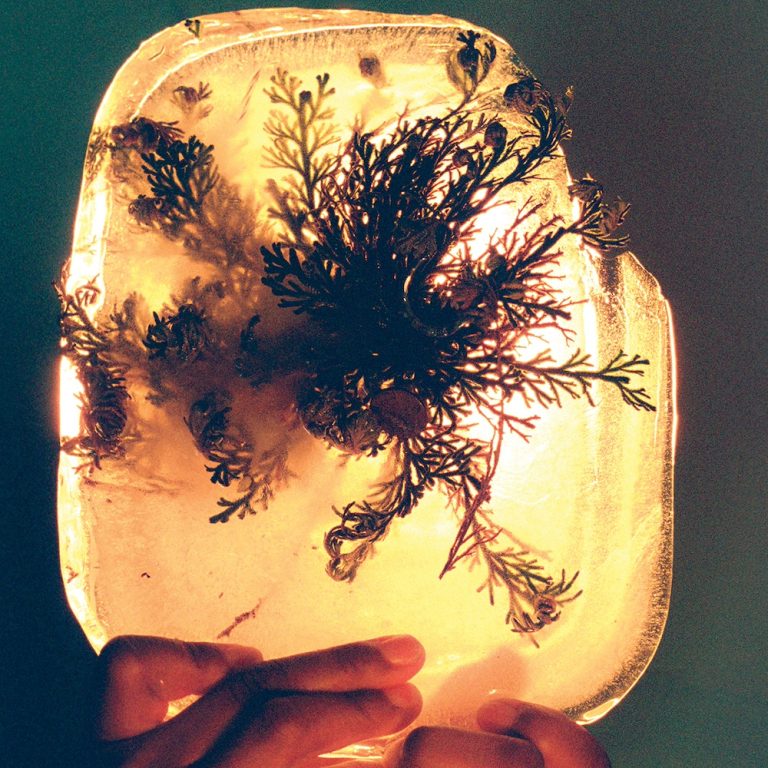
All four L’Rain albums share a diffuse sense of elemental, if not esoteric, notion. Most of them concentrate on Cheek’s hands and present opposite colour schemes. They could be attributed to air, water, fire and earth (in that order), if a theorist would desire to interpret the colour and motif choices of their respective artworks. fata morgana seems the most explicit in that regard, as Cheek speaks of desert flora or deep sea fauna as inspiration: life that developed under impossible circumstances and flourishes even under adversity – a veiled symbol for the black experience? Cheek seems consciously cryptic: “Experimental music is over,” she posted online, “I never played jazz. Above all, I hope to make one thing clear – I do what the fuck I want…”
Indeed: fata morgana defies expectations. Where her previous albums followed a clear continuity into clarity, her fourth album returns to the stranger, murkier tone of her debut, pairing strange and elaborate compositions with the confidence of I Killed Your Dog. Much seems incidental initially, maybe even nonsensical, before the brain suddenly embraces the foreign textures and assembles them into logical progressions. At times, Kid A and Strawberry Jam come to mind in how brain neurons adapt to a new aesthetic language. The dense layers and clever collisions of vocal melodies with abstract percussion or looped fragments might have progenitors in Panda Bear, Yasuaki Shimizu, Atlas Sound or Coil, but this is even more daring and innovative material than Cheek’s previous work.
With “rumors of light”, the motif of short, distorted vocal samples that introduce each project continues, with Cheek being continuously interrupted as she attempts state “I keep trying to start the -”. The eerie moment shifts into the uneasy piano ballad “with time”, which contains the mood of a forgotten horror-movie theme, aided by a tense synthesiser bridge and slowed down voices. There’s an air of Thom Yorke’s bipolar writing style here, as the song becomes progressively more tense in its odd spiral movement. Parallel to that, Cheek introduces a strange contrast between a grieving lover and the narrator, who posits themselves as vampire, with sunlight a motif for estrangement.
“blue” leans towards the hushed avant-garde of John Hassell, muting horns and distorting percussions to a point where they sound almost totally submerged in water. With its themes of perception, death as another form of living and symbolist coda (“Shadows can only be made from light”), it seems to respond to “with time”.
“july 5th” has the nervous arpeggited texture of a Bradford Cox composition ca. Parallax, with Cheek’s soulful vocals drifting and extending over the rapid movement, before it suddenly explodes into a strange finish that collides dancehall and reggae as if meshing together action figures.
The pretty guitar melody of “borderline” equally blooms into a strange underwater pop songs, all echoing riffs and sparkling percussion. As the song reaches a state of almost firework-like extension, it shifts into “elmyra”, which introduces itself with the halcyon glow of a 70s TV jingle, as complex percussive elements intrude and slowly take the song over. Both these tracks observe relationships as somewhat uneasy landscapes of transgressions, of mixed signals and tense misunderstandings. Like mutes or beasts, these protagonists seem to express themselves solely through mannerisms and physical interaction. Is this love, or a form of adversary that assess dominance with each fuck and bite? “elmyra” does not provide any answers, but in its aura – the diffuse comfort of kids TV show, banished to VHS – it expresses a deep sense of familiarity and homeliness.
“soulless cycle” breaks the harmony: a gradual buildup of rock chords into reverb laden guitar noise, it’s an epic and brutal journey that reminds of Boris, or My Bloody Valentine’s “You Made Me Realise”. An utterly unbound and genuinely physical track (is Cheek screaming, two minutes in?), it’s a shock to the system on a record that, so far, ventured in the intangible realm.
“glass ceiling” finds soft RnB among manipulated samples of breathing and sapphire synths, while “birthday” slides fully into the plastic smoothness of 90s future soul music, gospel choir and all. Cheek’s vocal performance on the track is likely her most impressive on the entire album, as she hits the high registers effortlessly. With its clever use of kitsch elements and slight spiritual notions, there’s a hint of Prince in the track as well.
“church of no one” returns to the vague and spectral qualities of the album, using reverb to imply massive structures and vast landscapes. Where “with time” introduced the concept of the vampire, “church of no one” introduces images of a ghost-entity, content with non-existent but simultaneously finding beasts within their shape. Cheek has written about the passing of her mother before, but here she seems to observe how death itself unleashes new versions of existence, or consciousness, that the corporeal won’t permit. As with the earlier track, and the album’s theme of life within impossible environments, Cheek is interested in this question of perseverance – vitality within a flailing romance, existence beyond the shadow of death, plants conquering the merciless heat of desert dunes.
Psychedelic music has investigated this status recurrently. Dark Side of the Moon chronicles the anxieties of failure within a performance oriented society. Low charted depression and alienation. Sgt. Pepper’s was the outcome of a band drifting apart and SMiLE rebelled against the fragile psyche of its creator. Psychedelia was rarely the outcome of harmony, but all too often of individuals who find themselves at odds with their environment, the expectations put upon them by society, the failure of the constructs they achieved.
And therein lies the parallel to the black experience. Black people have fought ceaselessly to achieve a fraction of the freedom handed to white people, just to be met with adversary – only to be reminded of the inherent oppression in white systems. America’s response to ‘Black Wall Street’ was the Tulsa massacre, and Black Lives Matter resulted from the naivety under the Obama years, where the neo-liberal dream of a post-racist society was shattered by the murders of Trayvon Martin, Michael Brown, Eric Garner, Rekia Boyd, and many others. Through this, black psychedelia becomes an expression not just of black liberation (as many art forms using revolutionary semantics attempt) or of black utopian thinking (which Afrofuturism is the foremost embodiment of), but of a sideways motion: of a parallel reality, which finds compassion and vitality within the barren and immutable. The impossible – the position in a lifeless moment – becomes a breeding ground of possibility.
When Cheek says “I do what the fuck I want”, then this becomes an expression of this sideways movement – not just beyond genre tags or established structures, but into a realm beyond charted possibilities. Thus, fata morgana isn’t hard to categorise because of its sonic diffusions or compositional diversity, but because it characterises spectral qualities beyond perception. It takes the point of view of vampires and ghosts, delves into the deep sea trenches and far desert dunes to chronicle the life beyond, and how those perspectives express themselves. Cheek’s music is a byproduct of those spectres, instead of just description. The record quite literally sounds like science fiction, without ever adhering to preconceived notions or borrowing ideas. A hard album to grasp initially, fata morgana might be much, much more visionary than people will initially realise, precisely because the language to describe it is still inconceivable to many.
87%