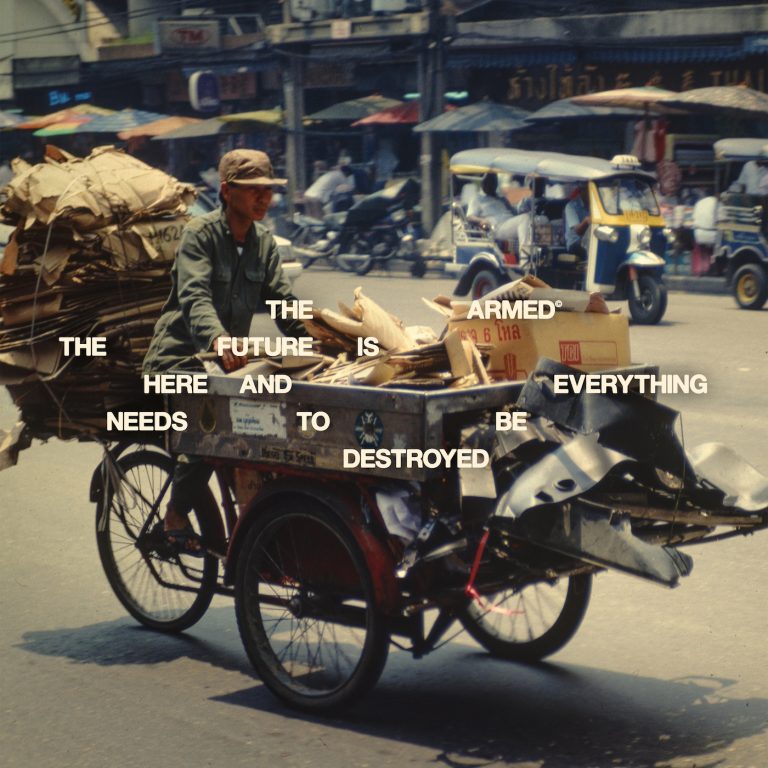
The Armed’s early albums, notably 2015’s Untitled, explored a punk/hardcore meld and leaned toward math-y/prog-y instrumental breaks. With 2021’s Ultrapop and 2023’s Perfect Saviors, the Detroit collective shifted toward or at least incorporated noisepop, experimenting with textures and a more defined sense of melody. With their latest album, The Future Is Here and Everything Needs to Be Destroyed, they’re at their most eclectic, striving for a “greatest aspects” project. The set highlights the band’s multifacetedness, offering moments of transcendent rage, but also feels cumulatively scattered, lacking an emotional axis or sense of sonic continuity.
Peak The Armed, which occurred somewhere in the intersection between 2018’s Only Love and Ultrapop, like peak Deafheaven, exuded a kind of sinister playfulness. Both bands were fans of beauty, though The Armed approached romanticism with a greater sense of mischief and irreverence. Traces of their idiosyncrasy were still present on Perfect Saviors. Perhaps those traces are present on The Future, as well, but they seem further diluted and backburnered, as the band overly reinterpret their previous work, in the process (re)exposing their sources, which they had largely distanced themselves from by the time Untitled was released.
Still, one can’t help but feel a rush when encountering The Future’s opening tracks. “Well Made Play” combines mandatory screamage with blistering guitars. A cacophonous yet precise instrumental break recalls Black Midi if they had consumed a fistful of cheap amphetamines. “Purity Drag” sounds like any number of 90s punk-listing tracks, including Nirvana’s “Tourette’s”, run through a wood chipper, then re-blended in a pharmaceutical mixer. The piece serves as a portrait cum caricature of the contemporary narcissist: “Nothing is my fault”; i.e., it’s everybody else’s fault!, a perspective that often seems synonymous with the 2020s.
The oscillation between semi-melodic verses and a tortured chorus on “Kingbreaker” is effective yet sounds retrofitted, oddly incongruent with the tenser, more polarized, more outrightly psychotic world we find ourselves in. With “Broken Mirror”, the band resemble a revamped Rage Against the Machine, guest Moe Kazra from Prostitute doing his best next-generation Zack de la Rocha. “These anti-Christ Christians sure look more like demons”, he proclaims. Yeah, given the lopsided economy and the politicization of Christianity, maybe we should consider tearing this shit down and starting over. But would our fundamental impulses operate differently? Would we end up at an alternate destination or one that pretty much resembles where we are now?
“I Steal What I Want” is a melodic highpoint. The band forge catchy verses and speedy choruses, stumbling into a limbo that used to be time-shared by early 2000s quasi-hardcore groups such as Breaking Benjamin. The room is pretty much empty these days (Soul Glo and Show Me the Body occasionally stop by for a shot of nostalgia). That is, The Armed are free to claim it, move in, make it their own. “Local Millionaire”, meanwhile, walks the chain-saw blade between protest and lament, a hooky solo erupting from a toxic cauldron.
“Heathen” is the album’s most intentionally paced song, launching with a more subdued, slightly sultrier ambiance. “On a railing / speeding train”, Tony Wolski moans. Doesn’t sound promising, but rather like a situation that will, and does, escalate: “Tearing apart / shatter into pieces”. Enter the blow-torch guitars, an American anthem-esque solo playing woefully in the background, the band stirring the banal and sublime, the cliché and mythic. The album appropriately closes with “A More Perfect Design”, a frenzied, pummeling, off-the-rails noise-fest replete with a gasoline-doused vocal, the moral of the story being: when times are hard to stomach, force-feed the people reality.
If you consider that Minor Threat’s debut came out in 1981, Bad Brains’ in 1982, it’s not surprising that even hardcore can sound vintage (Converge’s Jane Doe was released almost 25 years ago!). In other words, the term “heritage”, by no means necessarily an aspersion, can apply to more than Americana. At any rate, injustice, rage, and sabotage are The Future’s de facto themes, though that doesn’t automatically point to a cogent manifesto. The Armed are on the verge of parodying themselves, their version of parody involving copious amounts of accelerant and old-school sacrilege: effigies of God and the Statue of Liberty erected in a vacant lot and set on fire. What does it say about the era we live in that these idées d’annihilation seem inevitably quaint?