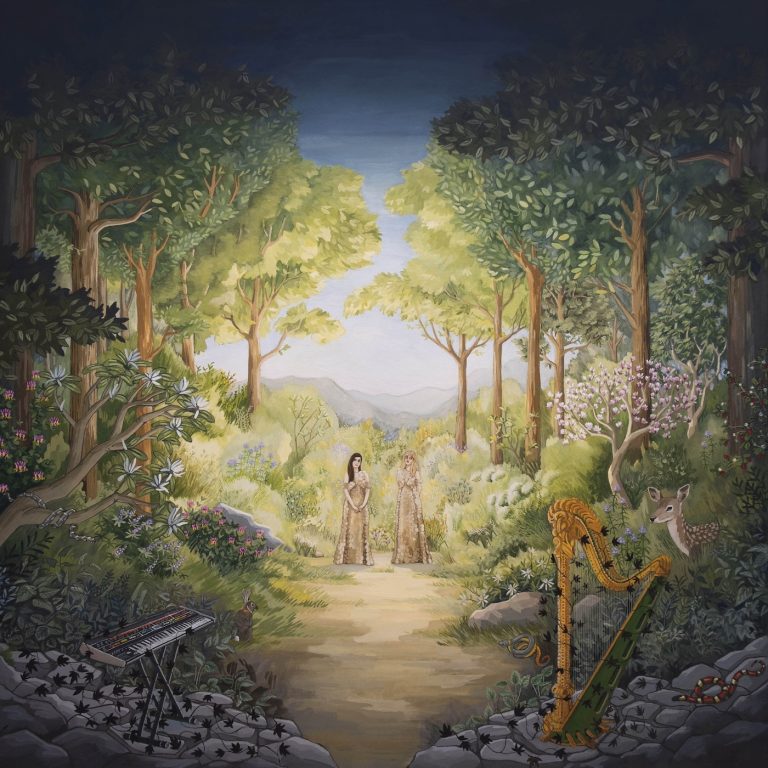

Is there any among us, upon seeing the announcement of Tragic Magic, that didn’t go, “Yeah, that makes sense”?
Keyboardist, synthesizer queen, but above all, supreme vocalist Juliana Barwick and harpist Mary Lattimore have been traveling and touring together for years, but even if they’d never set foot in a room together, there’s a sense that they’d have reached musical symbiosis just as readily.
After all, even beyond the way their respective instruments and “sound” fits together, there tends to be a shared feeling in their work. Naturally, making my job here difficult, it tends to be almost indescribable: one of deep yearning and (even for the atheists among us) a nearly overwhelming sense of spiritual awakening. Take Barwick’s high watermark, Nepenthe: even in its quietest moments, you can sense an entire world, teeming with life, just out of sight. Or, rather, just beyond what your eyes can hope to perceive. At its best, her work practically aches.
Lattimore, meanwhile, often finds strength in what she needn’t say. The beauty of her work is that it relies only on her instrumental prowess, rather than voice. She has simply increasingly found power in patience, letting a gradual sense of feeling reach the listener, rather than seeking grander flourishes or peaks, leading to, to my mind, her best work to date via 2023’s Goodbye, Hotel Arkada.
All of which to say, beyond their obvious similarities and shared perspective, it wasn’t hard to imagine Lattimore’s subtlety and intentional distance gracing Barwick’s own urgency and ornate grandeur.
So, with Lattimore on a high and Barwick having been biding her time since 2020’s Healing is a Miracle for inspiration, it was a perfect moment for like-minded collaborators to finally link up properly, and see where it led.
Sadly, Tragic Magic earned its title, with a stark genesis: the two found themselves in Paris, shortly after the now infamous wildfires of January 2025 devastated their home of LA. That weariness and concern certainly informs the music here, but nonetheless, unique conditions quickly benefited their work: recorded within the Philharmonie de Paris, the pair were allowed access to the entirety of the Musée de la Musique’s instrument collection. Lest one underrate this latter aspect, this meant they were able to play with instruments dating as far back as the 1700’s. With none other than Trevor Spencer entering as co-producer, the stage was set.
Those looking for something truly Earth-shattering to rival either musician’s greatest accomplishments may be disappointed, but what they have conceived and created feels far more natural. Rather than concerning themselves with expectations or overly lofty goals, they clearly simply enjoyed each other’s company and creative process, and allowed the music to form as it may. As such, they arrive with some surprises, from a song written for them by Roger Eno to a cover of a Vangelis Blade Runner classic.
In the end, Tragic Magic feels like a response to the wildfires they’d suffered through. Rather than capture the tragedy and strife of it all, they sought – and created – refuge. They took comfort in their collaboration, and, in turn, offered comfort themselves. As the album comes to a close, it reaches both its most urgent moment and most direct address of the fires: “Melted Moon” builds worried energy, with Barwick’s voice emerging, only as the clouds break. Forward, she seems to say. Ever forward.