
What does the future sound like? Does it come in the Vangelis-like city ambience of 2814’s Birth of a New Day? Is it the crushing grind of ancient industrial machinery awakening in a gilded art-deco metropolis, on Imperial Triumphant’s Alphaville? Stuttering remnants of an agoraphobic civilisation, as on Burial’s Antidawn? Or the rainbow coloured cyber-pop of 仙Android by 회사AUTO?
All of these are possible scenarios, of course. But besides their speculative fiction, they also illuminate the present, and how the time in which they were perceived expresses its own desires and anxieties. Antidawn chronicled the crushing months of lockdown paranoia, while Alphaville observed the collapsing American ego at the end of Trump’s first presidential term. Birth of a New Day imagined London’s sprawling, multicultural hub as potential Neo-Tokyo, and 仙Android collides the globalist opportunities the internet fosters with introspection. But there is one question that unites them all: where does infinite opportunity collide with our soul and human needs? When do our playful fantasies of transhumanism shift our experience of the self?
When it came to this central question, Arca has always been at the forefront of the discourse. Rightfully so: the Venezuelan’s chameleonic records and sharp production work always attempted to approach the alien, the mutation, the disfigured and re-contextualised. Where her early albums Xen and Mutant presented a cavernous deconstructed club sound, her self0titled third flung itself into operatic glitch pop. The old Arca was gone, and in their place came a broken Soprano. The Bronski Beat or Klaus Nomi of a new generation? Arca garnered praise, but it also chronicled an artist whose ambition was, for the first time, limited by their perception – the writing on the album fell short of the many collaborators Arca had carried into the future.
As if to crack these limitations wide open, a butterfly breaking out of their cocoon, Arca soon released the pentalogy known as Kick. With each album, Arca pushed forward: hyper pop, Latin electronica, deconstructed glitch, IDM opera, ambient classical. It was a startling and sometimes brilliant project (personally, I consider the last two entries most successful), but it left Arca burnt out. Having charted so much territory, where else was she left to go? The answer was to sidestep: painting.
This is where the very context of Arca’s identity comes in. With the first Kick album also came accusations of nepotism and privilege. Arca’s father, it was widely reported, was a big time investment banker, who founded his own capital venture firm. Wealth brings with it the opportunity to explore abstract art without the danger of failure: you have access to state-of-the-art equipment, mould your wardrobe by runway standards, gain approval of scene gatekeepers. Arca’s messy paintings – which incorporate a wide variety of materials and techniques – are reflective of a psychedelic perspective, but they also come across as cluttered, low brow kitsch.
As personal as Arca presents these works to be, they also highlight an issue with the current hipster aesthetic: always keen to appropriate working class and poor people’s aesthetics. The current hipster status quo leans towards a bad taste-hydra of grotesque, disparate clutter. While queer aesthetics have often incorporated and embraced philosophies of camp as a subversive alternative to the normative – ugly is beautiful – there has come a marked excess with this celebration, where any and all elements are game: the canvas is scattered until there is no authentic canvas left. Has this play with the total concealments of authenticity led to political frustration and the rise of conservative neo-traditionalism? Art is meant to challenge and shock, and young talent should not be discouraged, but when does the artwork merely become a reflection of chique blandness? When do these works stop being an experiment and morph into vain celebrity luxury? Ultimately, her paintings are too close to those ghoulish canvases by Adrian Brody, James Franco or Jim Carrey.
Thankfully, Arca returned to music this year. Fans will note that the artist’s obsession with the number five continues, as it has been five years since Kick iiiii and – like Arca’s mixtapes – is named with five symbols: XXXXX. Indeed, like @@@@@ or &&&&&, this new album was intended as a mixtape first, morphing into a full blown concept only later.
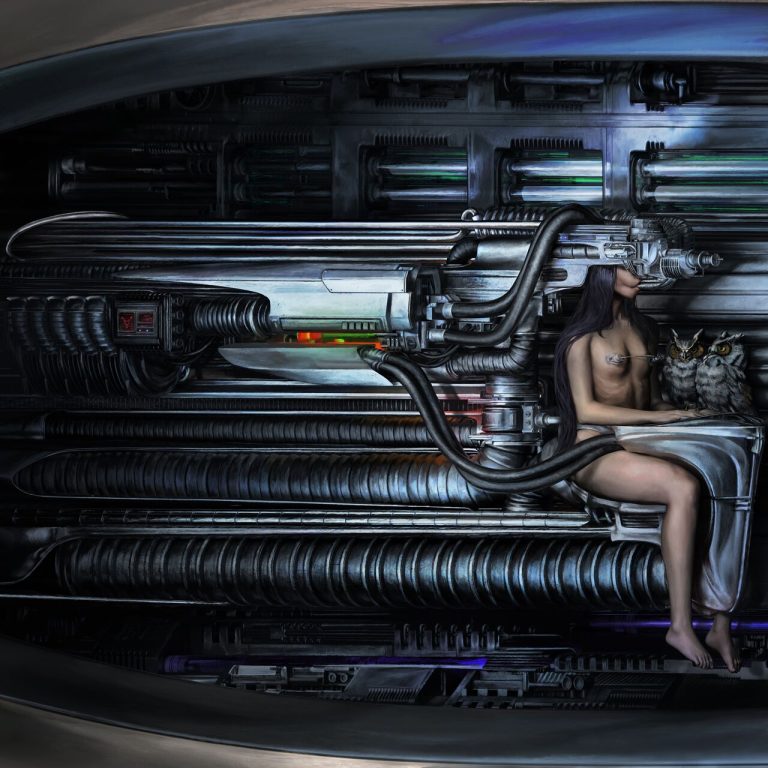
Strapped into an alien machinery reminiscent of H.R. Giger’s chromatic works, and accompanied by two owls this writer would immediately adopt, Arca presents herself as captain of a magnificent craft on the cover. It is a more than fair metaphor of the album.
Abandoning the homogenous approaches of the self-titled and five Kick albums, XXXXX is her most diverse, yet also most balanced album since Xen and Mutant. Experimenting with glitch, classical compositions, electroacoustics, IDM, hyperpop and even dreampunk, Arca has crafted an album that is the standout of her career so far. Where comparisons to the Warp-label giants of Aphex Twin and Autechre have often been engaged in the past, XXXXX is the first record where the musician actually delivers something as emotionally resonating and technically daring without hitting her limits as composer or performer.
Harkening back to the mixtape @@@@@, the album opens with a glitched invocation of a diva – Arca’s whispers will occasionally be a companion on this journey, akin to an alien radio broadcast, or the dreamed transmissions in John Carpenter’s Prince of Darkness. The cavernous “Willow” then leads with the sound of echoing bells and sharp synthesisers, before Arca’s distorted voice and sharp beats cut in. The composition is very similar to Aphex Twin’s writing, before vast icy synthscapes and nostalgic chiptune sounds morph it into quasi-witchhouse.
“Finisher” presents its somewhat distorted strings and pounding beats as dark vision of Boards of Canada’s eerie tone-poems, finally collapsing into industrial rattlesnakes, with an ominous coda of whispers and a drawn blade. “Heart” presents a manic ringtone that is gradually dismantled into a hyperpop instrumental, until it duels with Arca’s childlike taunts and sexual moans. “Fxck” simulates a dance-pop anthem whose Latin style is distorted in the vast delay of an an underground crypt-club, the diva chirping “I want to fuck” and “kill the father”.
“Syncope” scatters manic beats across a deep sub-bass, promising a climax which dissolves in cosmic explosions. “Enraptured” presents as artificial intelligence ballad, while the strange, futuristic “Everything” distorts music to its stuttering base movements – a little Death’s Dynamic Shroud.wav. “Grip” meanwhile returns to Arca’s idols, almost nostalgic in its relation to Autechre, contrasting the deconstructed Latin dance pop of “Taconeando”.
There is a nervous collision on XXXXX, between the almost ambient soundscapes of “Throb” or “Cinch” and the club-ready beats of “Eidolon” or sinister stylings of “Raver” and “Futurality”. Their dynamic to each other is definitely uneasy – one side imagines the cityscapes of William Gibson’s The Sprawl, while the other asks how seductive, toxic, delightful and exhausting the many clubs and bars it harbours can be. It presents a future that is infected by the past and present, but rejects simple definition – there is no clean cut cultural segmentation to be found on XXXXX, even at the most radical turns.
The album edges towards Crystal Castles and DDS.wav as much as to Richard D. James and the Sandison brothers, but those echoes never feel ingratiating. Instead, its many concepts genuinely feel virtuosic, inviting the listener in with just enough familiarity to make them comfortable, only to then show them the alien and unaccustomed. While stylistically different – jazzier, bubblier and more lounge oriented – this is also a parallel to Flying Lotus’ breakthrough album Los Angeles, whose cultural proximity to black music history feels like a progenitor to how Arca approaches IDM and concepts of the uncanny within electronic pop, where the moments incorporating witchhouse and Industrial can be located.
Most importantly, XXXXX never feels cluttered. At 47 minutes, it fits comfortably on a single disc, while each individual element blends into the larger flow effortlessly. Each nuance gives a quick glance of another story, a glimpse of yet another brightly shimmering cyberpunk character passing by, a story to be told and become lost in. Hackers, hitmen, holograms – erotic dancers and lost souls. Arca imagines the present into the future as a constant stream of our desires and corporal movements in a way she’s not been able to before. Maybe the exhaustion of Kick and the clutter of hear paintings allowed her to clean out what held her back so many years. Maybe now, she is finally free to not just imagine, but step into the future, unburdened.
86%