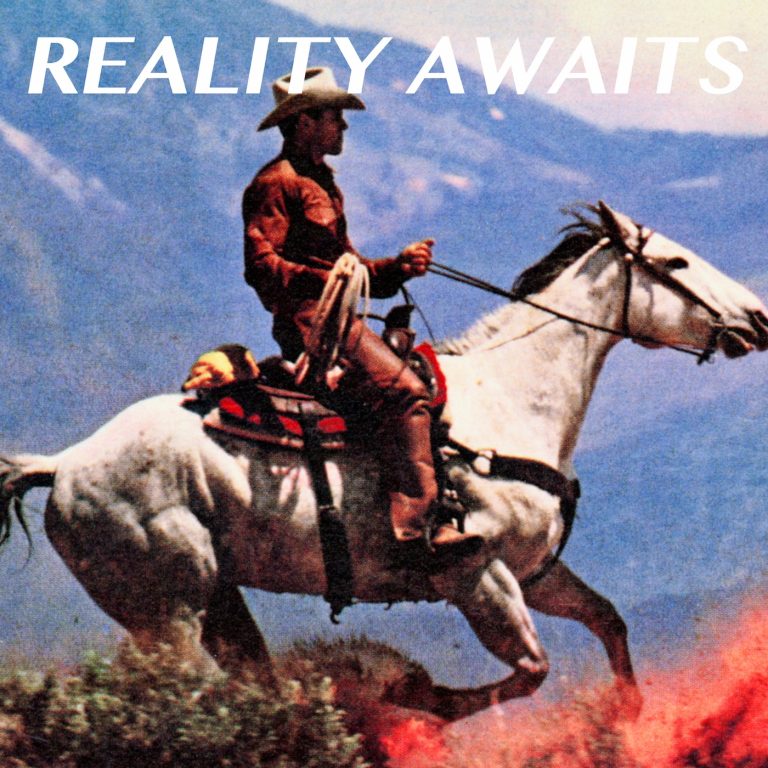

Richard Prince is one of the most interesting contemporary American artists – specifically due to his audacious and controversial approach to image making. Following in the tradition of Andy Warhol, like many of the artists of his generation, Prince focuses on re-contextualising pre-made photos – many of them from populist sources, such as advertisements, product packages or magazine articles. However, unlike many of his contemporaries – such as Barbara Kruger or Lorna Simpson – that added to these images through painting, typography or collage, Prince quickly bypassed these additions to concentrate solely on the cropping of the re-produced images.
It wasn’t until much later, with his Nurse Paintings-series – from which Sonic Youth picked “Sonic Nurse” for their album of the same name – that Prince would return to a more manipulated and involved method. From this previous phase stem what many regard as his most brilliant works, the Untitled (cowboy)-series: stark, iconic images of cowboys riding across orange sand dunes, in front of azure skies. Prince would photograph Marlboro billboards, leaving out the cigarettes, cheekily presenting the idealised kitsch imagery as ironic revelation: are these the real American men, or merely a design to sell individualism as romantic fantasy? Prince has always been open that he had no clue about the actual machinations of the photographic process, the dynamics within a dark room. He simply generated a most confrontational result by reducing images we interact with every day to their plain, corporeal status.
Even if The Strokes had not used a Prince work for their new album cover, a lengthy comparison would have been due by now. Like Prince, the New York group have often been reduced to ‘a bunch of kids who barely know to play guitar’ – a presumption that couldn’t be further from the truth. Yes, The Strokes are not the most skilled group in a city rich in geniuses. But their success is the product of a tight, perfectionist regiment, both in terms of composition and performance. Drummer Fab Moretti and lead guitarist Nick Valensi are especially precise and inspired parts of an immaculate machine that understands rock music almost as an alchemical process.
However, this focus on technical precision and compositional tightness does led to vastly divergent results early on already: while Is This It? and Room on Fire are seemingly unstoppable works of constant driving impulse, First Impressions of Earth struggled with the group needing to prove they were able to deliver more diverse and challenging genre concepts, resulting in one of the chief disappointments of the 00s. The much better Angles reversed this concept, concentrating on 10 songs that expanded the core sound, instead of trying to push larger ideas into the same style. But the band found themselves at a breaking point: they barely were in the studio together, with each writing their respective parts. The resulting diversion of this era led to many solo projects, and an uneasy truce, in which some members wanted the others to concentrate on the unit over their own side-projects.
Which left things all the more uneasy with their audience, as Comedown Machine was almost entirely rejected upon its release. The album has since enjoyed a bit of a revision, as individual songs keep appearing in reels and TikToks – it really isn’t qualitatively all that behind the celebrated ‘comeback’ album The New Abnormal, a skilfully minimalist record that saw the band digest the recurring disasters of the 21st century American fallout. Having had to suffer under constant critical condescension – they just copied other bands, they lost their inspiration, they couldn’t play their instruments. The Strokes had, almost two decades after their debut release, proved their cultural relevancy.
And then, this year, they broke the pop cultural discourse wide open when they performed their EP track “Oblivius” at Coachella to an accusatory montage, revealing the heinous consequences of American foreign interventionism. The group could not be in a better position – and they haven’t been for a long, long time.
Reality Awaits, their seventh album, is striking in how evasive it feels of this reclaimed status. Throughout their career, the group utilised fine art for covers almost like meta-statements on their status as a group: Peter Phillips, Lothar Quinte, Basquiat – and now, Prince, the artist who most aggressively represents the group’s gestalt to the critical masses.
Featuring the choice inclusion of vocal manipulation for Julian Casablancas, at times correcting his pitch as aggressively as the worst Black Eyed Peas tracks, the album mostly follows a similarly melancholic, slow pace as The New Abnormal, while Casablancas seems still in the modus of his Voidz side-venture.
On opener “Psycho Shit”, this leads to a very contradictory experience: as dramatic as the composition is, Julian’s voice is oddly emotionally removed where a raw, faltering performance of cracking and gurgling should have been. But this seems to be conscious, as the lyrics paint an ongoing apocalypse: the narrator imagines themselves a bird of prey – an eagle, if you will – that exists between libidinal courage and violent onslaught. “We learned to harvest bombs from lead / We learn to die to learn to live / You run along ’cause I was born / Never scared, but I don’t yet count the days / To your doom, get to your room / Wounded child with no shame”. As the song progresses, the narrator observers a drone operator or politician, who kills from behind their safe desk space – is the perpetrator even human anymore, or just soulless artificial intelligence?
As “Dine N’Dash” rushes in (an uneasy, ominous disco track with prominent church organ), it becomes clear that the five-piece approached Reality Awaits as bold art-rock statement – potentially even the most consciously artistic recording of their career – while Casablancas’ lyrics are aggressively political.
On this second track, Julian seems to struggle with his inner life philosophies directly contradicting structural oppression and increasing warmongering: “I’d shoot him now if he was here / I’d slit his throat from ear to ear / But I have sworn a life of peace / How can I reconcile this beast?” There is no clear answer. “Lonely in the Future” returns to a classic Strokes composition, all slick new wave aesthetics and great hooks, with Casablancas bringing out the vocoder only for the bridge. Lyrically, he bemoans the progressive commercialisation and cynicism of the music industry in light of his own growing age. “I wore that years ago, I did / I liked that years ago when I was a kid / And in a hundred thousand days from now, I’ll say / ‘I did that yesterday when I was a kid’”, he muses, while religious imagery (“Join me as I pray for the grace to be merciful/ Help me not lay waste ’cause it’s not their fault”) and fake idols (“I guess I’m flattered, maybe / All good, we all steal, baby / Y’all ready for the next fad? / Chris Hedges’ next”) mount behind him.
And then there’s the already much publicised shoutout to Anthony Fantano: “Fantano, word for word, when I was a kid / Stick to the technical ’cause that’s great / But you would not recognize art in any age”. Anthony, who has been especially raw lately after the much-earned ridicule for his fiercely debated Halsey review, took the lines quite gracefully, but seemed to miss the point: his reviews often focus on his own, quite particular and guttural enjoyment of music over the artistic depth or intentional effect of a record. It’s an approach that leads to many controversial opinions for Anthony, but on a larger scale, this tendency reveals a rising anti-intellectualism within the critical community. Of course, responses to art will always be subjective – but this demands for a serious critic to engage with and interrogate this response. Is the art good, then an abrasive or mocking or maybe even bland response is intended to make you confront your own gaze and emotional make-up. So in that tradition: maybe the vocoder is meant to elicit in the listener the impression of music that led the charts when The Strokes were at their commercial peak: flat, deconstructed black music that evaded soulfulness for gimmicks.
The best moments of Reality Awaits continue to be the songs where The Strokes return to their familiar sound. “Going to Babble On” is another ‘classic Strokes song’: aided by an autumnal atmosphere and great guitar work, it’s maybe my favourite song on the album. Simple, striking, infinitely listenable, it’s the sort of song that reminds fans why they love this band in the first place. The track was previewed during the band’s support of NYC mayoral candidate Maya Wiley, so there’s also an added quality of political frustration to the resigned lyrics (and yes, even if it feels like label notes, I will point out that “Babble On” and “Babylon” are homonyms).
“Going Shopping” is equally simple, equally politically frustrated (“The worse reality gets, the less you wanna hear about it / Solidarity can be difficult / When you got cool stuff to lose”) and equally refreshing: just a great new wave track with charming guitar hooks and a cool bass line. No notes – everything works!
“Liar’s Remorse” seems to connect with the minimalism of The New Abnormal, leaving out the drums and adding an organ for a solemn ballad. The production here is dynamic and the musicianship great, but at the same time the song has the phlegmatic shuffle of a McCartney Wings track. I could imagine it growing with time, but its conceptual nature holds the listener at arm’s length. This is especially curious, as it lyrically seems to deal with the ongoing phenomenon of political assassins and the rise of artificial intelligence as corporate tool.
Some of the experiments are where things become more rocky for the band. “Falling out of Love” bears the naive beauty of an Angelo Badalamenti composition (think “Just You, And I”, aka James’ song from Twin Peaks), sneaking melodic references to Sinatra’s “My Way” in for good measure. The lyrics here are a little scattershot, combining once more apocalyptic imagery (the protagonist dancing in acid rain) with the hurt of heartbreak and images of privileged, luciferic westerners that hunt African wildlife. At six and a half minutes, it’s all a bit much, a bit overcooked. The New Abnormal suggested that reduction really helps The Strokes, and this song feels like it proves this thesis.
The melancholic, bongo led shuffle “The Fruits of Conquest” builds itself to a tense finish, tuning Julian’s lyrics down near the end. But the first part is quite boring, while the lyrics don’t come across as inspired as most on the album – it’s the sort of track that you find as an outtake or B-Side. And closer “Tyrants of the Mellow Moon” almost sounds like an unfinished Radiohead track, ca. Hail to the Thief: the progressive guitar lead and nuanced drumming don’t really work with the vocoder-heavy vocals, while the progression just lacks a climax. Instead, the song suddenly disintegrates into a dark finish, which almost feels like a Boards of Canada-type composition. Radiohead perfected this merger in the early 2000s – here, it seems a bit elusive and anticlimactic.
Sometimes, the intentional quest for art can lead into these awkward territories, and I’m curious what the individual members make of the album. It’s not an easy listen: the ending stretch seems to fall apart and drags quite a bit, giving it a somewhat mellow feeling even though the best of the preceding songs are very slick and radiant. The dynamic feels off, the drama sometimes won’t communicate.
Still, Reality Awaits is a good record. It’s a bold and charming statement by a band that has all too often been reduced to their perceived status as nostalgia act. Yet, some songs sound tired or flat where they should be as provocative, lurid and acidic as the emphasis of the record cover choice suggests. Maybe the answer to those qualms is simple: considering it was Rick Rubin who put the group back into the front line of contemporary rock, maybe this album proves that The Strokes have, two projects into their collaboration, already outgrown the superstar producer-cum-guru.