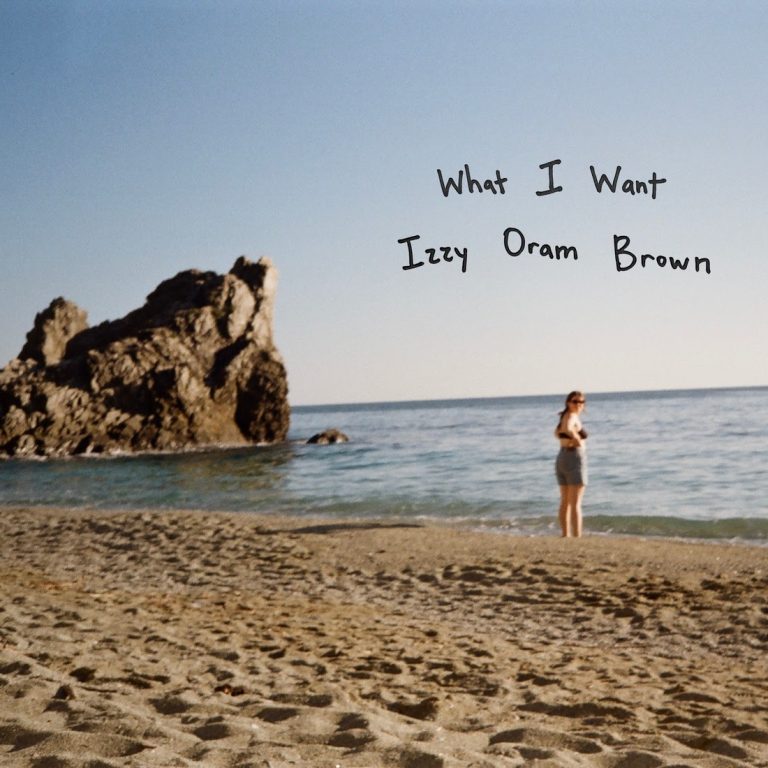

“My hands cannot sit idle / When they’ve worked my whole life.” That’s Brooklyn singer-songwriter Izzy Oram Brown at the heart of her new record, What I Want. In context, the line speaks to a sleepless anxiety brought about by a breakup, raising the kind of questions that emanate from the shards of a broken relationship where the pieces are still sharp enough to draw blood. The line also works as a snapshot of Brown’s career to date: she’s an accomplished session and touring musician who has worked with guitarist and composer Julian Lage as well as New York bands Why Bonnie and Youbet. She moved to Nashville at an early age to work in live and session music contexts, taking time away from undertaking jazz studies at home. She’s the kind of musician who immerses herself for the sake of learning and for the joy of creating. In other words, her hands are always busy.
Along this journey, Brown found herself falling for the art of pop songwriting and started creating her own music. Though she grew up singing folk songs, her first music used these genre frameworks as a springboard. 2022’s Mess was only six tracks long but it made for a dense and occasionally unsure half hour of music, the admirable result of a songwriter trying to challenge themselves. She worked deliberately, even if it still had some growing pains; though labelled as an EP, it had the air of a cautious and short debut album.
What I Want comes with equal measures of deliberation. “Every song I’ve ever written happened because I decided it was time to write some songs,” Brown explains in relation to her music. Her new album has a sharper focus and clearer narrative to follow. Although it’s only three tracks and a few minutes longer than Mess, it boasts a clearer throughline. Existential ruminations and self doubt woven around the aforementioned breakup are what give What I Want its identifiable heart. She looks back plenty here, worrying about her legacy of work and of love. Brown’s downtrodden ache and yearning as well as her rebuilding and hopefulness allow a more fully formed vision of her to form for the listener.
There are plenty of familiar checkpoints across the album: contradictions and the push and pull of life on opening tracks “What I Want” and “Got Me Down”; anguished loneliness in the form of questions to the universe (“If I’m Not Made For Love”); peace that comes with apathy (“I Don’t Mind”); and acceptance forming into optimism for the future in the final two tracks, “Love U the Same” and “I Believe.” Brown isn’t going to shake or rattle anyone with her lyrics – “I am never more alone than when I am in a crowd”; “I forgive you / The past is out of sight” – but there’s something to be said for her often hushed delivery. When she’s in her own sunken place her despondency becomes the best hook, as evidenced on “If I’m Not Made For Love”. “So if I’m not made for love / Why to love, am I bound?” she asks over a harmonium-like hum as earthy pedal steel guitar notes stretch out like the sun rising over a desert plain.
The sonic features are arguably the other best feature What I Want has going for it. The guitar textures on “Got Me Down” are just enough to help make it a distinguishable power pop number, the pulsating alarm-like synth and knotty backtrack effects on “When There’s Nothing Left” speak well to an itchy desire to create, while “I Don’t Mind” and “What Is Wanting Worth” are performed with an understated and deft delicacy. “Go On” offers the most promising musical moment here, even if it is unrealised: during the bridge the track breaks out of its languid, woozy haze and seems ready to unleash a swell of cathartic noise. Instead Brown quells the emotional wave; she would have done well to embrace the teased din and frustration so as to let the music burst out instead of trickling slowly.
These kinds of intuitions to embrace the call of the wilder side come with time though. Brown still feels like she’s introducing herself to the world. Her timidness can work against her when the listener is left craving a spike in emotion, but it does help gentler moments, like the endearing opening title track (that may be a smidgen too twee for some with its stylophone-like synth) and upbeat closing track “I Believe” where her sights are set firmly to the future. Brown’s hands are no doubt going to stay busy with plenty of other work, and with the deliberate care she chooses to create with, her next record will no doubt be just as considered and hopefully less cautious and afraid to spill itself over the edge. It’s good to keep busy, but it’s also good to sometimes let go completely.