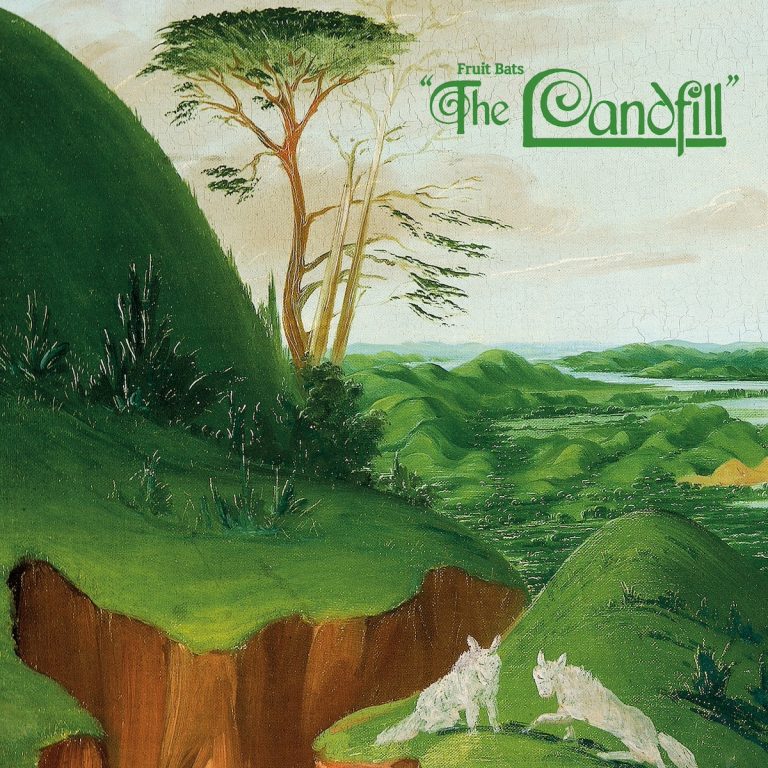

For some 25 years on the scene, Eric D. Johnson, who operates under the Fruit Bats moniker, couldn’t exactly be counted among the most prolific artists, with some 10 albums before his latest The Landfill. Yet, among those, it is hard to find one that could be labeled as filler.
The key there might lie in the fact that Johnson seems to always take time to slowly build musical landscapes through his songwriting, carefully building musical structures and lyrics to complete a picture, just like a refined painter. A rare exception there might be his previous album Baby Man, a sparse, completely solo acoustic outing that sounded like one of those spur of the moment affairs which generated split opinions both among the critics and Fruit Bat fans. Still, who knows, maybe Johnson again took his sweet time to come up with such a concept and execution and after all, it made no difference.
When describing The Landfill, his PR refers to the fact that Johnson comes from the part of American Midwest that is mostly a flat expanse (and that expanse is mostly incomparable to any other) “but blink and you’ll miss other man-made rejoinders to horizontal living dotting the landscape, hill after hill, built from the refuse of the past: landfills.”
Trying to portray such a landscape, Johnson goes for what he sees and hears as a full band sound – something that would at the same time represent those wide spaces dotted with both human use and misuse. Yet at the same time he tries to make a balance between intimate and expansive, whether it is the slow burn of the opening, soul-tinged “The Saddest Part of The Song”, the countrified “Fishin’ for a Vision” or the acoustic rocking combination that is “Perhaps We’re a Storm”,
In a sense, sitting or standing on that man-built vantage point of both use and misuse, Johnson creates one of his best works so far – “the mountain that gives us this vantage point,” Johnson says, “is made out of the trash that we’ve created, the collective weight of the past and where it’s taken us.” It is something he clearly points up in the closing title track – “a holy vision / of what could be / and couldn’t be / and could have been.”
With it all, Fruit Bats come up with one of slow-burning, slowly-evolving albums that should keep people locked in through the long, hot and fragrant summer.