
Located in the Quarantaine of Beirut is the club B 018. This is where some of the worst atrocities committed during the war took place and named after a recurring party that’s been ongoing since the 80s, the dancefloor is hidden underground. Above, a white disk and brutal, black structure mark its location. Like a maw, a gate opens, to beckon visitors into the dark. The architecture is meant to resemble a communal grave, with seats shaped like coffins – a macabre echo of violence. There’s a recurring motif, where visitors claim – or joke – that the dead come alive again during raves there, dancing among the living, unrecognisable. The artist Rabih Mroué narrated this story in one of his video essays, pointing out how time seems to freeze and friends become lost, with him wondering – am I among the ghosts of war? Was the night real, or just imagined vision?
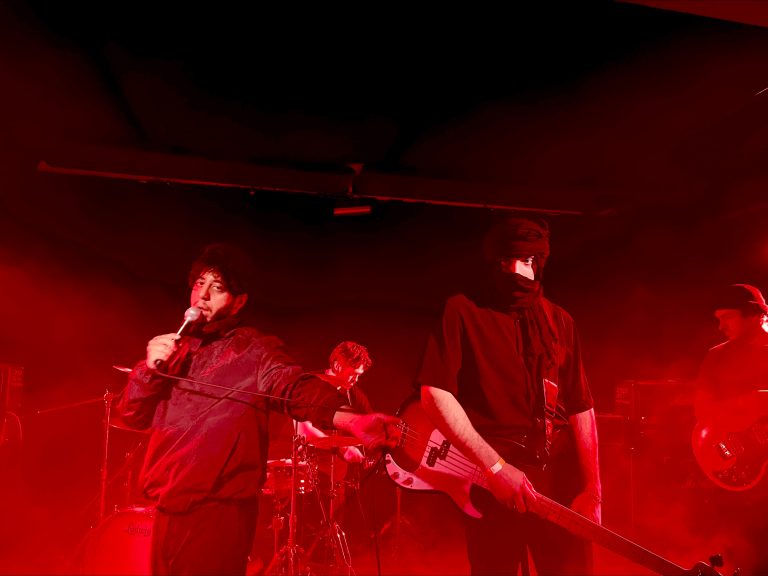
It’s a story that comes back to me multiple times as I watch the Futurismus act Prostitute perform in Berlin’s Urban Spree – itself too somewhat of a liminal space. Located in a former hotbed of autonomous artists and semi-legal joints, the club is in an area signed up for demolition, to erect urban office graves and high end stores, hosting some of the edgier, noisier shows you can see these days. Prostitute themselves seem out of place, as the band – a five piece live – stand on stage waiting for the enigmatic vocalist, Moe. Dearborn natives, the group is nonetheless thoroughly committed to their Lebanese heritage, both in substance and style: the band’s bassist is draped in a black balaclava, resembling the figure adorning their debut album’s cover. As Moe enters, red light floods the stage and as both guitarists (to the left and right end of the stage) vanish in darkness, the band’s bassist steps forward.
A few words on the identity of the group. On the liner notes of their debut album, Attempted Martyr, all members are merely listed by first name: Moe, Andrew, Ross, Dylan, Bret. Two of them (Dylan and Bret) are listed as bassists, though live there is only one, and two guitar players. It’s possible the names are aliases (note that none of the members carries a traditionally Arabic name), but still, it’s not easy to pinpoint which is their bassist, who quickly takes centre stage as figurehead of the band. Towering and moving to the very front of the stage, his confrontative demeanour is immaculate! Moe, meanwhile, starts breathing heavily into the microphone, as he stares across the crowd, his gaze both tired and panicked. Fog fills the stage as he slows down. “I turn to you… and I turn to you… and I turn to you… for if I’m caught!” he yelps, and the band explodes into “Body Meat”!
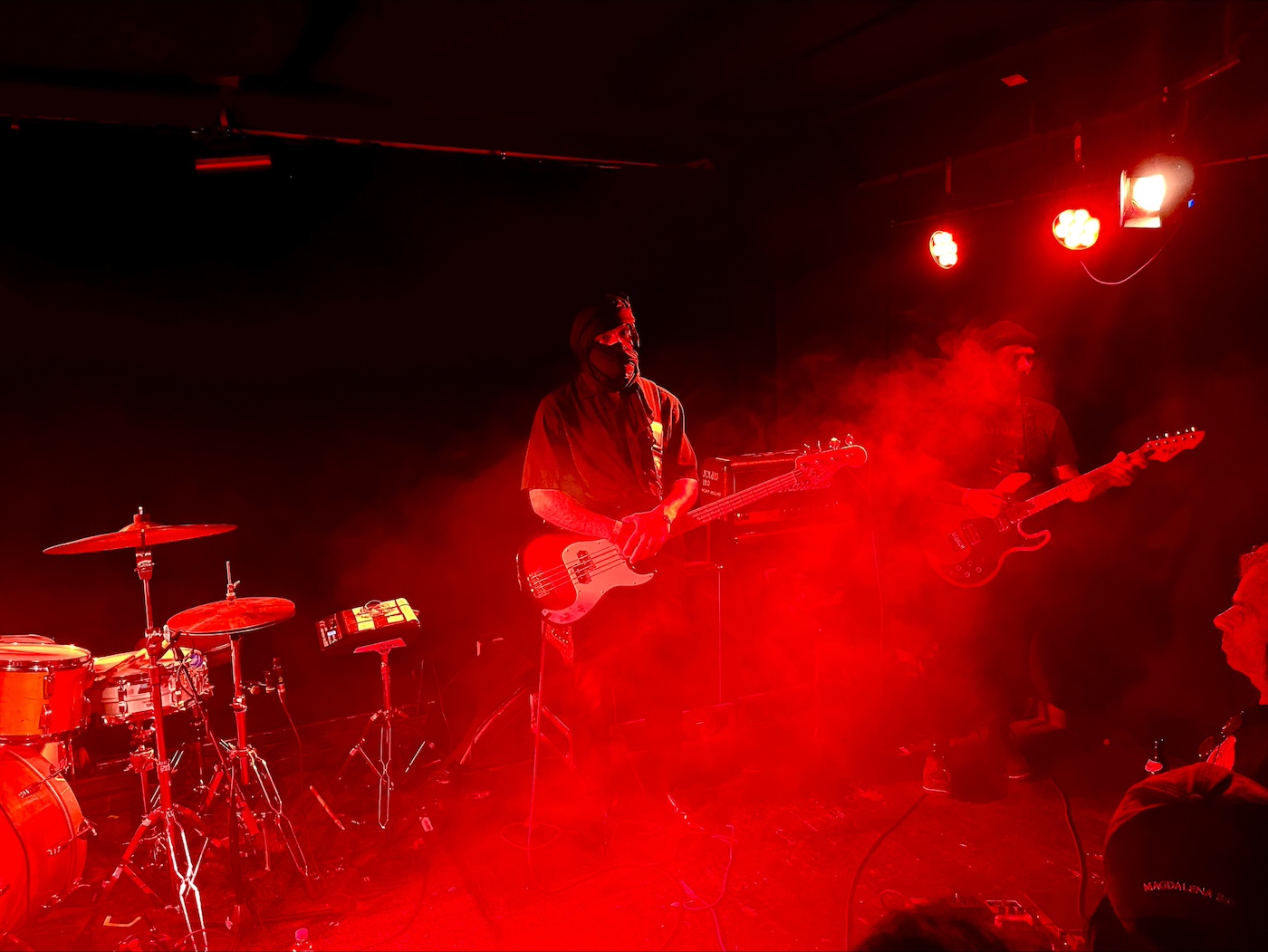
As if in trance, Moe is writhing his body in tune with the music, a possessed shaman from a distant realm, exasperated and hypnotised. It’s an incredible and immediate start, tho the Berlin audience seems almost frozen in response, barely moving. As the band shift, and Moe takes to the keys, the bassist removes the fabric from his face, staring down the audience with an iron gaze. The brutal “M. Dada” follows with pummelling rhythm and screeching synthesiser. The two guitarists have now almost totally vanished into fog and darkness, only visible as outlines. The audience slowly wakes up, but by the end, of the song, it’s clear Moe noted the somewhat cool atmosphere. With the same tired, almost disembodied gaze he held since the beginning and the distant intonation of a Twin Peaks character, he addresses the audience: “I’ve come to dance. So let’s dance.” His heavy breath and searching gaze lead into a bluesy intro and groove of the next track – which finally cracks the audience wide open.
As the duo of vocalist and bassist stare down the visitors, the image of B 018 comes to my mind. The sheer theatricality and precise physical nature of the band stands out as a question of embodiment, or memento. Not just cultural, but also spiritual. The Arabic nations have undergone endless pain, often at the hands of western invaders. The very idea of martyrdom, of glory in the sacrifice of blood, has become a defiant position in light of the genocidal mania and cultural assimilation. With the song, it becomes clear how far the band goes in digesting western influences into a uniquely Arabic aesthetic. As Moe’s movements explode into wild dance during the climax, the group break down what is usually a safe space of cultural hegemony: an invasion of the very natural western heritage in punk.
The performance the band’s two figureheads continue throughout the set is deeply meaningful. They don’t oppose the audience so much as they confront them with alienation. Their faces, like masks. never seem to switch emotion, creating a strange tension. Between songs, after rapturous applause, they seem to bathe in the following silence, hardly moving, as if to read the nervousness among their visitors. Midway through the set, Moe drinks from his water bottle, staring into the crowd, and after a few gulps just lets the stream run down his jacket, mixing with the sweat that pearls off his skin. Then, once more, silence, before the band dives into a crushing rendition and Moe, staring to the ceiling, writhes. The crowd by now is finally joining his exasperated euphoria.
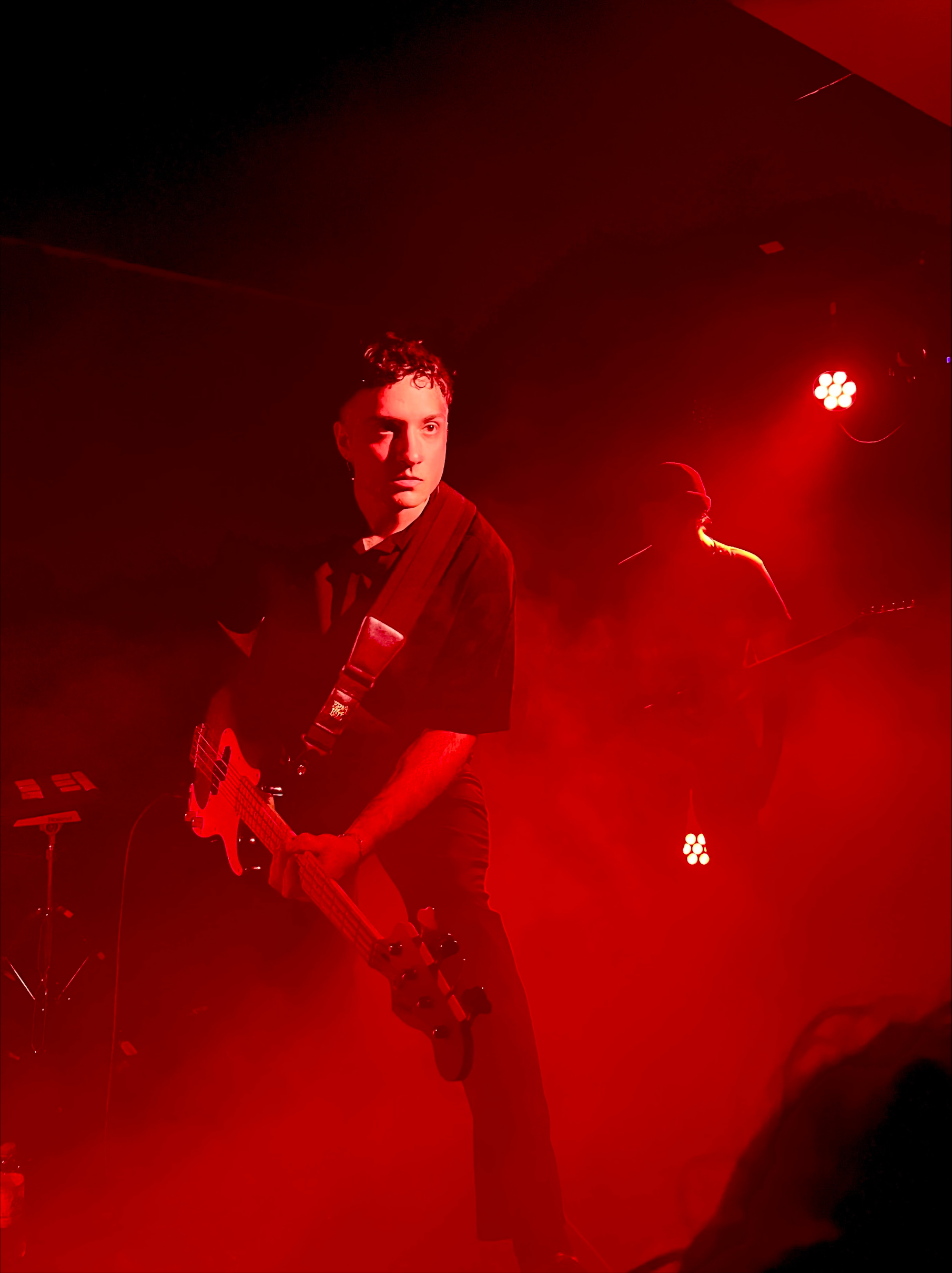
With blistering, brutal renditions of “Judge” and “All Hail”, the band reaches the 45 minute mark. At this point, Moe is drenched in fluids, his vocals wrath drained growls. Especially “All Hail” is absolutely exceptional, with the bassist lifting his hands to the sky for the intro, leading the audience on to clap along. It’s an immense, crushing performance, which seems to transform the club, rip it out of space and time. As the song ends, Moe shuffles over to the keyboard, starts the arabic spoken word introduction to Attempted Martyr, lifts the instrument to his shoulder, blows the audience a kiss… and leaves. Unmoving, the bassist stares down the crowd, then shakes hands in the front row, and leaves with the rest of the band who emerge from the shadows. And that’s it. After exactly 45 minutes of surreal, crushing, theatric excellence, the mysterious group has vanished as suddenly as they appeared. There’s no break of character, no introduction, no encore, no lifting of the veil. Just as they conquered the room totally, they remove themselves.
If you talk to Arabic people, they will always point out how each nation has their own identity, humour, theatrics, spirit. If you mention the Lebanese, many fellow Arabs will say that they are immensely playful and that they, well, like to mess with people a little. Everything is a rule-based performance of emancipation and independence, one Bahraini friend once told me. This spirit is absolutely translated in Prostitute’s on stage appearance. The traditional lead characters of the music – the two guitarists – disappear in darkness. Their supposed band leader Moe seems lost, exhausted, almost confused throughout, his gaze far gone as silence marks his presence. And then the tall bassist, whose stoic, tense stare measures the crowd below. There’s links to the great goth bands of the early 80s in how fully formed and aesthetically demanding the band appears, how important this performance and aura is to express a cultural statement.
But in this tense silence, the strangely lost Moe and shadowed stringmen, there’s also a question to the crowd. To what degree do we perceive those who look or seem a little different to us as enemies? In all their surreal theatrics, Prostitute never seem hostile or aggressive. Rather, they seem lost in the ecstasy of music. Another observer might let loose on their internalised racism, or read the band as consciously militaristic. Ironic, considering that the band is American after all. Still, as I stumble into the night, my thoughts drift back to B 018. Prostitute are an inherently political band, their album is accompanied by a manifesto and sports the Cedrus libani. As the country is bombed mercilessly, I think of those ghosts in Beirut, who come to dance among the living. As I try to read the shirt I purchased, I quickly realise some of it is gibberish – that second half of the band-name on it is definitely not spelling “-titute”! There it is again: the Lebanese spirit. That evening, what’s real, perceived and implied merges, only to exist as memory. This band will conquer the world!