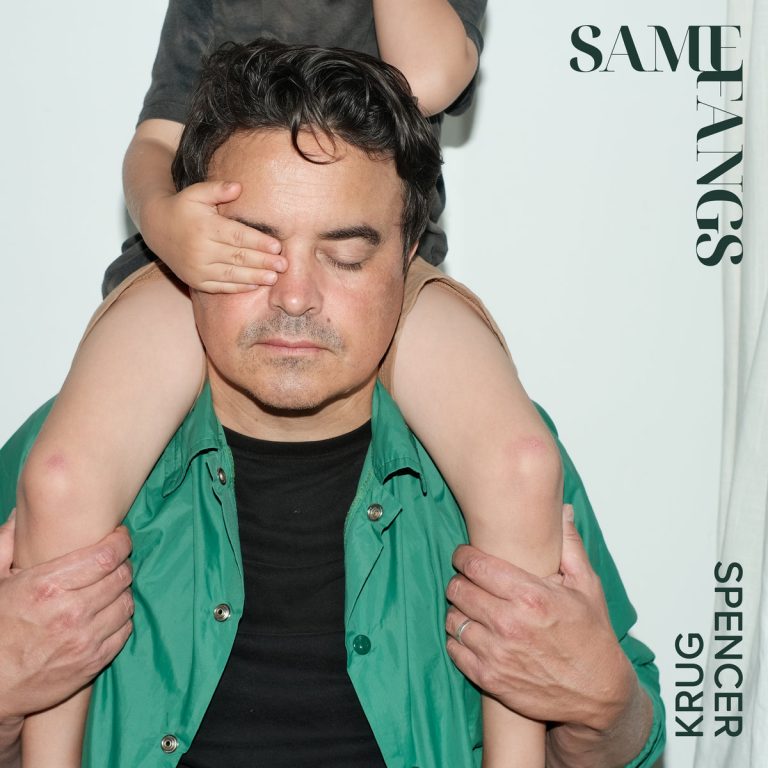

Safe to say, it has been a good year for Spencer Krug’s music, namely his 2005 hit “I’ll Believe In Anything” with Wolf Parade. After appearing in an episode of the TV series Heated Rivalry back in December 2025, global streams of the song rose to over 2,650% according to Spotify and the track has now found an entirely new audience two decades after its release. Krug followed the viral popularity of the track with a re-recorded piano version of the song released digitally and on 7” back in February. Following on neatly from this surge is Krug’s latest album, Same Fangs, which will no doubt fall onto the ears of both old and new listeners.
It’s fortunate then for these new fans (but you know, also for all listeners) that they are arriving to some of Krug’s most interesting work. Same Fangs continues to carefully nudge at the edges of experimentation he has been introducing for the past few years while also showcasing his deft and mordant skills as a songwriter. This is his most self-referential and reflective album and it adds a layer of depth to his music that invites you in to burrow that little deeper. Krug gives you the tools and opens up the mine for excavation.
Introductory track “Get To Live” lets us directly into Krug’s brain as he explains his thought process behind the track’s conception. “A bit overly cinematic,” he remarks on tape after trying out a flurry of piano chords before opting for a different approach. At the other end of the album we have “Listening to Music in Cars 2.5 (All the Tired Horses)” which takes us through the song’s conception, rewriting across the years, and referential treasure chest; references to Sunset Rubdown tracks from days gone will tickle the ears of fans. It’s a song about the song and the making of the song, which reads like an academic and narcissistic slog but even at five minutes long, it’s surprisingly breezy and lighthearted as a repeated piano chord pattern and strings from Maria Grigoryeva help it float on by. Earlier on, during “Timebomb”, Krug details more of the process: “I thought there might be more meaning there to find / Turns out the song’s just what it is / In fact I probably attached too much meaning to the thing the song’s about.”
When Krug isn’t shining the light on his songwriting, he’s shining it on other aspects of his life. Covering the likes of marriage, fatherhood, ending friendships, small town living, and facing the bin fire of the surrounding world, he broaches topics with an outstretched hand. He’s curious even when he’s damning; he’s empathetic even when he’s self-affacing. “I’m fucking freaking out / Because I am middle-aged and thick-necked now,” he laments over groggy synths on “Real Long Headlock” with a warble of panic in his voice. Later on, during “Pinecone King”, he resigns himself away from the spotlight: “With any luck I’ll fade away in the room where the prince was born.”
Lyrically Same Fangs is ripe for taking apart, but Krug isn’t immune to clunkiness, which shows itself worst on sections of “List of Names”. But the earnestness is always there to drive it home, as is his ability to navigate an enticing composition. You see the care on the aforementioned “Get To Live” in wanting to make everything connected. (The 10 songs on the album, like on previous records, originate from tracks uploaded on his Patreon. They aren’t just simply compiled but carefully picked to fit together as neatly as possible.) But sometimes the songs just speak for themselves: “Berserker Mode” is both bobbing and gloomy, light percussion adding to the drive; the regal stride of “Hasn’t It Always” adding a sobering glean to lyrics questioning how life seems to flash by; the conclusive waving into the distance drama of “Souvenirs” (which circles back to both the opening track and also shares a similar cadence with Julia With Blue Jeans On closer “Your Chariot Awaits”).
Like with previous albums, Krug continues to nudge himself out of his comfort zone. The distortion-heavy “Timebomb” is bold and daring even though the textures won’t be overly unfamiliar to his fans. The inclusion of strings across the album (again from Maria Grigoryeva) add both a stateliness and a slant to the songs; they are never just there for show or to simply accentuate the chords but instead are like a force pulling the tracks in different directions. And the additional vocals of Elbow Kiss add an equally welcome new texture; it does bring to mind the days of Camilla Wynne providing vocals on Sunset Rubdown records. With guitarist Jordan Koop joining Krug in the studio for production once again (as well as some additional musical parts), it makes for a merry band of collaborators. Their contributions may be familiar to old fans, but to new ones they will offer fresh evidence that Krug is an artist always working towards the next thing. If you believe in anything, believe that his career is full of peaks, both 20 years ago and now.