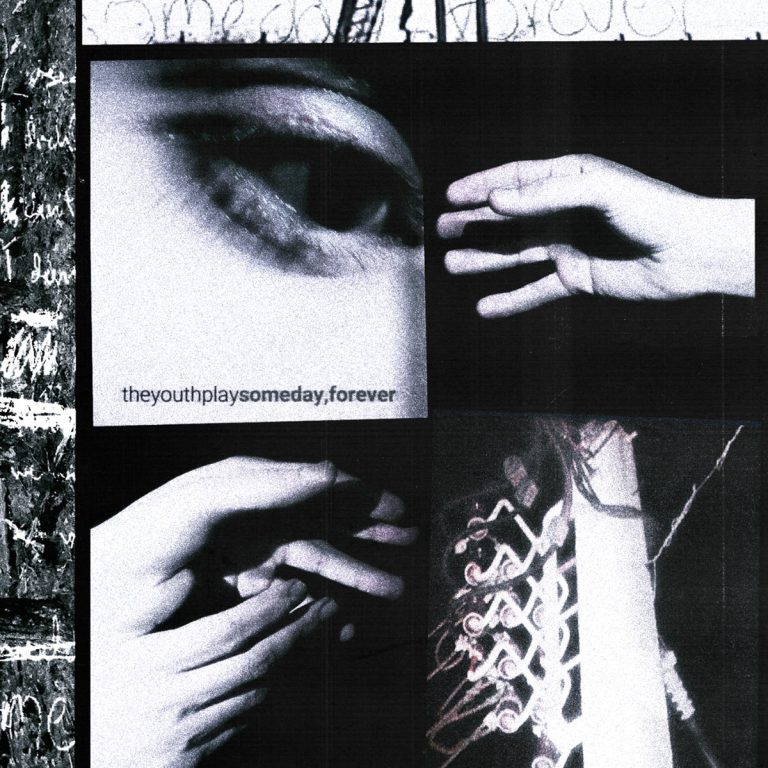

The Youth Play’s debut EP, 2023’s On Fire, showcased an affinity for smoky melodies, driving rhythms, and lavish textures. Diego Bracho’s vocals stood out, as the singer expressed grief, courage, despondence and outrage. That said, a persistent restraint or sense of caution pervaded the three-song sequence, resulting in a set that often felt overly sober or lacking in abandon.
With their new six-song EP, someday, forever, the London-based band shrug off their straitjackets, forging sumptuous romps, sprawls, and flights, all without compromising their well-honed craft and disciplined synergy. In this way, the project brings together the cool and fiery, the structured and spontaneous, spotlighting the band’s expanded range and ability to integrate diverse sounds and approaches.
Opener “Maybe This Was All For Us” is built around crystalline/crunchy guitars that surround Bracho’s grabby melody. On “A Fair Life”, too, distorted guitars vibrate on a moonlit horizon. Bracho slurs verses, then steps warrior-like into charged choruses: the oppressed morphing into the liberated, the downtrodden transformed into the destiny-maker. Both tracks make use of inviting instrumental lines. Swirly and stormy atmospherics evoke ennui; on the other hand, adrenalized eruptions suggest that the search for love, meaning, and the higher self is still a worthwhile endeavor. Let’s not throw all absolutes into the trash bin just yet.
Certainly The Youth Play are heirs to the shoegaze and dreampop torches (Slowdive, Cocteau Twins, etc.), but it’s Joy Division’s influence that’s most evident; the corpse in the room. What’s refreshing is how The Youth Play, like a handful of current postpunk-leaning bands, draw equally from more pop-sublime sources. The Murder Capital’s Blindness, released this year, and Fontaines, D.C.’s Romance, released in 2024, were successful in large part for the way they countered Joy Division’s unshakeable gloom, reinterpreting The Smiths’ complex buoyancy and abiding interest in melody. In similar fashion, someday, forever draws from Western FM/XM as well as, given Bracho’s background, a spectrum of Latin pop.
“If We Just Ever Were” features layered, crunchy, and wailing guitars, as well as a sultry melody, conjuring birth, death, rapture and apocalypse, all stirred into one magical, hooky potion. This is live-forever and already-dead music, an eclectic soundtrack for some indie film about karma, vampires and the nothingness that Buddhists and deconstructionists tell us is at the heart of everything.
“All I want is some communication”, Bracho moans. If Ian Curtis were in charge, none would be forthcoming. If Morrissey were running the show, contact would happen but be anticlimactic. With The Youth Play, connection may or may not occur; if it does, it may or may not be fulfilling. Ambivalence, though, is the state de jour. Cynicism is offset by wry humor. Default pessimism needs an overhaul, to be infused with something a bit greener. It’s a significant pivot, a milestone of sorts for the genre.
On “Straight Line” and the title track, the band slow the pace, studying disillusionment – personal, collective, archetypal – that can’t be denied but can indeed be worn like a loose sarape. Still, the piece exudes a moody intensity, recalling Drop Nineteens if the Boston band turned the anxiety effect up a notch or two. The former track is less opaque, more translucent, undergirded by a throbby bass. On the latter, guitars ring and echo, drums skip along. Bracho’s vocal is dreamy, scraping muddy troughs and soaring in well-lit skies.
On “Last Day on Earth”, guitars unfurl like severed wires stabbing into a rainy night, the flares dissipating, leaving residual flickers on the horizon. The band demonstrate the restraint that defined their debut EP. This time around, however, as the instrumentation and Bracho’s vocals pull inward, forming a cohesive mix, there’s also a centrifugal movement, as the band heaves for deliverance, a sustainable freedom. As with “If We Just Ever Were”, The Youth Play trek a line between transcendence and immanence, fancy and realism. Again, it’s an important repositioning, a revamping of the genre’s unexamined tilt toward fatalism.
The Youth Play’s gravitas is a black sky that’s beginning to clear, that amber glow just visible; their hooks have a sugary foretaste but avoid that saccharine after-hit; their lushness is slightly barbed, referencing the inevitability of discontent. They’re modern-day romantics, which is to say: they believe in epic love, epic discovery, epic knowing, even if they’re skeptical about ever experiencing them. This compelling dissonance is at the heart of someday, forever. It may well point to a growing zeitgeist. We’ve taken nihilism as far as it can go. Perhaps a posthumanistic idealism is in the making.