
In Abbas Kiarostami’s The Wind Will Carry Us, a filmmaker visits a small village to document the funeral rituals of an elderly woman who is about to die. While waiting for her death, he witnesses the intrusive nature his filmmaking has upon their society and begins to question whether he will be able to accurately depict these deeply personal and cultural sacraments he observes during his stay. These questions of accuracy and observation are deeply analyzed throughout Kiarostami’s filmography but are more unconventionally examined throughout Slovenian trio Širom’s discography.
“We don’t want to play something that sounds like it already exists,” admits Samo Kutin, who is one third of the experimental folk group. This is quite a strange thing to say for a folk musician as (generally speaking) folk music tends to embody traditions, cultures, and landscapes that have indeed existed at one point in time. These kinds of statements, as well as their previous four LPs, have led individuals to describe Širom’s music as “imaginary folk”. What this descriptor exactly means can be left up to the listener’s discretion, but what is certain is that Širom have proven time and again that they are masters in creating musical arrangements that somehow sound modern yet ancient, haphazard yet structured, explicit yet implicit.
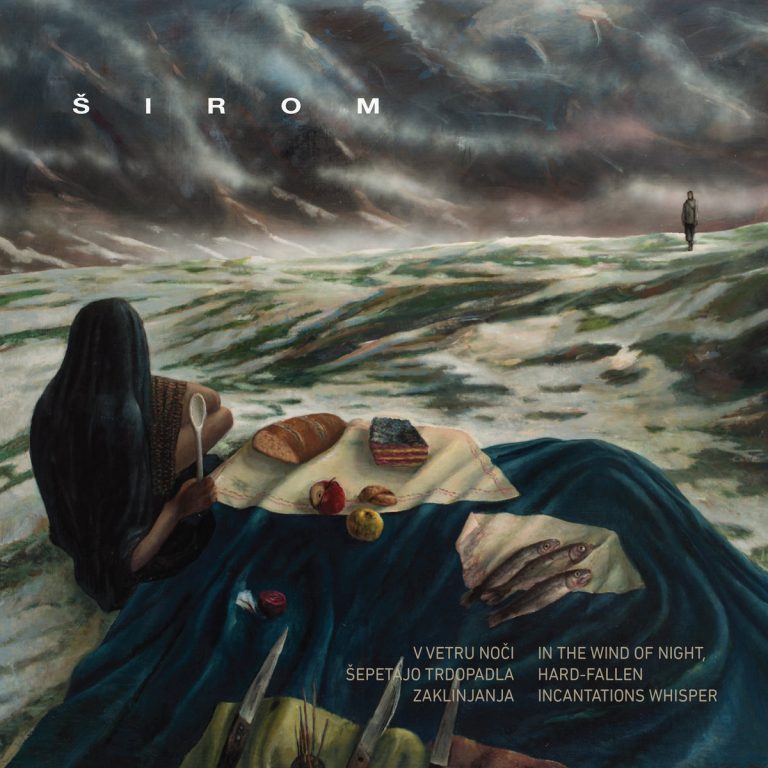
With their fifth LP, In the Wind of Night, Hard-Fallen Incantations Whisper, Širom have again successfully conformed to their imaginary folk maxim. On initially hearing any of its sprawling tracks, you might hear similarities to other avant-guard acts such as The Necks or Oren Ambarchi or other fringe folk artists like Moundabout or Smote. But as soon as the 30-plus instruments and “various objects” used on this record begin to emerge, it is futile to try and dissect what we are hearing. It is here that you might begin to understand why the phrase “imaginary folk” might be useful.
Additionally, Širom are often maximalist in their ideology but minimalist in their approach. Take the incredible “Tiny Dewdrop Explosions Crackling Delightfully” for example. The first half is led by Iztok Koren’s banjo as it carefully traverses a magical, delicate-sounding landscape before the second half blooms into a chaotic percussion-laden upheaval. While listening it sounds meticulously arranged, but in retrospect it is epic in scale. Even the titles invoke this methodology (e.g. exploding dewdrops, the dawn between fingers, whispers in the night, etc).
Most tracks on In the Wind of Night, and on their previous records, stretch well over the 10-minute mark yet none of them feel drawn-out or excessive. But more than any of Širom’s previous records, In the Wind of Night features three shorter tracks (all below six minutes). The best of this bunch is closer “For you, This Eve, the Wolves Will Be Enchantingly Forsaken”, one of the more hopeful tracks on the record that allows for a more immediate reward for those who might be impatient.
Still, for those who want a more complete journey, it is the 10-plus minute tracks that are the most rewarding. Opener “Between the Fingers the Drops of Tomorrow’s Dawn” foreshadows what is to come: rites of passage, intense spells of grief and acceptance, and stretches of mystical visions that seem so familiar yet so strange. It is during these epic tracks where the sounds from instruments you have never heard all combine to create something that feels perennial, enormous, and truly unique.
Much like the filmmaker does in The Wind Will Carry Us, Širom have long ago accepted their ontological constraints. They realize it must be nearly impossible to accurately depict historic notions of folk traditions and have instead successfully attempted to create their own imaginary worlds. Like the femur bone that drifts down the river at the end of Kiarostami’s masterpiece, Širom have embraced their own mortality and are carried by the night wind, floating ever so softly into the imaginations of listeners worldwide.