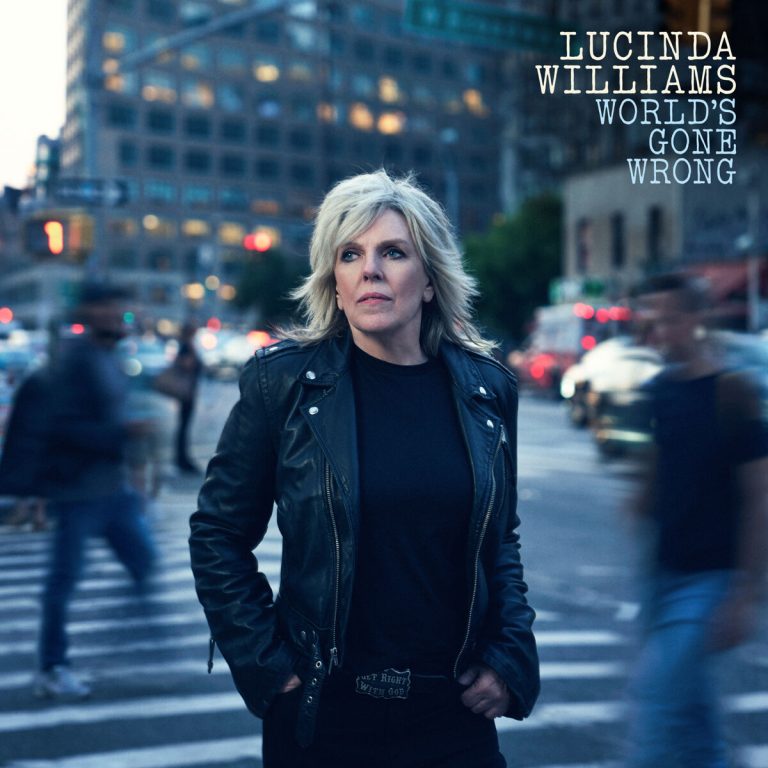

With her 16th album, Lucinda Williams continues to interweave the folk, rock, blues, and country templates she’s mined throughout her career. With World’s Gone Wrong, however, her lyrics are as direct as ever, bare-boned, depicting a world plagued by greed and power-hunger, what writer Paul Levy would describe as a “contagious psycho-spiritual disease of the soul”. Her vocals, tremulous and seasoned, exude the grief, wisdom, and gratitude for beauty she has so eloquently expressed since the release of her debut in 1979.
The title song is built around crunchy guitars and Rob Burger’s soaring Hammond B3. The track’s vision of financial and cultural decline will ring true to anyone who has recently driven through rural towns in the US Boarded-up storefronts, dilapidated houses, empty factories. Though Williams’ portrait is grim, her chorus is glorious, demonstrating how the all-mighty hook, regardless of content, can be experienced as transportive, even redemptive.
With “Something’s Gotta Give”, Williams dives into a bluesy/dark-country groove that would get a bow from, among others, The Drive-By Truckers, Whitey Morgan, and Sarah Shook, all of whom would inevitably cite Williams as an influence. Notable are Britney Spencer’s guest vocals and Marc Ford and Doug Pettibone’s fiery guitar interplays. “Evil has come … / You can feel it everywhere”, Williams sings, addressing how longstanding infrastructures – social, legal, ethical – seem to be eroding on a daily basis.
Arriving during a pivotal period, World’s Gone Wrong occasionally brings to mind Bruce Springsteen’s Wrecking Ball, which was released in 2012 in the wake of the 2008 recession. That said, while Springsteen’s project spotlighted the shadow symptoms of American capitalism – unbridled greed, inequities – Williams’ set is more fundamentally damning in tone, pointing less to specific circumstances and more to an archetypal horror connected to our evolution, our essential nature or instinctive blueprint. Wrecking Ball implicitly acknowledges the pendulum effect, World’s Gone Wrong … not so much. It’s as if Williams is thinking, we might not be able to swing back this time.
“Low Life”, penned by Williams and Big Thief’s Adrianne Lenker and Buck Meek, portrays a bar from the yesteryears (highballs are $1.25!, so we’re probably talking late-1960s or early-70s). The place sports, of course, a stellar jukebox and a rakishly hospitable clientele. While the abovementioned tracks speak to fragmentation (of self, society, world), “Low Life” points to the merits of community, wherever you can find it. Williams’ voice is raggedly resplendent and gospel-tinged as she declares, “I guess this is the low life / but it’s where I wanna be”.
The cover of Bob Marley’s “So Much Trouble in the World” similarly points to the pervasiveness of hardship and suffering. Joined by Mavis Staples, Williams and band potently reconcile a reggae lope and the more stoic tone of a country-tinged ballad. The version is memorable, exhibiting respect for the original’s melody and flow while also standing as a distinct and modish interpretation, particularly vocally. “Sing Unburied Sing”, meanwhile, inspired byJesmyn Ward’s novel of the same name, is roadhouse-ready, carried by amped guitars that recall Neil Young circa Psychedelic Pill and Transformer-era Billy Gibbons. Williams turns the ghostly and cryptic title into a mystical chant. Maureen Murphy and Siobhan Kennedy’s supporting vocals conjure both the Sunday service and Saturday night at the crossroads.
“Black Tears” is a 12-bar swampy blues take. “The dream is deferred / and the churches are burning”, Williams sings, referencing Langston Hughes’ famous poem and the 1963 bombing of the 16th Street Baptist Church in Birmingham, Alabama. Williams’ languorous vocal, the steamy guitars, and an unflagging stomp-beat make for a seductive, otherworldly sprawl occasionally reminiscent of Bob Dylan’s Daniel Lanois-produced Time Out of Mind.
Williams ends World’s Gone Wrong on an aptly encouraging note: “We’ve Come Too Far to Turn Around”. The piece unfurls like a timeless hymn, the kind of singalong that could’ve been performed by The Carter Family on a porch in Tennessee, by Mahlia Jackson during the 1963 March on Washington, or by Beyoncé amidst an elaborate choreography in the Crypto.com Arena. Norah Jones’ back-up vocals and piano give the song an intimate grounding, while Williams is astoundingly credible. It’s as if she’s been waiting all her life to sing this piece.
World’s Gone Wrong, co-produced by Tom Overby and Ray Kennedy, is at once minimal and atmospherically sublime. Via unadorned lyrics, Williams laments the frightening changes we face in the Western world, particularly the US, while also lauding community and the cathartic attributes of art. In this way, Williams examines the “dark age” we’re currently traversing but refuses to surrender to despair. World’s Gone Wrong extends Williams’ fertile run, infused with the aesthetic adventurousness and undiluted honesty that have characterized her work for over four decades.