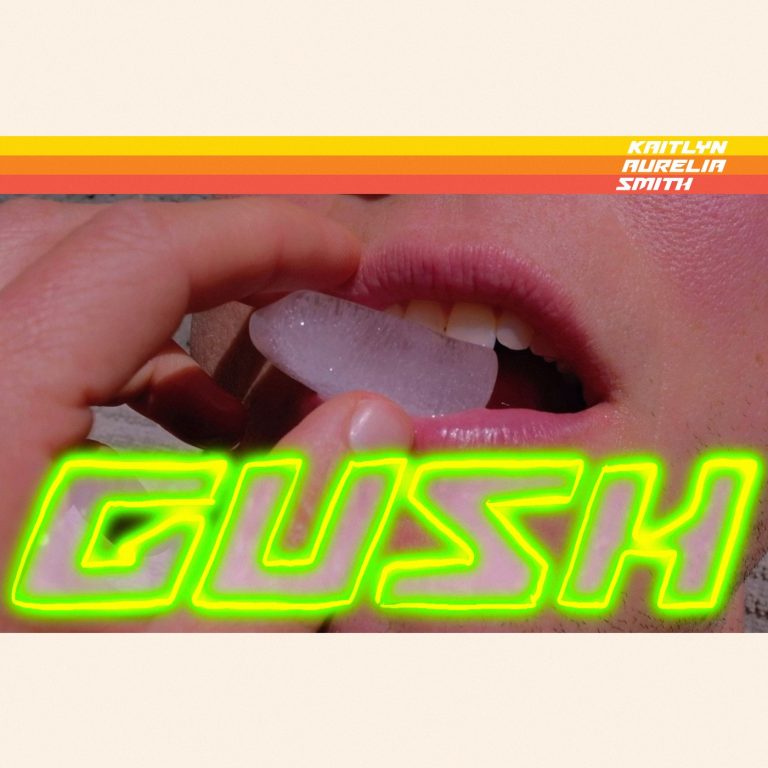

There’s no overappreciating an artist keen on reinvention. While I doubt she clambors into the studio thinking, “Now, how will I reinvent myself today?”, Kaitlyn Aurelia Smith has proven a restless creative, and with her latest album, Gush, she’s wandered off in arguably the most extreme direction from her origins to date.
Indeed, the music of 2016’s Ears – the album where many, including myself, began to take notice – was expansive, even maximalist, and, more than anything, fantastical, drawing inspiration from Miyazaki’s Nausicaä of the Valley of the Wind and more. Much like that film, alongside its otherworldly tendencies, the album was deeply naturalistic. It was both concerned with and – if one can say so – at one with the environment it envisioned.
Gush emanates from an entirely opposite pole. The music here feels beamed in from an alien entity. It’s immediately futuristic, sounding much more akin to something worn out souls in the world of Cyberpunk 2077 would wearily listen to in some back alley dive rather than something Ghibli characters might groove to. It also finds Smith tearing away from her more expansive ambitions, attempting to achieve the same level of presence, ambiance, and world-building via sparse sounds.
In fact, much of the music that lies within Gush is a tad paradoxical: at its core, the album is perhaps Smith’s most emotive to date, a mixture of pure sensuality and defiantly unguarded searching for connection. The songs seem rooted in newfound, if tentative, bliss: that phase in which something new might just prove everlasting, yet could just as easily collapse and drift fleetingly away the morning after.
Lyrical asides throughout capture that mixture of elation and nervousness. Opener “Drip” finds her “looking away, with my eyes on you”: romantic and anxiously possessive at once. The title track, meanwhile, is happier to slide into that bliss: “I love the way you see things / I like the way you think about it”, making for one of the most unabashedly romantic songs here.
So where’s that paradox, then?
Within, the music, naturally. Despite the warm tones present emotionally and lyrically throughout, the sound itself cleverly pulls in the opposite direction. It is cold, science fiction steel, sparse and to the point, clicks and wavering beeps. It’s prickly; music that nearly seems to bristle to the touch, the distinct opposite of the unguarded, largely lovely sentiment of Smith’s words and feelings on display.
Therein lies Gush’s greatest strength. An album pulling in opposite directions musically and thematically could easily have proven misguided, trying and obtuse, yet under Smith’s guidance, it proves an intriguing, tantalizing, and surprising natural fit. The sounds of a futuristic, alienated city encroach all around you, bringing all the feelings of loneliness and uncertainty one would imagine, all while her hopeful words and sentiments anchor you through the fray. It’s music for our present moment, in that sense: we may be faced with a reality that feels increasingly inhuman, but our lives linger on, as if our mere existence, an act of choosing happiness, is one of defiance. Gush acknowledges the devastation and chooses to keep on feeling, anyway. It feels it all. The horrors persist, yet so do we.