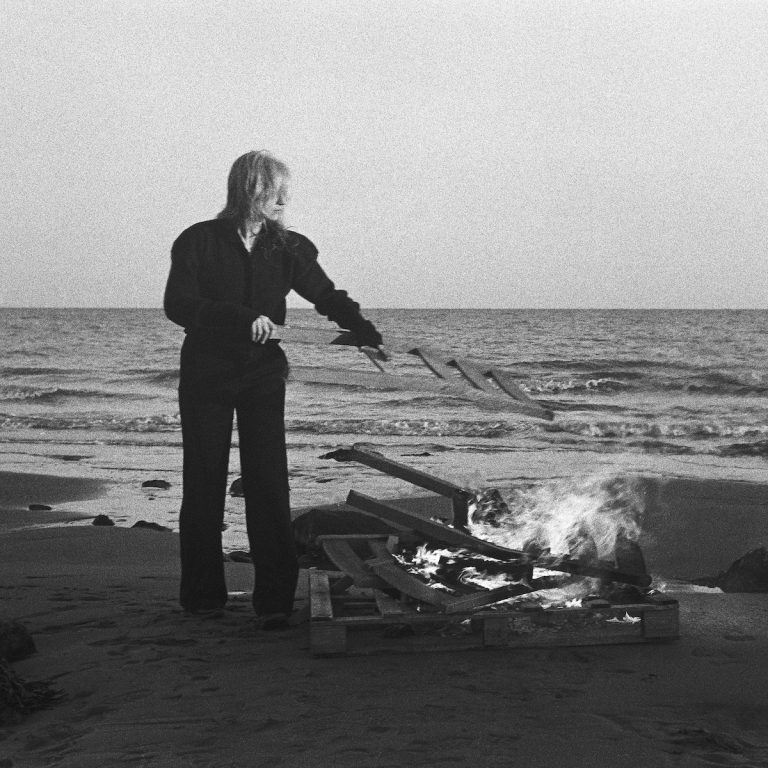

With her latest album, Burning Song, Kali Malone returns to the organ – not just any organ, the Bach Organ at the Thomaskirche in Leipzig, Germany. Again joined by cellist Lucy Railton and guitarist Stephen O’Malley, Malone largely revisits the MO employed on earlier work, including her opus, 2023’s Does Spring Hide Its Joy. The result, as expected, is a work of quintessential drone and exemplary minimalism.
There’s a consistent starkness, even asceticism, that pervades much of Malone’s music. Burning Song’s opener “Grieving Figure” launches with sustained notes that warble subtly. There are minor increases and decreases in volume. Railton’s cello, O’Malley’s bowed guitar, and Malone’s organ part wrap around each other. The parts unite, becoming almost indistinguishable, then separate for mere seconds, before reconverging. There’s precision here, a Zennish stoicism, a recognition that life, while exquisite in its intricacy, is devastatingly impersonal, irrevocably unsympathetic to human preferences.
“Map the Path” similarly captures the musicians as they merge and individuate. The old-school lava lamp comes to mind. One also thinks of a microscope, how with each twist of the knob, you drop deeper into the structure of the perceived object, until, at some point, you observe only space; i.e., everything is ultimately and fundamentally empty. It’s hard to imagine that Malone isn’t a dedicated meditator.
“Crawling Ashore”, like other tracks in Malone’s oeuvre, points to cosmic time. A listener is no longer in the world of everyday activities, quotidian plans, and egoic agendas. Time does not fly. In fact, it almost ceases to exist. We’re transported to the land of the eon, the universal timeline (13.8 billion years). “Sounding a Void”, with its slightly heavier and darker tones, similarly points to the drama of eternality: the Big Bang and everything that ensued from it (the entirety of existence).
“My Eve My Dawn” ends the project with the set’s lengthiest exploration, the musicians operating with breathtaking patience, each note intentionally expressed and fully embodied. If there’s order in the universe, a cosmic plan, then Burning Song points to it: how each cause produces an effect, resulting in the proliferative processes known as evolution, karma, and naturality.
Burning Song fits well into Malone’s oeuvre and reminds us that she, like William Basinski, is as much an incidental philosopher as a musician, an artist whose work runs counter to the freneticism and distractibility of 21st-Century life. She invites us to go inward, to experience silence and stillness – the nothingness from which everything emanates and to which it returns.