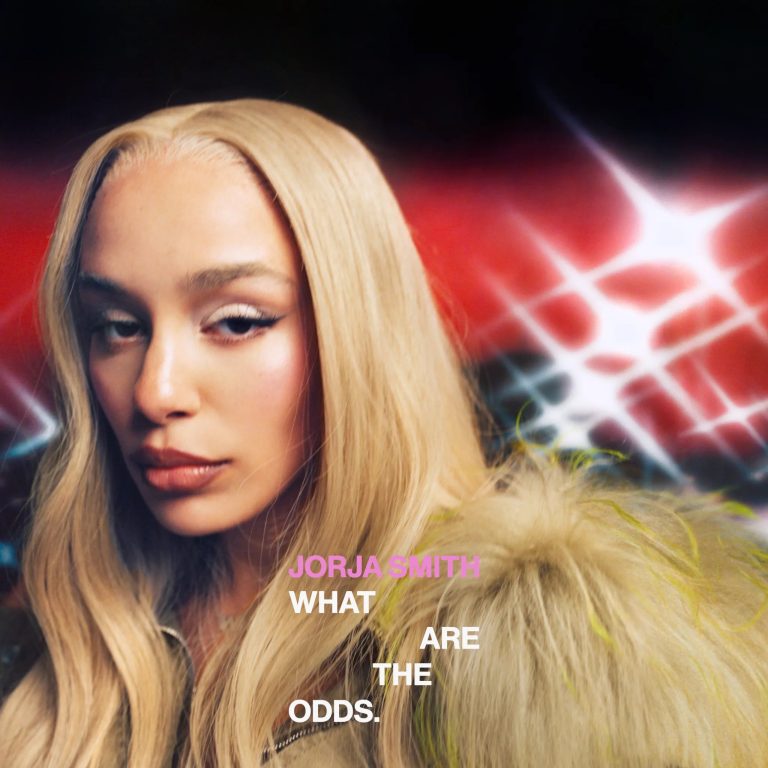

Ten years ago Jorja Smith uploaded a song about police lights and became famous before she had finished being a teenager. “Blue Lights” arrived in 2016, she was 19, and the decade since has produced a BRIT Award, two albums and a persistent complaint from certain critics that she is a singer of extraordinary instrument who does not always seem sure what to do with it. What Are the Odds is her answer, and the interesting thing about it is not that she has made a dance record; it is how quickly she made it, and what she brought along.
The origin is a single track. P2J, the London producer born Richard Isong who has worked with Beyoncé, Stormzy and Wizkid, made “Little Things” with her for 2023’s Falling or Flying, and it turned out to be the best thing on that album. The two of them spent the next two years talking about doing a dance project properly. They got into his East London studio in September 2025. She delivered the finished record in April. By her own account it is the shortest time she has ever spent on an album, and at one point she and P2J wrote eight songs across two days.
You can hear that. The record moves like something made by people who did not stop to second-guess. P2J produced all 12 tracks alone, which gives the album a consistency her earlier work sometimes lacked, and he takes her through most of the British dancefloor at once: grime on the title track, garage on “This City”, jungle on “The Way It Was”, drum and bass under the saxophone on “I Lied, You Lied”, deep house on “Make It Your Home”, Afrobeats on “Alive”. Smith turns out to be a natural club vocalist. She does not push against the tempo. She sits behind it, unhurried, and lets the drums do the work, which is a more difficult thing than singing over the top.
The subject matter is where it gets genuinely interesting, because none of it is party writing. “For Life” opens the album with a song about loving a friend through addiction. The title track is about growing up in public, which is the one experience Smith has that almost none of her listeners share. “Pretend” is about betrayal. “Young Heart”, the longest song here at four minutes, is a note addressed to her younger self. She has made a record about the cost of a decade of visible life and set it to 130 beats per minute, and the friction between those two things is the album’s best idea.
“This City” is the sharpest sequencing decision. Devlin, the Dagenham grime lyricist, went back and re-recorded his verse from “London City” for it, which means a piece of writing from an earlier era of British music arrives here freshly sung rather than sampled. It is a small thing and it matters, because the whole album is arguing that these sounds are current rather than archival. “Dancing” is the most immediately effective song, built on a hip-house beat and a hook that does very little and does it perfectly. “Alive”, with Wizkid, is the obvious single and behaves like one.
The reservation is structural, and it is real. What Are the Odds runs 37 minutes across 12 tracks, and eight of those tracks are under three minutes. Club music works through duration. It needs room to repeat itself, to build, to wear you down until the release means something. These songs are pop lengths, in and out, and the result is a dance album that rarely gets to the part of the night it keeps describing. Several tracks establish an excellent groove and then simply stop. “Make It Your Home” and “When It Gets Like That” both feel like they end at the point another producer would have started developing them.
The single-producer decision cuts both ways too. P2J’s touch is tasteful throughout, and tasteful is not always what a record like this needs. There is very little roughness here, very little that sounds like it might go wrong, and the album’s smoothest stretches pass without leaving a mark.
None of which stops it being the most confident thing she has released. Smith has said plainly that she knows some listeners would rather have her at a piano but that this is where she is now. Made and released independently through FAMM, it is a record by someone who has stopped waiting to be told what her voice is for. It could have been longer. It could have been messier. But after 10 years of being told what she ought to be, she has made the album she wanted, and she sounds like she enjoyed it.