
“His best since Scary Monsters” is an essay series by John Wohlmacher discussing David Bowie’s albums after 1980 – taking its name from the recurring conclusion that any newly released Bowie record was “his best since Scary Monsters”. Exploring the individual albums, the series hopes to provide newfound insight of David Bowie’s most misunderstood phases.
By all accounts, David Bowie had likely the most incredible first decade of any artist in music history. Kicking off with the release of his second self titled record – and “actual” debut of the entity David Bowie as we know him today – in November 1969, Bowie released 12 albums in just 10 years, covering a wide range of genres and refashioning himself into a kaleidoscopic pop artist.
He invented a lasting rock-archetype with the Ziggy Stardust figure in 1972, and starred in the brilliant The Man Who Fell to Earth as actual alien Thomas Jerome Newton in 1976. He introduced queerness and camp to a global audience that just slowly started to question the prevailing status quo of heteronormative identity, and then re-invented himself as avant-garde dandy when he moved to Berlin with Iggy Pop. And speaking of, he also shepherded the comeback records of Iggy and Lou Reed, interviewed William S. Burroughs, acted besides Marlene Dietrich (just on screen and not in person, as she filmed her parts in Paris, while he shot in Berlin) in the flop Just a Gigolo, befriended and recorded with John Lennon and had his shoes complimented by Andy Warhol when the two briefly ran into each other. Bowie had become such an icon that he could practically collect former idols of his like other people do with autographs. And he became a father, on top.
But where there’s light, there’s also shadow. Bowie had lost himself to an all-consuming cocaine addiction by 1976. Cannibalised by white powder and occult-fuelled paranoia, Bowie got too close to one of his alter-egos, the fascist ‘Thin White Duke’. As Bowie recalled in a 2002 interview for German Musikexpress, his fruitful Berlin stint was fuelled by his realisation that he, in the wake of euphorically overdoing drugs to celebrate the purchase of an “aura camera”, had been driving his car for two days straight down the highway.
His many collaborators of the 70s would go on to describe Bowie as “utilitarian”, and felt abandoned by him as soon as his attention gravitated to a new interest. Personal fallouts ultimately led to larger dissolutions, such as with manager Tony Defries, who co-owned the MainMan label with the musician. Notably, Bowie’s 80s started with the divorce of his self-declared closest collaborator, wife Angie Bowie in February of that year. Considering the mud thrown by Angie at camp Bowie, this could be counted as a plus, tho.
In 10 years, Bowie experienced what would be another artist’s entire lifetime – and his choices entering a new decade reflected this. Coming off the divorce, Bowie went into the sessions for his 13th album. Scary Monsters would go on to be his big retrospective work, deeply self-referential in using his own stature and catalogue as a foil. Bowie personified the Pierrot on the album’s cover, calling back to his foundational act “The Mask”, hinting at the potential of “David Bowie” as a character actor, a clown, a reflector of society for the entertainment thereof, veiling the potential of criticism within the comedy act (something Bowie hints at throughout – “Fashion”, “Teenage Wildlife” and “Ashes to Ashes” are as much about the character “Bowie”, as they are about the man behind the name pondering his societal and political impact). In other words: the character “Bowie” was outgrowing himself.
Soon after, the man behind the character found himself in New York, inhabiting the skin of yet another foil of his favourite archetype of the outsider alien dragged into human society: Joseph Merrick. The Elephant Man was directed by Jack Hofsiss, and allowed Bowie to make good use of his experience as a mime, contorting his body and voice instead of choosing extensive prosthetics.
The show had toured Denver and played Chicago by the time that Angus MacKinnon interviewed Bowie in August 1980 for the NME. Here, he found Bowie elated, introspective and razor sharp – which MacKinnon read as somewhat controlling and artificial PR, even calling Bowie “one of the more profoundly amoral people I’ve ever met”. Yikes! When MacKinnon confronted him with that, Bowie revealed: “I have an awful lot of reservations about what I’ve done inasmuch as I don’t feel much of it has any import at all. And then I have days when of course it all feels very important to me, that I’ve contributed an awful lot. But I’m not awfully happy with what I’ve done in the past actually.” And positive achievements? “The idea that one doesn’t have to exist purely on one defined set of ethics and values, that you can investigate other areas and other avenues of perception and try and apply them to everyday life.“
As The Elephant Man trudged on to New York, there was one peak Bowie had still not achieved: conquering America fully! Young Americans – the album meant to connect Bowie with a mainstream audience – only reached #9 in the US billboard charts. His glam rock and more experimental albums were too weird for the American mainstream, and his bisexuality too much for the puritanical media machine. The furthest he got was his performance on Saturday Night Live, featuring Klaus Nomi and Joey Arias, staging a brilliantly strange moment for millions. But the coveted top spot alluded him.
It’s tough to tell where Bowie wanted to go as he zig-zagged the States and winter 1980 rolled in. It’s possible he already was considering a response for potential future play offers, as most of the interviews of that year see him focus on his acting (spoiler: The Elephant Man wouldn’t spawn any future stage assignments). Potentially, he was pondering where to go from Scary Monsters, the eccentric art-pop album he chose not to tour that year, or maybe he was considering taking another step sideways and focus on painting, which he did a lot while in Berlin.
But then, something grisly happened. John Lennon was killed.
Bowie was allegedly performing The Elephant Man in the Booth Theatre, about five kilometres from the Dakota, where his friend died. Lennon’s death, like that of all great people, looks hazier and hazier the closer you look, with multiple details contradicting each other. Alternating reports later claimed that Lennon’s murderer saw the play, that he planned to attack Bowie if his plan failed, that he had gotten a front-row ticket for the following day, that the NYPD found Bowie’s name as next up on the killer’s list. Most of this seems untrue – the murderer, by reliable accounts, mostly seemed confused by New York’s urban cityscape and was unlikely to have attended the play. On the night of the show, the Booth was closed and, according to May Pang (Lennon’s ex who, at that point, was linked to Visconti), Bowie had been out on a date. And while Bowie himself told the December 9 story in 99, the multiple statements on the case that came out of the NYPD (was Lennon speaking to the two late arrival detectives as he was transported to the ambulance, or found already deceased by the three cops arriving at the scene?) are ultimately contradictory, characterising the NY police force as a rather unreliable party in this story.
What is definitive is that Bowie, somehow, made it to Pang’s apartment later that evening, where he screamed “What the fuck is going on in this world!” over and watched news coverage until the sun came up. The next day, December 9, saw Bowie retake the stage, with three front row seats left empty. He would go on to say: “I can’t tell you how difficult that was to go on. I almost didn’t make it through the performance.”
Something shifted. Yoko Ono later noted that in the time that followed, Bowie would step in and take care of Sean Lennon. The following years had Bowie only release the occasional single, often collaborations (“Under Pressure”, “Cat People”, “Little Drummer Boy”), and the Baal EP. A grand artistic statement didn’t happen, all the while Bowie found his new calling in front of movie cameras: Baal, Merry Christmas, Mr. Lawrence, The Hunger – all cyphers of Bowie himself, potentially creating a kaleidoscope of how he assessed himself in the time after Lennon’s death: the mad singer, the morally righteous rebel, the life weary and rotting vampire. In all three stories, his character dies.
Meanwhile, the 80s raged on. The top best selling albums of 1982 were Thriller, Phil Collins’ Hello, I Must Be Going and Toto’s IV. Oh, also Culture Club and Lionel Richie. In that company, runner-ups Asia, Prince and Fleetwood Mac almost seem like artsy outsiders. Yes, even though the New Wave bands that were influenced by Scary Monsters and Bowie in general were massively successful, POP was now written with all caps and dominated the airwaves.
Bowie took note: for the first time, he had to live up to other people’s standards and invent a version of himself that would be able to compete with a major icon like Michael Jackson and sell as much as Phil Collins. The Bowie of the 70s wasn’t a pariah, but he enjoyed the company of those that society regarded as such – the Bowie of the 80s would have to re-fracture himself to, somehow, walk among the plastic pop-stars (whose sound and stature he predicted with Young Americans) that oozed all over MTV. The outcome would be his most bizarre character yet.
Merging the New Wave “CEO” look that was pioneered by the Talking Heads and Heaven 17, and the well coiffed 50s style of crooners and early Rockers, Bowie devised a corrosive, quasi-corporate pop star. He dyed his hair melon yellow and gelled it up into a feathery wedge, wore suspenders and belts at the same time, slung an open tie around his neck and draped himself in expensive, pastel coloured designer suits. The public demeanour was all rehearsed. A saccharine photo-negative Elvis or Little Richard. A sober, neoliberal sibling of the Thin White Duke – a parody of success!
By late 1982, Bowie had already booked studio time for December, but was somewhat lost. His band was, by all means, dissolved. Carlos Alomar was the last to go, insulted after Bowie’s camp refused his (by then customary) request for a raise. He also split with RCA, his long-term label. So Bowie had a character and vast ambitions, but no sound or vision – until chance called.
In autumn, he found himself in the VIP section of New York’s club The Continental, where he ran into Nile Rodgers, blockbuster producer and the brains of disco mainstays Chic. There’s varying stories how the two collided, the most iconic of which has Rodgers dodging the vomit of a wasted Billy Idol (according to Rodgers’ autobiography Le Freak, he spotted Bowie when, prior to the vomit, Idol loudly shouted “Fuckin’ ‘ell, that’s David Booooowiiiieeeee!”) and escaping to a lone Bowie, who was sober and drinking orange juice at a corner table. While the other versions of this story aren’t quite as colourful, they all result in the same outcome: Bowie and Rodgers got along well, trading stories and exchanging notes on favourite albums. The call came soon after: Rodgers was in and after a decade together, Visconti was out! The split came suddenly and must have hurt – Visconti wouldn’t produce Bowie for the next 20 years.
There’s decisive irony in the choice: it was Visconti who produced 1969’s Space Oddity and the titular decisive hit, while Rodgers, by 82, was coming off a few notable flops, such as Debbie Harry’s polite Koo Koo and Material’s oddly brutalist One Down. Rodgers wanted avant-garde credit, in his own words a Scary Monsters 2, while Bowie had spent the year listening to Motown and Soul albums: Aretha Franklin, Marvin Gaye, Sam Cooke. Simple, soulful music that evaded the trappings of the elaborate Young Americans and Station to Station.
Rodgers was, for obvious reasons, disappointed. The sentiment just continued once he arrived in wintery Montreux, where Bowie presented him with a melancholic folk ballad, played on acoustic guitar, which he considered a “hit”. Crossing the melody of “Quicksand” with the sensibilities of “Fame”, the skeleton of the song is a haunting lament – more “Wild is the Wind” than “Golden Years”. Bewildered, Rodgers countered how Bowie could write a song called “Let’s Dance” that you couldn’t dance to? A black artist, he later explained, wouldn’t have such an eccentric privilege – the song would have to be danceable: “It’s not because there isn’t interesting intellectual subject matter for black artists to delve into, it’s the fact that you won’t get played!”
While Rodgers got to work, composing a backing that was fit for a hit, Bowie reportedly bombarded him with bits and pieces of inspiration: photos, album covers, songs, all dating back to the 50s and 60s – a living mood board of intent. Rodgers, meanwhile, assembled a few local musicians that were available – among them, a young Turkish multi-instrumentalist from a jazz background by the name of Erdal Kızılçay, living in Neuchâtel.
Kızılçay would go on to become a vital part of Bowie’s inner circle much later – but in the winter of 82, he butted heads with Rodgers over the bass line for “Let’s Dance”. Kızılçay played something akin to Jaco Pastorius, which his collaborator rebuked as too showy.
When provisional work was finished, Bowie and Rodgers relocated to New York’s Power Station studio, leaving the initial musicians behind and hiring a solid group of session players. Kızılçay’s final, simplified bass line went on to be played by Carmine Rojas and is still one of the most recognisable elements of any 80s hit. Cleverly, Bowie and Rodgers fit it into a patchwork of historical pop references. Opening with a nod to John Lennon, Bowie recreated the intro of “Twist and Shout”, while Rodgers added horns to the verse that harken back to Henry Mancini’s work for the film “Peter Gunn”. As the song grew, so did the band, with Bowie enlisting Stevie Ray Vaughan to lead guitar, much to Rodgers’ disapproval – his solo here is, self-admittedly, lifted from blues musician Albert King. On top of that, the engineers of the Power Station added their trademark gated snare sound, which in 82 was regarded state of the art engineering. The result of all this is a mind-blowing hit, a track that transcends cultural and generational lines, a song that is both melancholic and euphoric and works in any occasion.
The incredible, magnetic power of “Let’s Dance” proved Bowie’s process right, but it would also go on to magnify the key issue with the resulting record it lent its name to. The album is kicked off by three immense, long tracks that would go on to be signature singles: the title track, just over seven and a half minutes long, a cover of Iggy Pop’s “China Girl” (which was a Bowie song originally, after all), that’s about five and a half minutes long, and the opening “Modern Love”.
It’s the latter that Bowie aficionados most champion off the record; a modernised Soul tune that replicates the structure of “Five Years”. Bowie would mention his composition as being in the vein of Little Richard (that call-and-response refrain), but it could equally be likened to big hits from Motown’s golden era, such as “Heat Wave” or “Dancing in the Streets” – stories of communal bliss, of the defiant movements found in sex and dance, defining black culture and framing joy as an act of survival. Yet in his vocals, as Bowie works himself into a frenzy, once more there’s a hint of John Lennon: “Church on time Terrifies me / Church on time Makes me party / Church on time Puts my trust in God and Man / God and Man No confession / God and Man No religion / God and Man Don’t believe in modern love”.
“Modern Love” doesn’t have a proper chorus, it’s all just driving force, constant movement, all while Bowie’s protagonist is motionless: “I’m standing in the wind / […] I’m lying in the Rain”. As minimal as the lyrics are, they still seem cryptic – “modern love”, whatever that is, remains obscure.
“China Girl” meanwhile, picks up the topic, and returns Bowie to his earlier composition, reframing Iggy’s manic, threatening lyricism into a slick croon. Slyly toying with a cool disco impersonation of his idol Scott Walker, Bowie read the song as being about emotional and physical colonialism, where Iggy used it to tear into his obsessive drive and sinister desires. With its added hooks (a brilliant, quasi Asian opening riff and synth line, Bowie’s signature “Oh oh oh oooooh, little china girl”), the track garnered massive airplay – all with a song whose original is better, but would eventually be abandoned live by its original interpreter.
Hit after hit after hit: the opening triptych on Let’s Dance is so powerful that it effectively overshadows everything else there is on the record. In effect, the album can be read as two EPs, stitched onto each side of the vinyl.
The first ends with an odd ballad: “Without You” seems like an overtly groomed variant of “Always Crashing in the Same Car”, with any abstractions and artfulness removed. Chris O’Leary, author of the encyclopedically brilliant bowiesongs blog reads it as an impersonation of Bryan Ferry, a “mimicry of Avalon” and “a mockery of Bowie contemporaries”. It barely crosses the three-minute mark and seems bereft of a climax, as there’s no solo, no build up, no tension or release. Just an added-on curio, which would be expected, or excusable, on an EP. It’s an odd choice, but then the B-side is even stranger!
“Ricochet” crosses the five-minute mark, but sounds like an abandoned idea from Lodger. It’s an awkward reggae track with a spoken word chorus delivered through megaphone. The lyrics are vaguely political, pointing towards Walker’s “Nite Flights” as inspiration, heralding the same merciless machinery of death: “Men wait for news while thousands are still asleep / Dreaming of tramlines factories pieces of machinery / Mine shafts things like that / March of flowers, march of dimes / These are the prisons, these are the crimes”. Bowie loved the track, but felt Rodgers messed up the syncopation. He was right – it remains clunky and clueless.
Then there’s the mid-section of this side, with two reworked songs. The first is a cover of Metro’s “Criminal World”. An odd transitional act, Metro released their debut – which opens with the song – in February 1977. Fusing Glam, Punk and New Wave, it’s a bit of a forgotten cult album, a jewel in the 5-buck-bin. Bowie defanged the song’s somewhat provocative lyrics, which ran afoul of the BBC, and fashioned the original, a strange cross of Pink Floyd and The Cars, into a groovy banger. These alterations will be addressed later! But for now: his cover is a perfectly agreeable mood piece, and a great mid-tempo addition to any DJ set. It’s also the sole stand-out on the B-Side, as the reworked “Cat People” is enjoyable but by the numbers. Where the previous Giorgio Moroder version recorded for the Paul Schrader film is a thumping, manic film noir nightmare, Rodgers’ take on the song is a snappy rocker that was likely intended to prove a live-band sound. In other words: a selling point for tour tickets! It’s still a great song and very good rendition, but its inclusion as remake is just immensely curious for an artist so content on reinvention.
This only leaves the closer, “Shake It”. Likely the closest to Rodgers’ initial dream of helming Scary Monsters 2, the track seems a reworking of “Fashion”, all weird composition, off-kilter guitar lines (Alomar must have shaken his head upon hearing it for the first time) and nervous synths. It’s an odd closing track, as it evades the emotional punch Bowie usually reserved for that spot. It’s a great composition, but it becomes also painfully apparent that Rodgers wouldn’t have been the best fit for a Scary Monsters 2. He adds Bee Gees-style backing vocals here, which are just out of place, while his production defangs what would have been a much more unbound song under Visconti. Compare it to “Scary Monsters (And Super Creeps)” or “The Secret Life of Arabia” and note how elegant and dynamic their oddball structures and vast instrumental virtuosity are. The biggest crime of the song is that with how immensely and unapologetically “Bowie” it is, it equally ends up surprisingly unmemorable, fading away just before crossing the four-minute mark and without allowing Stevie Ray Vaughan a signature, key solo that catapults it onto the airwaves alongside “Fashion”.
Let’s Dance can be divided into three categories: there’s the soulful tracks that have Bowie merge black genre with radio pop (“Modern Love”, “Let’s Dance”, “Without You”); the arena rock reworks of earlier material that is connected to Bowie’s avatar as cultural figurehead (“China Girl”, “Criminal World”, “Cat People”); and the glimpses of an avant-garde follow up to Scary Monsters, which frames black genre in stark, abstract movements (“Ricochet”, “Shake It”). All of it is produced skilfully, presenting the impression of a live setting.
The initial intention of the Power Station engineers with the gated snare was to produce something more vital than the classic 70s drums sound, erasing all studio reverb and presenting listeners with the initial hit on the instrument: a sound they would expect from a live experience. The lead vocals for five of the songs was recorded in one day; most of the instrumental solos in another. All this is surely no accident, and explains Bowie’s business model for Let’s Dance: hit people with a trio of unshakeable singles, fit in two (or three) artsy experiments that remind them of your status as innovator and pad out the remaining slots with enough solid material to interest them in paying for tour tickets. The album as commercial product: a venture gold mine!
Maybe that’s why the record still feels so odd. It lacks the usual cohesion that comes with a Bowie project. He had a skilled group of musicians behind him, but their playing lack the brevity and interplay that came with his established crew. And the emotional tone seems somewhat off-center. Most tracks just carry on for too long, where they should have ended two minutes earlier. “Ricochet” is a good indicator of that: the track is finished at the 2:30 mark, but still drags on. By 3:30, it already feels overlong. Why it carries itself all the way to a five minute finish is a mystery. On Scary Monsters, Bowie would dive into a pained improvisation, or let Alomar carry the track when things went over time. But here, there’s no darkness, no edge, no playfulness.
Still, Rodgers was right: fashioning “Let’s Dance” into a dance track was an intoxicating spell for success! The song carried a new image that announced itself forcefully: Bowie had sobered up and was playing the ‘straight man’. For once, mainstream audiences ate up his act, rushing to acquire the single. In April 1983, Let’s Dance entered the UK album charts in the top spot, while the titular lead single finally delivered a number one in the US (the album reached the perfectly respectable fourth spot). Worldwide, the album led the charts, and continued to sell for months. At far over 10 million sold copies, it went on to become Bowie’s best-selling album, with radio play and popularity of its singles increasing steadily.
And how magnetic these three songs proved themselves to be when Bowie was seeking backers for his commercial venture. Out of all viable candidates for a label, Bowie chose EMI and signed a five-year contract that was reportedly worth just under $17 million. The label had reportedly agreed immediately after Bowie played them the album’s tracks.
The news was announced at a March 17 press conference, with Bowie presenting himself as rock royalty. He had made a great deal (negotiated all by himself), but EMI walked away with an immeasurable bargain! Let’s Dance was the sort of investment they anticipated would be an evergreen, but even the most optimistic execs couldn’t have predicted its staying power.
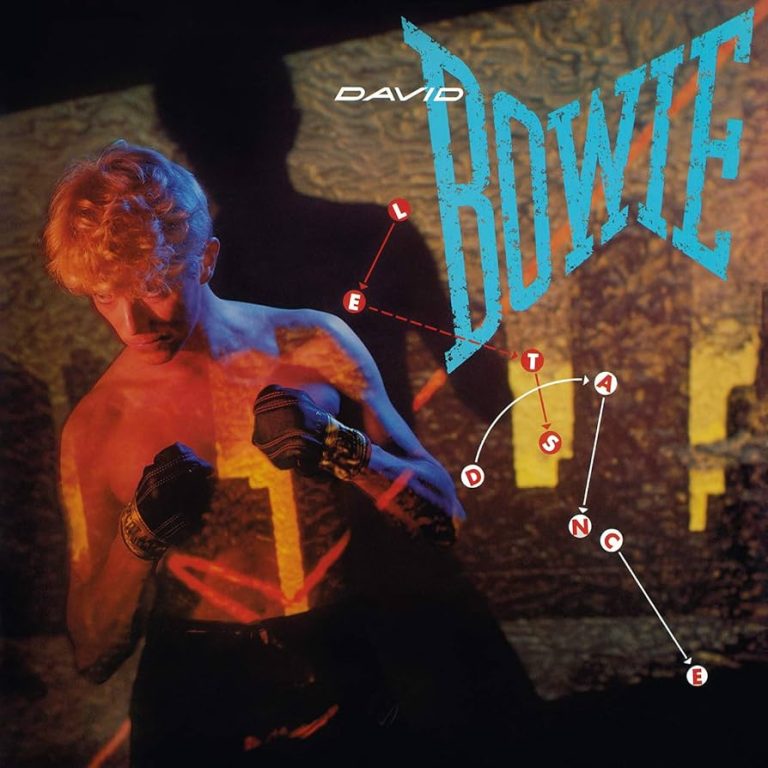
Maybe Bowie shouldn’t have called the fight so early. His new hobby should have primed him: Bowie had picked up boxing to get fit for an upcoming tour (a 12 round match roughly parallels an average concert) and took on the role for the artwork on the record’s sleeve. Photographed by Greg Gorman, Bowie presents himself bare chested, muscular, radiant. Fists in gloves and raised in anticipation of his opponent’s next move. The back cover and inner included drawings by Derek Boshier, somewhat imitating Keith Haring’s iconic style. 80s excess is all over the artwork, with an odd projection of a cityscape onto Bowie’s upper body, while additional graphic elements of a gigantic last name in sky blue and instructive dance directions spelled the album title. It’s a little overloaded to the contemporary gaze, but still, in all its pastel glory, instantly memorable.
The gloves came off for the album aggressively. In May, parallel to the start of Bowie’s world-spanning Serious Moonlight tour, Rolling Stone magazine released a key interview, where Bowie sold himself to American audiences. The knockout comes early on: “’The biggest mistake I ever made,’ [Bowie] said one night after a couple of cans of Foster’s Lager, ‘was telling that Melody Maker writer that I was bisexual. Christ, I was so young then. I was experimenting….’” Kurt Loder continues: “So: he is not gay, whatever he may have blurted out in 1972. Nor was he ever a transvestite, thank you. Still, American TV – for want of any more-recent product, it’s true – has kept running his 1979 “Boys Keep Swinging” video, and so total strangers still breathily inquire whether he’s doing drag onstage again. (‘I’ve never done drag onstage,’ he huffs.)”
It’s painful to read, and ruffled feathers upon release. Where Metro’s “Criminal World” had been banned by the BBC due to its queer imagery and royal irreverence (“I’m not the queen, so there’s no need to bow”), Bowie cut most of the first verse, and changed some of the others: “I saw you kneeling at my brother’s door / That was no ordinary stick-up” became “You caught me kneeling at your sister’s door”. In 83, just as the AIDS epidemic had claimed the life of his one-time protege Klaus Nomi, this was indeed perceived as a slap in the face of a community Bowie always championed. Changing lyrics is one thing, but wholly denouncing your sexuality to Kurt Loder of Rolling Stone magazine?
In his writing on Bowie, Marc Spitz delivers a key statement from queer musician Justin Bond regarding the travesty: “I didn’t feel betrayed. I just felt like he was a product. But then he lost his touch, didn’t he? For many people it was a betrayal. You can’t take that back. ‘Oh, no, I really am cool. I really am on your side.’ At a time when Reagan was in office and AIDS was rearing its head he decided he was going to cash in on his white, male privilege and put a distance between him and his stigmatized fans…”.
But it’s also interesting to note that the initial quote might be an unfortunate misunderstanding by Loder. He reads David Bowie’s proclamation that his coming out was a mistake on his way to achieving fame as David Jones actively discouraging the idea that he was bisexual. And this is pretty much how modern Bowie scholars read his words: a moment of brief corporate marketing comment. In 2002, Bowie reflected on his statements when confronted by Blender: “I had no problem with people knowing I was bisexual. But I had no inclination to hold any banners or be a representative of any group of people. I knew what I wanted to be, which was a songwriter and a performer, and I felt that [bisexuality] became my headline [in America] for so long. America is a very puritanical place, and I think it stood in the way of so much I wanted to do.”
Time has been gentle to Bowie on this one, but the scars his act left are still noticeable. It’s not particularly helped by other artefacts throughout his career – “John, I’m Only Dancing (Again)” erasing the queerness of the original track, a 1993 Rolling Stone interview where he declared “I think I was always a closet heterosexual. I didn’t ever feel that I was a real bisexual. It was like I was making all the moves, down to the situation of actually trying it out with some guys […]”. But then, it’s important to read almost all of Bowie’s interviews as cyphers for whatever foil or avatar he conceived at that moment in time. The 1983 piece has Loder refer to young Duncan Jones as “Joey, formerly Zowie”, elegantly showcasing that whatever truth Bowie fed to journalists was still manufactured, or outright bullshit.
No matter David Jones’ orientation, in 1983 David Bowie was considered straight as a nail by most Americans. What angered many allowed for a whole host of other political topics to take centre stage as Bowie was confronting the imperial core of the western world. When interviewed by MTV, Bowie suddenly switched to the role of inquirer and confronted the channel with its internalized racism. Go ahead and watch the clip – Bowie is strikingly aggressive and cynical, shading his opposite with such skill and style as he tries to deflect the observation that there’s few black acts playing on the channel. When Bowie is being told the Isley Brothers don’t mean much to a 17 year old, he retorts “Well I’ll tell you what maybe the Isley Brothers or Marvin Gaye mean to a black 17 year old…!”
The video for “Let’s Dance” went further: using a veiled Wizard of Oz reference, it frames an Aboriginal couple’s struggle within a contemporary urban setting. The two observe the wake of an atomic bomb explosion, then paint on the walls of a gallery after being forced to work menial jobs. Colonialism, racism, class inequality, all paired with the central symbol of “red shoes”, which echoes the song’s lyrics. Some of these images would return later (prominently on the Tin Machine song “Goodbye Mr. Ed”), but the video for “Let’s Dance” is still considered a high water mark of Bowie’s pop politics. With its protagonists living through a host of scenarios, it sharply focuses on the surreal rituals within so-called civilised societies: the excess remains rooted in exploitation.
Soon after, Bowie made amends with Alomar (likely shedding some extra cash in the process), and in May 1983, kicked off the Serious Moonlight Tour with his former band leader in tow. Encompassing 96 shows and stretching from May 18 to December 8, Bowie would travel the world as the yellow-haired CEO of his capital venture. What was meant to fill venues of about a thousand people soon exploded into arenas. In Auckland, he faced up to 80,000 visitors, and at a festival in California, he played to 300,000 people.
The tour would become a high watermark of the trade and garner a reputation as a showcase that underground “art rock” can translate to the mainstream. While Bowie claimed his song selection was encapsulating his most popular work, much of the tour was comprised of deep cuts, many from the Berlin days: “Look back in Anger”, “What in the World”, “TVC15”, “Breaking Glass”, “Stay”, “Joe the Lion”. Let’s Dance took a back seat, mostly just represented by its singles. And even if his general delivery was rehearsed and slick, the recorded documents of the tour prove the pre-80s tracks to be as edgy as their original versions. Besides great performances by the always reliable Alomar, there’s also a few notable restorative moments with Bowie’s past. Mick Ronson would join the band in Toronto for “Jean Genie”, terrifying additional guitarist Earl Slick when he borrowed his prized guitar and swung it above his head. On the final day, the three-year anniversary of John Lennon’s passing, the band would go on to play “Imagine” in his honour.
The tour spawned an interesting documentary by Gerry Troyna: Ricochet. Blending somewhat staged moments with concert footage and interactions of traveling Bowie with his environment, it’s cleverly obtuse. In one of the best moments, Bowie allows himself a playful transgression into the silent storytelling of his days as a mime. In Singapore’s Far East Plaza mall, he ascends and descends neon lit escalators, the blue of the lights contrasting with his melon yellow hair, while “Sense of Doubt” from the Berlin days gives an eerie aura to the proceedings. Singapore’s Far East Plaza suddenly looks both like Berlin’s Bahnhof Zoo and Blade Runner‘s future Los Angeles – “a man lost in time, near KaDeWe”. Pedestrians turn their heads as Bowie, in dark trenchcoat, seems more like a replicant than human. A cop points and yells at him – Bowie scans the orderly as the camera cuts to his profile. Then he walks away, in silence, finally resting in the empty mall.
The man who sold the world had sold himself to the world. He had become everything he always wanted to be – artist, legendary musician, achieved actor, world citizen, number one in America. Perversely rich and world famous. But what did he sell to get here, to this point, all alone in Singapore?
He had fulfilled his commercial ambitions, yes. But he had shedded not just detractors – Angie and Defries, who had become unbearable weights – but also lost many friends. Lennon had been killed. Visconti had been ‘let go’. Alomar had returned after being insulted, but for how long would he accept a commercial venture over artistic freedom?
Many of his fans felt let down and left behind, all while he had achieved his financial dreams with the record that – outside of the roleplaying cash-grab Pin-Ups – was his least representative, his least personal, his most scattershot and overall his weakest since the ill fated Decca debut. “It’s kind of a mixed bag, really”, he told Musician magazine that May.
Even if it allowed him to re-package the brand of Bowie to an audience of millions, he was more than aware that Let’s Dance marked a creative dead end. For somebody so obsessed with the concept of death, dystopian terror and apocalyptic horror, Bowie must have paused to ponder who it was that he sold his soul to when he signed with EMI and filled arenas. Soon, he would come to know. But for now, his future was on the stages of the world, in front of millions of people that all chanted along to “Let’s Dance”.
Also in this series: