
Earlier today, I came across the last entry in Jeff Buckley’s journal. It’s unprinted in the archival His Own Words, and can only be seen through the scanned front page. The entry reads: “My mind was born broken / Glass it shakes in my head / A thousand colors it reflects / All but one shade of red”. The lines make me shiver as I type them – they are the sad gasps of a young man struggling with a severe mental illness that would go on to claim his life. But more than that, they seem like a spiritual observation, one that in our current moment seems all the more poignant.
Everyone I know has, in the last two weeks, told me in so many words that (to quote a co-worker) “the very worst things that could happen, happened” in their private life. Meanwhile, World War III has officially started and relishes in its hellish, apocalyptic madness of religious fervour and fascist sadism. Our collective climate and ecosystems are collapsing, with a wave of extinction occurring uncommented. Genocide, genocide, genocide, genocide: don’t dare speak the word, or else. Oh, to be choked out by our own ruling powers, systems of slavery and spiritual decay, who barely point attention to what is the largest scandal of the 21st century: the end of our humanity, embodied by necro-butchers that look and sound like comic book villains.
A few years ago, I wrote an essay on the new genre Futurismus, which I described therein, in no uncertain terms, as a document of coming horrors, an unconscious protest against a world sliding into warfare, chaos, cannibalism, fascism. I expressed that these albums were a warning, which we had to heed.
We didn’t. The Doomsday Clock strikes 12!
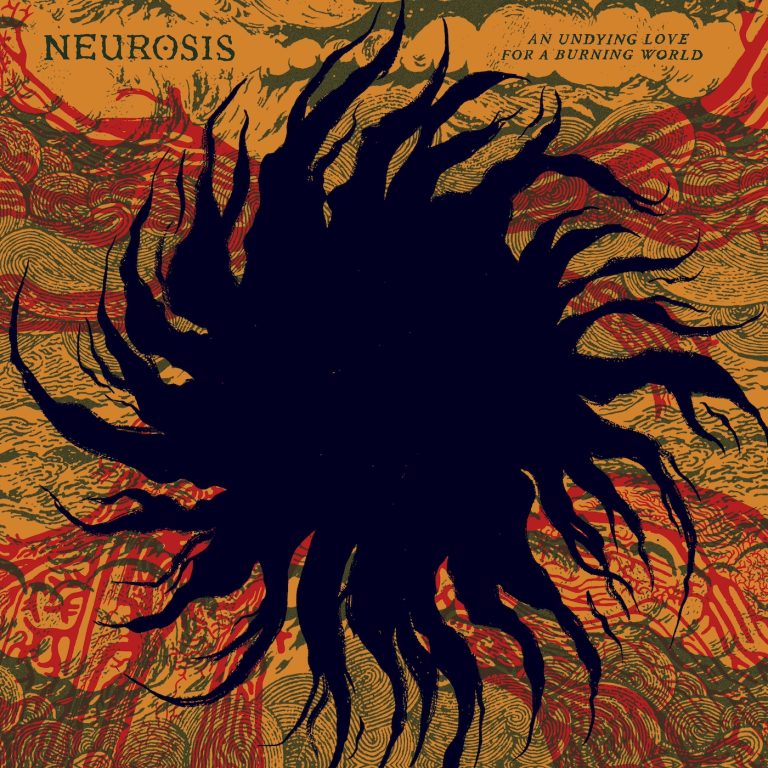
Suddenly, this album appears. No church bells, no falling ashes of atom bombs to herald it. It’s just there, born into the world. It’s impossible to talk about An Undying Love for a Burning World without mentioning why it shouldn’t exist. In August 2022, two statements were released in quick succession, one by vocalist Scott Kelly, one by his band Neurosis. Once the smoke cleared, the image was devastating. Kelly – a troubled but charismatic artist – had structurally abused his family and lied to those closest to him. Neurosis decided to part with Kelly when this was brought to their attention in 2019, but understood this as a consequential act of allowing their vocalist insight and betterment. In their words, they tried to reach out in the coming months, showing support and inquiring on his journey of improvement. Kelly seemingly rejected their effort, which the band deemed as intentional – his statement is characterised as “another attempt at manipulation”. The devastation in the group’s statement is palpable. As a consequence, Neurosis seemed totally done, as they close the piece stating: “We also grieve for the loss of our life’s work and a legacy that was sacred to us.”
But this was not the only consequential moment of caesura: in may of 2024, Steve Albini passed away. The legendary engineer had produced every Neurosis album since 1999’s Times of Grace and can arguably be seen as the architect of their “sound” beyond the industrial-tinged early period. Albini often rejected the monicker of producer, understanding himself as much an “engineer” as a recording philosopher. Losing a collaborator is always hard for a band, but losing their figurehead and helmsman seemed to do irrevocable damage. It came with no surprise that drummer Jason Roeder one year ago announced he would retire and, as a consequence, sell most of his equipment – Neurosis were, unofficially but apparently, over.
The world sank into shadow, and yet got darker still. The energies that tore Neurosis apart projected themselves on a larger, global canvas. The truth hurts: we needed them! Recruiting Aaron Turner, former frontman of the legendary Isis and brain of the magnificent SUMAC, Neurosis explain their rebirth as existential necessity: “We need this, perhaps more than ever, and we suspect we are not alone.”
An Undying Love for a Burning World is a harrowing confession of anxiety, of grief, of the inability to face the nightmare and reconcile with the horror of irreversible damage. Recorded by Scott Evans, who also worked on the albums by SUMAC and Shearling, the album is Neurosis’ most apocalyptic in a long time. This might sound like hyperbole, considering the band released an emotional black hole of epic proportions with the legendary Through Silver In Blood, arguably the best metal album of all time. But consider how Albini allowed their later output to embrace the gentility of post-rock, allowing for cautious optimism among the darkness.
This human longing for a new dawn is only present in one moment, on what could be the album’s masterpiece moment: the euphoric “Last Light” has the quality of Lars von Trier’s Melancholia, opening with a nervous, pumping beat, which slowly works itself into horror film ambience and Turner’s anguished organ documenting the end of all: “Seek last light / Stars blink out / Bodies knot in darkness / Together we cling / Stars fall cold / All swept away”. His voice breaks into a shriek during the last line, opening the song to mean tribal drumming, while Turner seems to lose himself to madness: “What have we done / To our own / Our own native clay / Finding our lives / Inside grief’s watchful eye / Learning to mourn / Corpses in the snow”. The song crawls through this section, before suddenly exploding into a section that could have come off Siamese Dream, all gentle, elysian psychedelic euphoria, before tumbling into barren ambience and a choir – an echo of a past: not quite folklore, not quite sacral. A eulogy: “Sorrow we feel as we harrow the fields / As we know death to be a ravenous beast / Weltering in the blood of our love / The river itself starts to weep”. By the end, as the song returns to sludge metal and the anxious beat, its singular gravitas in the current music landscape seems unignorable: a crazy, blistering masterpiece!
Neurosis had always been the most spiritual band in modern metal, incorporating Eastern religion and philosophical introspection into their work. But rarely have they seemed as angry and brutal as on this album, as the intro-segue “We are torn wide open” exclaims: “The separation that burns our hearts / Is the root of all our disease / We’ve forgotten how to live so we suffer / We’ve forgotten how to struggle so we suffer / We’ve forgotten how to die so we suffer / We’ve forgotten we are wild so we suffer / We exist in isolation so we suffer / The dissonance is deafening / The dissonance is deafening”! It is hard to fully encapsulate the songs that follow – I would have to describe each section, list each vocal and lyrical part (which the band, characteristically, exchange amongst themselves), come up with metaphors for the building tension and violent riffs that make this record, exhaust my inner lexicon to convince the mind that this is music that needs to be experienced. But that would be futile. This is way too personal a record for pretentious grandstanding.
“Mirror Deep” is such an intimate experience, for example: as the band interjects what sounds like sudden bursts of a vocal sample yelling “shut up!” between the crushing sludge riffs, before diving into a quiet section of cheap 80s horrorfilm ambience, only to finally grinding their way into Industrial-laced metal, is so furious and hopeless, it can feel almost mocking. These warbling synth tones familiar from “Anthropophagus” and a dozen other Italian low-budget shlockers seem intentionally cheap, as if to pinpoint that our human struggle is but a joke to the universe, before the final metal section acts as a gigantic meat grinder.
“First Red Rays”’ cosmic, Pink Floyd-adjacent atmosphere (think “Dogs” and “Echoes”) opens to a final section that generates images of alien monks, or angels, serenading the end of mankind, while “Blind” conjures sublime Lovecraftian imagery: “Nothing shines until we feel like we are nothing / Darkness pulls the moon from the ocean / Stars are blind, burning in the shallows / While despair wipes away delusion”.
This dynamic, this tense push-and-pull between quiet passages of nostalgic synthesizer tones, sludgy riffs, atonal madness, gentle vocal harmonies and Industrial nihilism, often is reminiscent of the band’s transitory project, Enemy of the Sun. Often treated as a ‘dress rehearsal’ for Through Silver in Blood, the record’s radical experimentation as a tone-piece is why it is often forgotten between the two masterpieces that came before and after. An Undying Love for a Burning World is not quite as mischievous (no 26 minute tribal drumming detour this time), but it shares a similar quest for pure emotional expression, for stark, at times frightening intensity. But in the end, it also is much better, more mature and – dare I say it – playful. The album is no misery porn, nor starry eyed agnosticism. It finds a frightening clarity of ongoing decay, of failure and disintegration.
Are we doomed? Likely so, I am afraid. An optimist at heart, I’ve pondered this question for a while: what is there left to say if this is the final time, the final line, the final shout into the abyss? What if this is the last album, the last review, the dying moment of all? What could I say – what could I do? Would I wave, would I laugh, would I hug you harder than before? We all hope to have done something good, to have moved the needle and given comfort to fellow travellers. We embrace our imaginary friends, as the tears come and the sound leaves. As von Trier postulated, we all build our tiny fort of sticks: we all dare trying, and yet come short. And there is no mythological comfort in dissolution.
Neurosis postulate that it is not mere human evil that is our undoing, but the very cosmic nature of eradication that is consequential and impossible to avoid. The folly of thinking we could last more than greed or madness. Their collaborator, Steve Albini, once ironically marked that moment: “The End of Radio”. Neurosis find no romanticism of human humour. They reflect the universe’s rays, to leave but one shade of red. To them, the stars blink quietly away. Gone.
87%