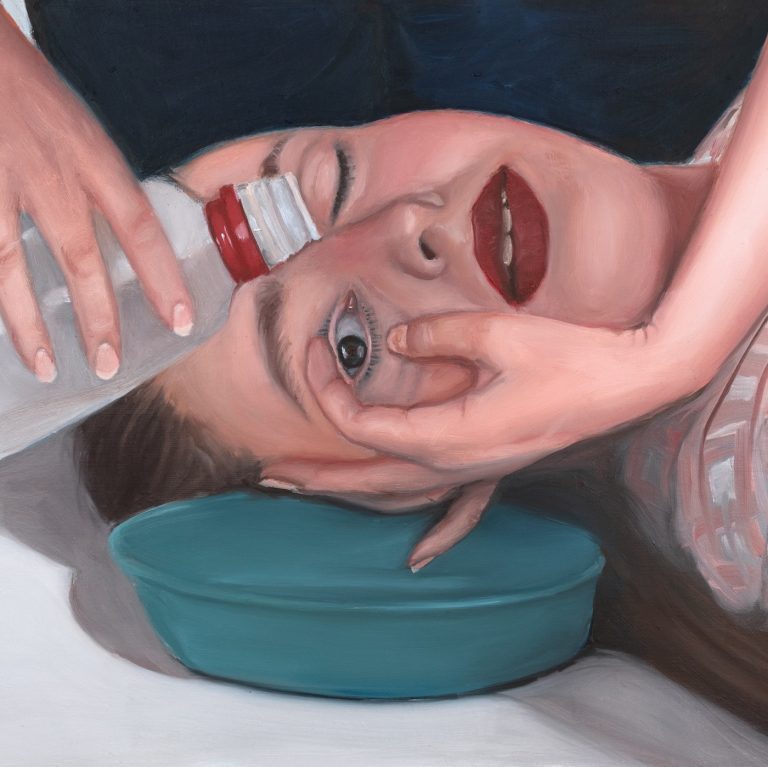

With their first two albums – 2021’s New Long Leg and 2022’s Stumpwork – Dry Cleaning moved between a new-wave-inflected MO and noisier, metal-adjacent gestalts. Florence Shaw forged her version of Perennial Dada, collaging meme-ish phrases into manifestos that addressed post-humanitarianism, the exploitive side of capitalism, and our pressing addictions to entertainment and distraction.
Working mostly with a deadpan voice, Shaw, like Laurie Anderson, mined the paradox of the monotone: how it points to a postlapsarian fatigue but also, when cast mindfully, a repressed volatility or explosiveness lurking beneath the placid surface – tamped down by trauma, conditioning, and social mandate. Together, Shaw’s fragmented poeticisms and the band’s rangy instrumentation made for a compelling take – lyrically and sonically – on current life.
With their new album, Secret Love, the band pivot from working with producer John Parish, joining forces with Cate Le Bon. Lewis Maynard on bass and Nick Buxton on drums meld reliably, forging thickish foundations. Guitarist Tom Dowse is at once anchored in the rhythmic and melodically nomadic. Shaw weaves spoken-word tapestries that are at once meta-biographical and socio-politically relevant.
With New Long Leg and Stumpwork, Shaw presented as a pensive counter-culturalist and wry comedian, seeding a refined brand of agitprop. With Secret Love, she’s more a guarded flaneur or cautious voyeur, a diarist concerned with processing overwhelm rather than sharing new insights or wisdom, however oblique. She still strolls a line between ennui and mercuriality, though with Secret Love, ennui gets top billing. Also, while she and the band have always navigated a loose relationship, her poise and the band’s more heated stance yielding fertile contrasts, here she and the band vacillate between hit-and-miss alignments and a curious incongruence. Tracks land as abstractly intriguing, though also, occasionally, a bit lackluster.
On opener “Hit My Head All Day”, Shaw explores how our identities are tied to marketing campaigns and longstanding capitalistic strategies. “I simply must have experiences” is expressed ambivalently: on one hand, there’s an epicurean eagerness to sample life’s many flavors; on the other hand, there’s the inability to be still, quiet, unstimulated. Shaw operates as an everyperson torn between living an engaged life and consuming/partaking as a way to dodge pressing anxieties, doubts, etc. The band erect an energized backdrop, driven by Maynard’s bouncy bass and Dowse’s lo-fi-ish/riffy guitar.
Following the opening track, the album settles into a ghostly cum zombic groove. If “Hit My Head” deals with cultural conditioning in a general way, “Cruise Ship Designer” considers this phenomenon more specifically. The designer is “climbing ladders”, “making the most out of a bad situation”. Buoyed by the band’s/Le Bon’s upbeat and textural mix, Shaw oozes exhaustion, suggesting that the human trajectory is defined less by choice or intention and more by genetic, social, and economic forces beyond our control.
On the title track, Shaw experiments with a shaky sprechgesang while Dowse offers meandering staccato accents. “Let Me Grow and You’ll See the Fruit” references fears re: loss of privacy and the dumbing-down of the Western world, but falls short of conveying urgency. “My Soul / Half Pint” spotlights Dowse’s wiry guitar runs and the band’s agile leaps between verses and bridges. Shaw declares, “I’m a woman and I think if I clean then I … / I feel resentment in my soul”; her affect, however, suggests that she’s somewhat removed from that resentment, stranded in a fuzzy bardo (whereas with the first two albums, her anger would’ve been understated but palpable à la Martha Rosler’s canonical “Semiotics of the Kitchen”).
In short, Secret Love is less infused with the potent paradoxes – fate/freedom, the social contract/the rebel impulse, consternation/humor – that elevated New Long Leg and Stumpwork. “Rocks” centers on discordant guitar ambience and metronomic/arrhythmic drum parts. Shaw’s low-key delivery is juxtaposed with the incendiary instrumentation. “The Cute Things” is ebullient, dance-y, Shaw tilting toward misanthropy and depersonalization. The ironically titled “Joy” similarly mocks the contemporary push for positivity: “Try to make a map of the heart. / … We’ll build a cute, harmless world”.
Secret Love may well capture the vapidity of the consumeristic life, but does it, in the process, dip into vapidity itself? Rather than critiquing or lampooning end-stage capitalism, Shaw in particular seems to have succumbed to its toxicities. Perhaps the album is best heard as a memento mori, a dying declaration – art, like everything else, drowning in the waters of mendacity. For a band that started out as snarky bohemians, even doomsday romanticists, collapsarians who nevertheless believed in the redemptive properties of art, that’s a pretty defeatist position.