
Known less as an awe-inspiring landmark in itself (or, according to some interpretations of Greek myth, as the birthplace of the goddess Athena), Chott El Djerid is best recognised as part of the pop culture zeitgeist. What may appear on maps as a lake of some 2,700 square miles is more often a dry expanse that can be crossed by foot. As it sits 15 to 25 meters above sea level, during summer months it’s more akin to a desert, the salt lake drying up and leaving small boats stranded with nowhere to dock. More commonly though it is known as the Lars homestead on Tatooine in the Star Wars movies.
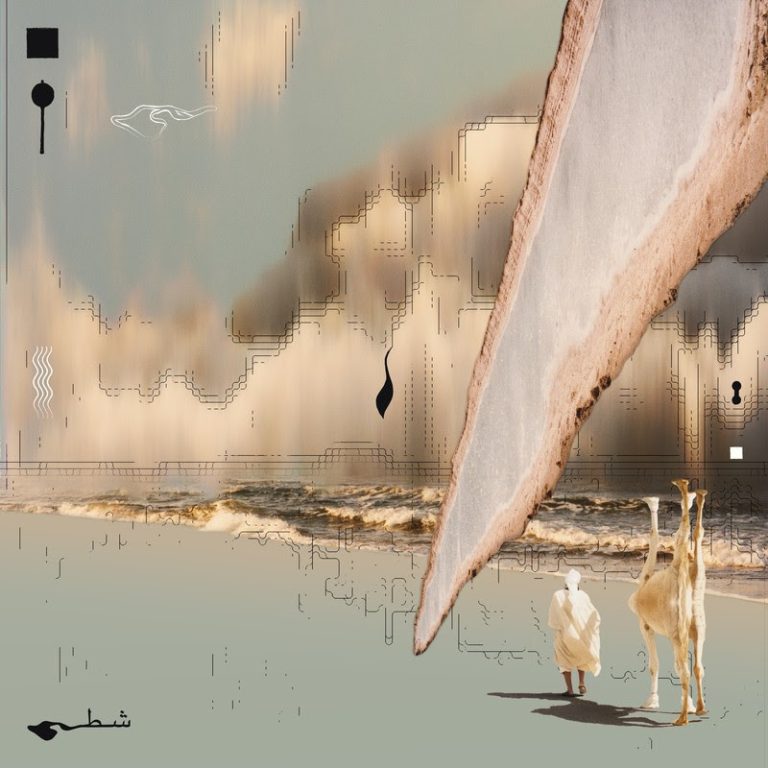
Chott El Djerid is the setting too for the second album from German-Tunisian musician Tarek Zarroug (aka Taroug). Chott explores personal history and identity across its 10 tracks. He reflects on life growing up in Tunisia, fusing traditional instruments with electronic ones, an artist trying to marry past and present, tradition and modernism. “Sirocco” bleeds from both ends, building from a ghostly electronic backdrop that is soon replaced with shakers, breathy flute-like instruments, and hand percussion. On the solemn and peaceful title track, Zarroug’s father recites an original Arabic poem against waning and wearied synth tones. The integration pulls from both sides, memory taking the driving seat while other times the drum tracks and synths charge forward.
As a percussionist, Zarroug lets the rhythm drive a lot of the tracks here, even when the tempo is on the more sedate side. Polyrhythms trickle out on tracks like the woozy and mystical “Mides” and the contemplative “Cicada” allowing for the journey to remain intriguing even when the elements in the mix feel sparse. Elsewhere textures take the wheel: Silent Shout-like haunted drones stretch about on “Nakhla” as snares scutter about atop the mix, creating a John Carpenter-esque feel; on “Saraab” a swallowing distorted voice adds to the nocturnal vibe; and two minute opening track “Wehmut” sets the scene with shying arpeggios, like the salt lake coming into view over the horizon.
While Zarroug’s 2024 debut Darts & Kites very much felt like a collaborative effort, Chott is a much more solitary affair. It’s an audio journal reflecting on scenes from his past, like looking at old photos and holding them up to the space now. (Zarroug also collaborated with architect and designer Marie Brosius for the cover art, creating an experimental collage from old personal photographs of Tunisia.) Melancholic tones ooze through the veins of the album, even when Zarroug is reminiscing directly over childhood memories like on “1995”. “We play hide and seek / between the laundry on the lines,” he recollects over piano chords and deep industrial beats. His sorrowful voice makes a playful memory sound somber, like there’s a hidden, deeper meaning at play. Perhaps it’s just a reflection on how life changes, how we become bigger and taller, how the world seems infinite when we are children.
Throughout Chott, the vision of the titular landscape looms, providing a proverbial anchor in the salt lake. It may be vast and dry and desolate, but it also comes with unexpected dangers: the grinding, drilling synths on “Miled” feel like flash storms against the barren terrain; “Sirocco” ripples and cracks, like breaking through the unstable salt crust; and “Saraab”’s moonlit feel also draws in a feeling of isolation. The salt lake is an almost brooding presence, much like memories can be. Zarroug mines that feeling and uses it to document a version of past and present, creating a record that feels both fascinating and otherworldly.