
Observing the career trajectory of Suede is an interesting venture: here is a Britpop group that have attempted to constantly defy expectations and change their sound, all while retaining their iconic, signature identity. Since their 2010 comeback, the band have constructed an impressive catalogue that might be more consistent than their original decade-long run, which took a bit of a nosedive with the bubblegum electronica of Head Music and overtly polite A New Morning. From the conceptually and musically dense The Blue Hour to the fierce Punk-spirit of Autofiction, Suede might be the only band to return from a 10-year hiatus and want to challenge themselves.
And there’s good reason for that – most of their contemporaries have settled into middle age with a sardonic melancholy that abandons their initial spark. The last respective albums of Pulp and Blur, for example are, while decent listens and charming; records likely to stand as fair contrasts to the utter genius those bands possessed. Brett Anderson, always keen to show his singular ambition, went as far as heralding that Suede are the only band of their ilk still releasing albums as an artistic statement, as opposed to looking for a reason to push tour tickets. Seems harsh, but is he that wrong? Which second-generation Britpop albums stand out after A Moon Shaped Pool and The Magic Whip? And how many of the other bands of that generation have been able to release a memorable album in the past 20 years?
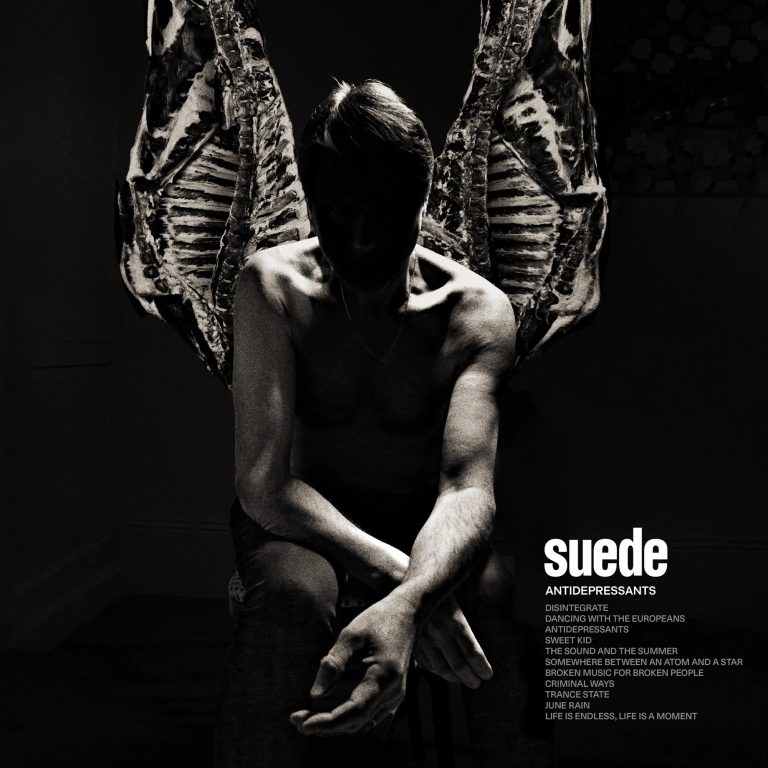
Suede have always approached their output in pairs, highlighted by the colour-coded artwork (in order: gold, rainbow, crimson, blue and now black and white). True to that spirit, Anderson announced that their new album would be the post-punk to the punk of Autofiction. A little surprising, given that the frontman had initially teased he was interested in approaching a project similar to Talk Talk’s Spirit of Eden or Laughing Stock. That teaser posed the question of whether Suede would go Gang of Four or Joy Division, or dive into full abstraction familiar from PiL and This Heat. Could that even work, for a group this elegant and glam-infused? Not that post-punk didn’t take a lot from Bowie and Roxy Music, but for a couple of guys nearing 60, and following a widely celebrated, boisterous and anthemic career highlight, the announcement felt a little grandiose.
Yet Antidepressants, Suede’s 10th album, not only substantially supports Anderson’s claim that his band is unique in pushing forward – it passionately posits itself as one of the band’s best records. In a discography this rich with celebrated albums, and following what many considered a return to the form of their first three albums, that’s a feat.
To evade any misconceptions: Suede have cleverly adapted individual tones and atmospheres of post-punk groups to their own style, resulting in a diverse, sombre tone. This makes it easy to divide the album by its two halves: the first, which resembles the jangly tone of Echo & the Bunnymen, The Church and Scars (whose record Author! Author! is criminally forgotten) while the second leans closer to the tension of The Cure and Ultravox, as well as the latter’s overlooked progenitor Rich Kids.
If that doesn’t translate: this is a very autumnal, dusky record, which sounds of the evening after. Richard Oakes, whose guitar style evolved from the early parallels to Bernard Butler, especially aims at a more textural quality, alternating between memorable jangle compositions to very smart rhythm play, which compliments Anderson’s vocal melodies beautifully. There’s an occasional hint of Bernard Sumner’s, John McGeoch’s and Keith Levene’s playing styles here, too, but only hinted at. He’s almost humorous here, at times taking a back seat, having the listener mourn the lack of Butler’s cheeky style, only to suddenly dive into an elaborate solo, which is just as iconic as the work of the band’s legendary initial player. This diversity allows him to toy a bit with the original inspirations of the genre, such as when he opens the title track with a sonic reference to Neu!; with a bit daydreaming and freed from the context of Anderson’s voice, the track could well fit on the B-side of Neu! 75.
It’s one of many incredibly clever decisions on the album. Bassist Mat Osman, the secret weapon of Suede live shows and rivaling Anderson’s intellect, opens the record with a distorted heartbeat, cutting through metallic vocal samples and a short spoken word intro by Anderson, working thuddingly towards the Bowie-esque chorus of “Disintegrate”. The track stands out in Suede’s discography, precisely because it uses established roads the band took to generate a more gothic aura, underlined by the pessimistic, yet romantic, lyricism Anderson generates: “Your relationship’s a lie, and the friction makes you scream / But you hold your love like a weapon in your hand / Come down and disintegrate with me / We’re cut down like the daisies, like the tall poppies”. There’s a hint here of Pulp’s darker spoken word pieces (“David’s Last Summer” comes to mind), but without any of their signature irony, as Anderson seems to fully embrace a dark fatalism, to euphoric guitars. It’s an instant classic of Britpop.
“Dancing with the Europeans” – an even better song – is a tour de force from Osman, alternating between the jangle-sound of Echo & the Bunnymen and nonchalant punk riffs, while Anderson channels Midge Ure. Sharp and emotional, his raspy voice gives the aristocratic imagery of the lyrics a strong edge. The heavier, gothic “The Sound and the Summer” suggests the cinematic values Fields of the Nephilim indulged in. All echo and grit, it allows Anderson to reconnect with the JG Ballard inspiration of his early work, making some very direct references to the writer’s magnum opus, Crash: “With the sound of police cars giving chase / Put your foot to the pedal, you are momеnts from disgrace / With our arms out the window, our heels on the dash / ‘Causе you’ve never been loved till you’ve been loved in a crash.”
“Sweet Kid” is dominated by a very McGeoch-riff and could have fit alongside Siouxsie’s punkier tracks. The rousing anthem has the power of the early Manics and is the most naive moment of the album – but in the best way possible, fitting perfectly into radio-rotation. If Anderson’s voice didn’t sound of thousands of drinks, it could easily be mistaken as the work of some mid-20 somethings. Its sibling, “Broken Music for Broken People”, may be the most “signature Suede” song of the album: reconnecting with Autofiction, it is a straight, clean anthem, once more with a hint of Bunnymen and The Church. Singalong chorus and massive sound, it’s quite nice, but it lacks the intellectual and compositional density of the other tracks – a working class anthem, for working class people. It’s odd when the weakest track on an album is still what a record executive would rush to deem “single of the year”, but I suppose Anderson almost purposefully designed the track this way.
And speaking of emotional response – the two ballads on Antidepressants are honestly some of the best in the band’s recent output. The existentialist “Somewhere Between an Atom and a Star” sounds like a bitter reflection of “Pantomime Horse”, with Anderson bemoaning his fading life: “Life is just a moment / And words are just a trick / And I wish there was more of life than is given to us / Like the rain that’s washed away, it’s almost gone now”. “June Rain” borrows the sound of early The Cure – think “A Forrest” – to dive into the broken mind of a suicidal man. It’s bitter, resonant poetry of broken hearts and wasted lifes: “In the hospital you can sit with me, we’ll watch the hours go / And you left me there like a fingerprint on your back window / If you held my hand and kissed me / Would I ever know?” There’s a bit of Ultravox here, circa Vienna, in how unabashedly romantic and urgent the track climaxes the narrator’s breakdown.
Speaking of Ultravox: “Trance State” could have been off Rage in Eden, all driving rhythm and guitar effects, yet also allows Osman to find the signature sound of Peter Hook’s style in an especially cool bass line. It’s possibly the most fully-formed thesis of the sound Suede aimed at here, cleverly marrying sound experimentation with signature songwriting aesthetics and Anderson’s “broken Dandy” narrative. “Criminal Ways” is, in contrast, more re-inventive, sporting a guitar performance that is reminiscent of Robert Smith’s abstract, psychedelic work, married to the tribal drumming Adam and the Ants leaned towards. It’s very post-Glam, once more showcasing Bowie’s influence on the new wave acts that followed (the closing and rhythm goes all the way back to “Jean Genie”).
This last stretch of songs leads towards the record’s most surprising moment, the closing “Life is Endless, Life is a Moment”, which sounds like a straight lift off The Cure’s Disintegration. With its ruminative guitar part, sinister atmosphere, thundering drums and foreboding bass, it’s very memento mori, as Anderson goes for the most minimalist and bleak lyrical writing on the album: “Hate me / If you must / Love me / When I’m dust / Life is endless / And life is a moment”. The final lines are screamed, to the point where you can hear Anderson’s voice break. It’s emotional and haunting, with the echoing drone of the instruments fading for a full twenty seconds as the song closes.
Anderson has been open that his intention for this new album was to provide a sense of carpe diem – to have a reminder that this one life is all that we have. Antidepressants comes at a strange moment in our history, one that is impregnated with horror and tension. We experience multiple genocides, the collapse of economical safety, rise of autocratic leaders that slide familiar nations into dictatorial overreach and the dissolution of free speech. I haven’t even mentioned the disastrous state of the world climate here and it already looks like a total mess, which gets worse with the news of each new day.
So it’s fascinating to see a band that could, potentially just retire to nostalgic ’emotional relief-artworks’ make an album that strives to fully emulate a mood that is familiar from the height of cold war panic. Coming off Autofiction – which was this joyful, life affirming record that cut all fat – with an album that is not only more poignant but also better, all while channeling the all-pervading pessimism into such a gorgeous musical work and euphoric mood, is a massive achievement for a band in its fourth decade. Somewhat of a companion piece to The Cure’s Songs of a Lost World, Antidepressants will not only be a new favourite of Suede fans, but also open a new audience up to them.