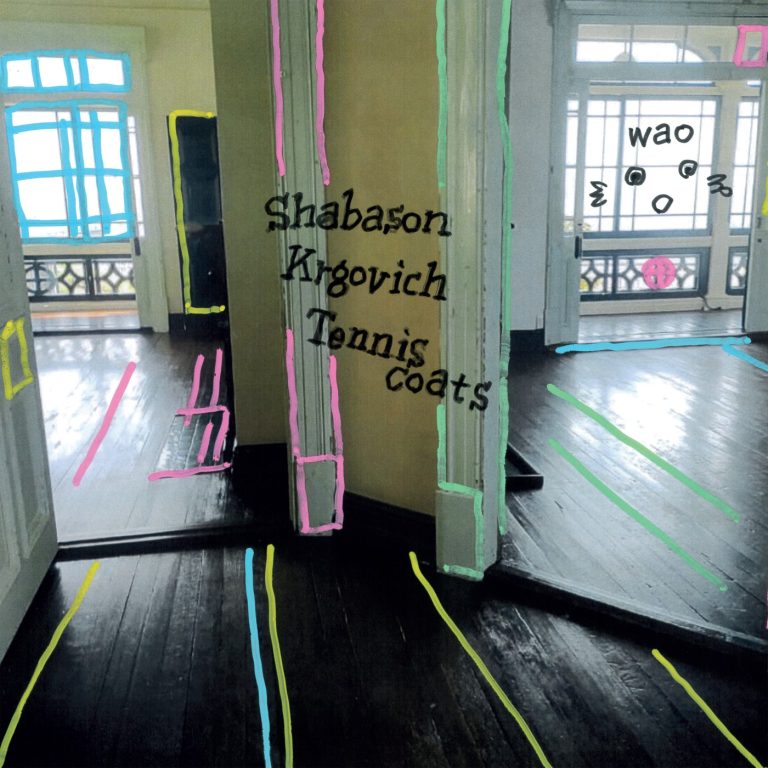
Last year, while on tour in Japan, Canadians Joseph Shabason and Nicholas Krgovich were introduced to the Japanese duo Tenniscoats. An immediate rapport was felt and Tenniscoats subsequently joined Shabason and Krgovich’s tour after rehearsing only two times together. Some time later they found themselves staying at the Old Guggenheim House in the city of Kobe for a short two days, and during those 48 hours, decided to start recording with no preparation whatsoever. The result is the new release Wao, a melodic, organic, and Occam’s-razor-sharp collection of tracks that remind us to recognize the quiddity and splendor of ordinary, everyday objects.
Both duos’ previous efforts have been equal in their attempts to highlight the beauty in the mundane. At Scaramouche, Shabason and Krgovich’s 2022 record, is filled with melodic synths and lyrics so stunningly quotidian that you can’t help but smile (e.g. “I’m so happy with my little dog”). Tenniscoats have achieved a similar atmosphere throughout their discography in the last quarter century – recording playful and moody ballads with lyrics that make even non-Japanese speakers shimmer with delight (e.g. “Pa-papayaaa”). All in all, these musicians create music that basks in the beauty of simplicity. However, they do it with such craft and conviction that it never seems monotonous or dull. In fact it seems quite the opposite: it draws you in, slows you down, and forces you to forget everything else going on around you. It is what I imagine Kōji Yakusho’s character in Wim Wenders’ Perfect Days must have listened to as he contemplates komorebi. The two duos continue to achieve this effect on Wao.
Both sonically and lyrically, Wao is a record that focuses purely on the present. It takes you to a specific time and location, and immerses you inside the Guggenheim House. On every track you will literally hear the setting: the floorboards creaking, the neighbors outside on the street chatting, a train rolling slowly down the tracks, and the waves crashing along the nearby shore. It’s a fully unique time and space that could not be recorded the same way ever again.
What threatens this quiet transcendence however are the brief flashes of a sort of contemplative melancholia sprinkled throughout the album. On “Ode to Jos’”, Shabason ponders if he misses his wife, his kids and the YMCA back home. On the dubby standout “Our Detour”, he muses “If I look back, I used to know what to do”. And on “A Fish Called Wanda” he begrudgingly accepts (in Beckettian fashion), “Back to life / Back to reality / Will I go? / I go.” But whenever there are feelings of doubt or apprehension, the sounds of the Guggenheim House hurl us back to the present. “This is now / This is happening / This is happening now.” he realizes later on “Ode to Jos’” as the music fades off into the rich atmosphere of the house.
The lyrics throughout the record are often delivered in a free-form haiku-like fashion. This obviously deliberate style further exemplifies the observant and perceptive nature of the album as a whole. What makes it so special is how melodic and catchy Shabason and Saya Ueno (the vocalist for Tenniscoats) deliver these haikus. Perhaps the catchiest bit is found on closer “Lose My Breath”. “Where were you? / Come back again, I want you to / ‘Not now, girl’, you say / But I was born to lose my breath”, Ueno sings softly in a poetic fashion amidst just a few guitar chords, occasional key presses on the piano, gorgeous synths, and a light rain falling outside. All of it combines in a perfect way to close out a contemplative, ephemeral, and ineffable experience at the Old Guggenheim House.
I could easily imagine someone saying that this record could have been better if it had only been “fleshed out” a little bit further. “Perhaps with a bit more practice and thought”, one might say, “then this record could have been great.” To this, I wholly disagree. It is the very fact that this feels undone and stitched together that gives Wao its charm. It acts as a memento to a certain time and place and could have only sounded this one specific way. Indeed, Shabason, Krgovich and Tenniscoats have accomplished something here that is wholly unique both in style and structure. With each new listen you will pick up on a melody you missed the time before, and trust me, you will be humming it for days after.