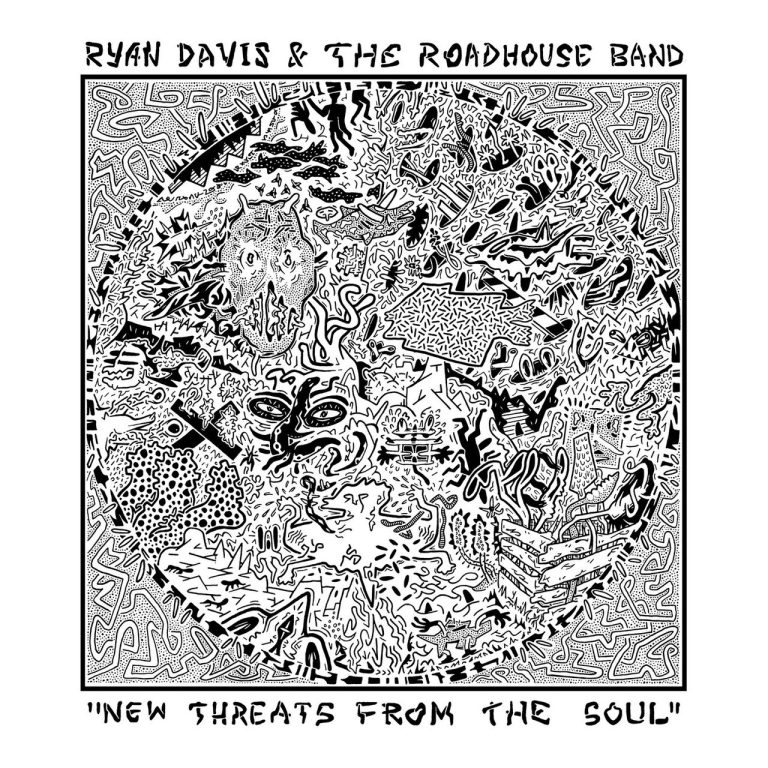

Ryan Davis is of the proliferative bent, his lyrical MO part of a long and important legacy: Dylan, early Springsteen, Jason Molina, Fiona Apple, Jeff Mangum, Katie Crutchfield and David Berman, who, along with Bill Callahan, is probably Davis’s primary vocal influence. Davis honed his skills with his previous band, State Champion, but it’s via his new incarnation, Ryan Davis & the Roadhouse Band, that his explorative and lit-leaning proclivities have come to full fruition. 2023’s Dancing on the Edge was a memorable calling card but on New Threats from the Soul, however, Davis takes a bolder stance, tossing aside pop restraints and aesthetic inhibitions. The result: rambling yet poetically rapturous lyrical streams, wildly shifting melodies, and soundscapes that brim with taste and flair.
“I left my wallet in El Segundo / I left my true love in a West Lafayette escape room”, Davis proclaims on the opening nine-plus minute title track, later adding, “I will never be anything other than a caged bird / Swinging from a chain swing / Whistling for my pay-seed / Pecking on a W9”. The former excerpt exemplifies Davis’s brand of exotica-cum-absurdism, the latter his tendency to pack lyrics with implications that would make a grad student smile: the “caged bird” evokes confinement, the “chain swing” a more benign suburbanism. The “pay-seed” and “W9” references allude to late-capitalistic drudgery. The setting and mood are established. If conflict defines every story, here it’s idealism versus the mallets of history.
Musically, the piece overflows with crisp beats, upbeat guitars, synths, and warm back-up vocals. There’s an everything-including-the-kitchen-sink vibe, and yet, the mix is impeccably balanced. “Monte Carlo / No Limits” is built around acoustic-guitar strums and piano runs, the recording studio meets the honky-tonk joint. Splashes of distortion and string interludes nudge the track toward avant-gardism, though Davis’s country-infused vocal keeps the track anchored to planet earth. Davis occurs as that guy who can be happy with PBR or a pricey champagne and is equally at ease discussing vintage cars and the difference between Plato and Jean-Paul Sartre.
On the softer (and 12-minute) “Mutilation Springs”, metaphors, political shade, and self-reflections abound: “The ransom notes continue as the groceries flee the shelves / I held myself in such high regard when I was someone else”. The Roadhouse Band intuitively segue between starkness and cacophony. “Mutilation Falls” spotlights Davis’s ability to embrace archetypal grief while eschewing sentimentality (“Seems the dream is dead / But the hopes are necrophiliac”). His vocal remains equanimous even as he plunges into sadness, malaise. In this way, Davis reports his content (like a Gonzo journalist) and feels it first-hand (like a diaristic confessionalist).
On “The Simple Joy”, he navigates memorable constructions (“I can barely tell the cattle roads / From the chemtrails of our past lives”; “I keep busy in the daytime / Charging glow worms”; “I learned that time is not my friend or my foe / More like one of the guys from work”), landing periodically in a refreshingly simple yet hooky chorus. On closer “Crass Shadows (at Walden Pond)”, he evokes the mythic fall, albeit in cosmopolitan terms: “I used to hock primordial truths in the faces of men / Now I’m down here pacing the pawn shop pulling IOUs out of ATMs”. Goodbye, innocence. Hello, melancholia. The West, Davis would probably agree, runs according to the dictates of a fabricated morality; the “I” is worthy only in proportion to what it can produce. The track and album end with the lines “I’ll be down at Walden Pond / Waiting on my assignment from the spirit world”, underscoring Davis’s lingering allegiance – our own lingering allegiance – to the quiet pleas of a higher self rather than the bellowing mandates of our intergenerational conditioning.
Davis has a knack for translating suffering and the reality of anticlimax into palatable, slightly humorous tableaus. Like a comedian who’s also fluent with the tragic, he describes our inescapable conundrum in a way that is singular yet accessible. He is a sophisticate and an everyman, possessing both happy-hour charm and late-night gravitas. With New Threats, Davis, flanked by the talented Roadhouse Band, makes his mark, perhaps indelibly, joining a select group of artists who are deepening, broadening, and revamping the Americana genre.
84%