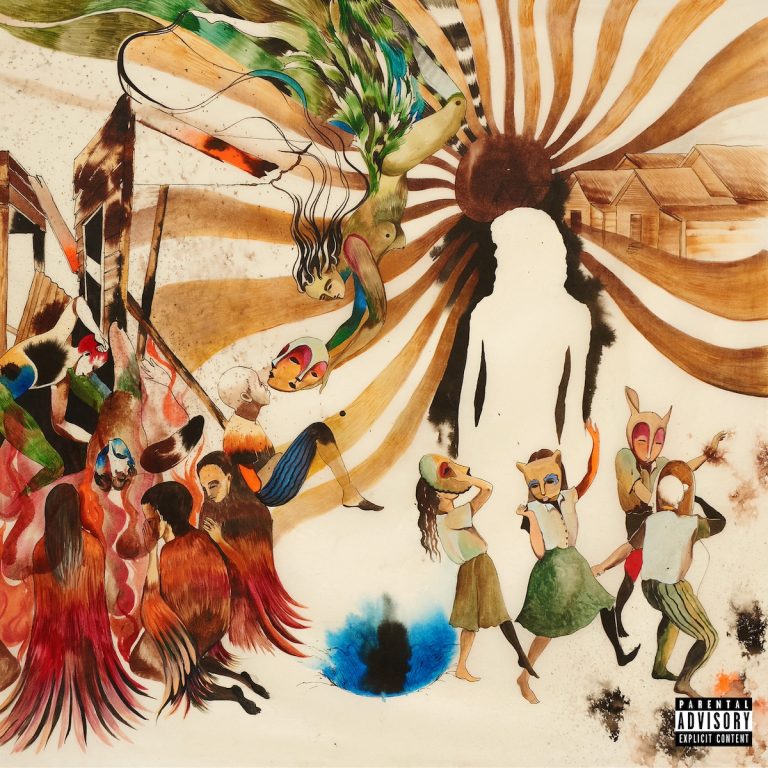
By the time JID slipped into the Dreamville fold in 2017, two underground projects in, he was already sharpening blades in the dark and rapping like someone who hadn’t just studied the greats but memorised their footwork. God Does Like Ugly, his latest and most elaborate display, feels less like an album and more like an annotated thesis. It’s a dense, frantic sprawl, church organs collapsing into synthy LA funk, breakbeats breaking into gospel choirs, post-Dilla detours that jerk the wheel at every verse. But underneath the spectacle is a student who’s turned master, syllables tumbling out like dice, not one of them wasted. It’s been three years since The Forever Story, and JID’s returned with something more precise, more obsessive, and possibly more brilliant than anything he’s touched before.
The album detonates with “YouUgly”, a stuttering barrage of 808s and what sound like snares struck with live drumsticks, percussive, feral. JID and Westside Gunn’s verses slither through three dizzying beat switches, from aggravating bass to gospel organ to some third rail in between. There’s a poetic recklessness to his flow here, controlled, but only just. “Glory” picks up like a sermon midway through revelation: motivational, gospel-tinged, a transposed soul loop echoing beneath syllables that fly fast enough to outrun comprehension. Blink, and you’ve missed something profound.
On “WRK”, a work-song turned war cry, the word “work” is chanted like a spell, clearing space for JID to swing the hammer with surgical precision. “Community”, with Clipse, folds boom bap into something stranger, more urgent – a street sermon steeped in cultural relics and prophetic static. “Gz” rolls in next, bass-heavy again, this time with a sax loop warped and filtered to near-madness, like jazz dragged through a sewer grate.
There’s levity, too: “VCR” opens with a crooked snapshot of the so-called American Dream, scored by Jay Versace’s dusty, collage-like production. It’s about getting paid, and what that does to the soul; guest Vince Staples is deep in his bag on this one. “Sk8”, alongside Ciara and Earthgang, is pure kinetic joy, highlife rhythms undercut by a slippery, melodic flow switch that reminds you JID isn’t just rapping, he’s dancing.
“What We On” arrives dreamlike, reversed bass tones swallowed by Don Toliver’s bold autotuned vocals that bloom into melody before you realise they’re also a flex. Then comes “Wholeheartedly”, an orchestral ache of strings, choirs, Ty Dolla $ign and 6lack cameos smuggled in among layered voices that create the feeling of an entire roomful of different men feeling the same thing.
”No Boo” might be the album’s most luxuriant moment, rich in both male and female vocals (from Jessie Reyez), its piano progression floats like a lover’s memory you’re trying not to forget. “And We Vibing” is a brief interlude, but it’s heavy with meaning, all stacked voices and elliptical phrasing. The following “On McAfee” hits like a half-drunk freestyle at 3AM, nonchalant, grinning, but the syllables still hit their marks with sniper accuracy.
“Of Blue” breathes for a moment, with soft guitars and Mereba’s angelic vocals easing you into a false calm before JID bursts through with another beat switch and sermon. ”K-Word” is cinematic layers of guitar and bass, moods shifting from quiet confession to battle cry. JID’s bars feel almost scriptural here: part diary, part doctrine. By the time “For Keeps” arrives, it’s all come full circle, a plainspoken, gut-punch finale that reads like a memo to his past self: hungry, unseen, uploading verses into the void of SoundCloud while the world looked away. They won’t anymore.
God Does Like Ugly isn’t just a flex, it’s a reckoning. JID isn’t asking for attention anymore; he’s demanding it, not with volume but with vision. There’s a touch of Schoolboy Q’s Blank Face LP in the record’s DNA, not in parody, but in inspiration. Both revel in murky, bass-heavy production that shifts like a mood swing, stitching menace and melancholy into the same breath. The way verses can spin from grimy street reportage to surreal is like a shared instinct, as if both artists are chasing raw honesty through switching distinct alleyways. In that sense, the kinship isn’t just in sound, but in how the atmosphere swallows you whole. Every track feels like a room he’s built from scratch, each syllable placed like brickwork, each beat switch a trapdoor to somewhere deeper. It’s a dense, dazzling body of work that rewards repeat listens, not because it’s cryptic, but because it’s alive. He’s not here to save rap, but to remind us that it still breathes best when it sweats, stumbles, mutates. Ugly, yes, but ugly like truth, like growth, like something you can’t look away from.