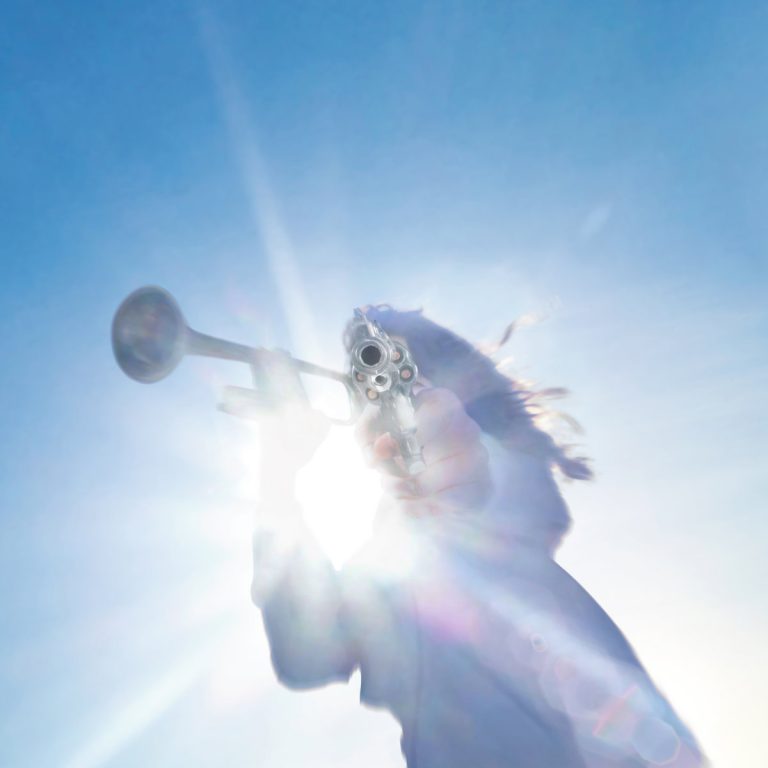

While Geese’s new album, Getting Killed, incorporates the New York band’s art-jazz and prog tendencies, definitive structures and recurrent motifs are readily employed; soundscapes unfurl more as shamanic palimpsests than flux-y improvs. In terms of songcraft and delivery, singer Cameron Winter draws from his solo LP, 2024’s Heavy Metal; joined by his bandmates – Emily Green, Dominic DiGesu, and Max Bassin – however, his idiosyncratic vocals and memeish lyrics take on added relevance and urgency.
The result is a project that frequently sweeps the listener into a trance, ruptures that trance, and then reestablishes it. Think a drumming circle replete with full instrumentation unfolding on a summer night, the event periodically interrupted, or we could say accented, by the sound of cars crashing, the firing of a shotgun, or someone bellowing Help! on the other side of the street.
“Trinidad” features gossamer instrumentation, as Winter pivots between languid, Thom-Yorke-inspired vocals and shrieks straight out of the how-to-get-a-mob-to-pay-attention handbook (“There’s a bomb in my car!”). “Cobra”, with its shimmery guitars and Winter’s croon-y cum Jagger-ish vocals, conjures bygone days while striving to revise the pop playbook.
“Husbands” is undergirded by a casually metronomic drumbeat and sinewy guitar parts a la John Frusciante-era Chili Peppers, the quartet broadening their foundational MO with references to gospel, mesmeric jam, and R&B-inflected lo-fi. Also, as charged as the project is, there’s a newfound sobriety here, an embodied sense of the precarious and tragic, albeit conveyed with theatricality and/or dashes of dark humor.
The title track is crunchier, initially bouncy, then more settled. Clearly the band aren’t afraid to apply longstanding notions re: the hypnotic properties of rhythm, perhaps taking prompts from a band such as the psychedelic Goat. Produced by Kenny Beats, Getting Killed benefits from the popular helmsman’s involvement, the band reconciling any number of sonic opposites: the clangorous and euphonic, the incendiary and laidback, the banal and apocalyptic.
On the stirring “Bow Down”, Winter addresses the fluidity of identity and perspective. “I was a sailor, and now I’m a boat”, he sings, adding, “I was a car, and now I’m the road”. This is Ovid run through a neo-Morissonian filter. The track is a funky iteration driven by an adrenalized guitar-and-drum interlock. Winter is initially deadpan, then more agitated. During the final minute, the band launch into a propulsive foray, reaching for ecstasy. You can visualize the crowd at the music festival gyrating beneath the moonlight.
“Taxes”, too, is propelled by an ebullient guitar and busy drum part, the instruments interwoven yet tugging against each other, creating a palpable tension. “I will break my own heart from now on”, Winter declares, acknowledging that his own desires and aversions are probably the source of his crises. He drives himself mad, but will possibly heal himself as well.
On closer “Long Island City Here I Come”, Winter offers intriguing one-liners (“Nobody knows where they’re going except me”; “The Lord has a lot of friends and in the end he’ll probably forget he’s met you before”; “There are microphones under your bed”). The band builds in intensity and volume, chasing a catharsis, as Winter leaps between desperation and outrage. “Watch out Long Island City”, he concludes, sounding at once supplicatory and menacing.
Whereas some solo releases stand as a way for a band member to express content that can’t be expressed in the band context, with Winter this is not the case. He revels in the songcraft and vocal range explored on Heavy Metal, yet allows himself to be retransformed by his bandmates, who complementarily celebrate the magic of rhythm and creative repetition. In this way, Geese radicalize the conventional, adopting recognizable approaches but with that insurrectional flair so integral to their DNA.
84%