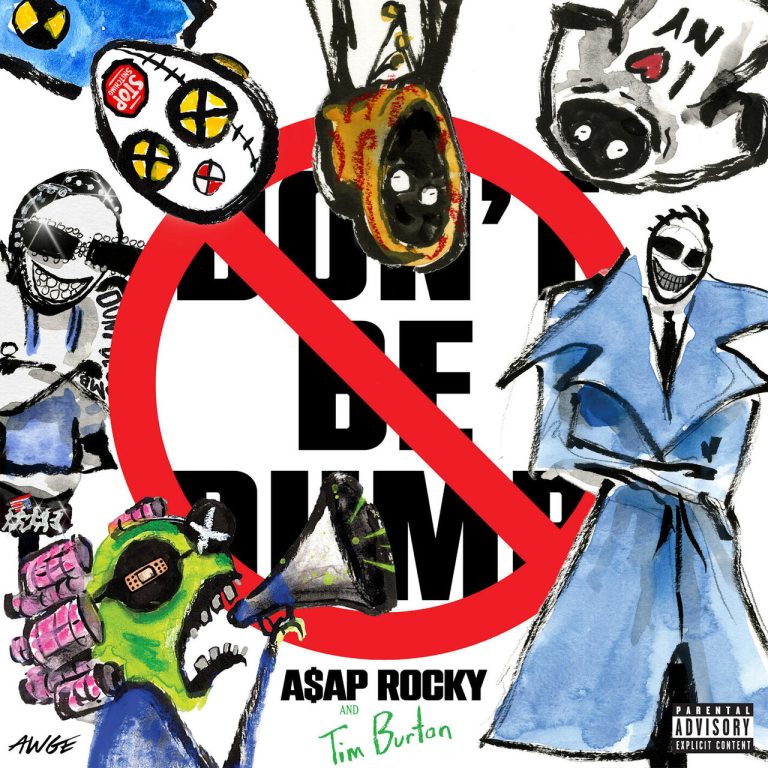

A$AP Rocky’s long-anticipated fourth studio album, Don’t Be Dumb, lands like a reconnection with both his past self and the messy present moment. This is Rocky’s first full project in eight years, arriving after years of legal drama, fashion ventures, fleeting singles and side projects. In the interim, the world, and his role in it, has changed: he’s a father, a style icon, a public figure whose life is lived across headlines and personal reinvention. Don’t Be Dumb feels like the sum of all that, an album that is as much about how he sees himself now as how he’s remembered.
The record opens with a swagger unique to Rocky, familiar yet refreshed, as if he’s dusting off a classic playbook and rewriting its opening moves. From the early bars of “Order of Protection” and “Helicopter,” there’s a sense of kinetic motion: layers of sound that nod to club energy, dystopian horns, and an undercurrent of unpredictable flourishes. The production, ranging from Danny Elfman’s unexpectedly dramatic touches to the psychedelic edges of “Punk Rocky”, feels designed to jolt as much as it grooves.
What makes this album distinctive is its refusal to sit comfortably in any one lane, its diverse style, beat switch and aggravating instrumentals. Rocky is playful one moment and confrontational the next. On “Stole Ya Flow,” he unleashes one of the year’s most talked-about moments: a direct, pointed lyrical jab that’s widely interpreted as a diss aimed at Drake, layered with the bravado and competitive edge of a seasoned artist still defending his turf. It’s a lyric that in itself doubled as cultural commentary, a bold, unfiltered moment that dominated conversations on social media and reflected the album’s willingness to court controversy.
Yet the album isn’t all swagger and battle lines. There’s a surprising emotional breadth here, a side of Rocky that navigates connection, vulnerability and legacy. Tracks like “Stay Here 4 Life”, featuring Brent Faiyaz, samples from Justin Bieber’s “Yummy” can be heard, dissolve bravado into yearning, as warm, immersive production gives space for Rocky to explore intimacy and the cost of existence in the public eye. Collaborations throughout, from Doechii’s jazz-inflected call-and-response on “Robbery” to Thundercat’s Silk Sonic–meets-dream-pop flourishes, help the album shift textures without losing coherence. It’s an album that wants to feel like an expansive world, not just a series of songs.
Still, it isn’t flawless. Rocky’s sharp lyricism and adventurous sonic palette is intact, but some edges feel cluttered or under-tightened, lyrics occasionally meander, and the album’s ambition sometimes outweighs its focus. While the album is often plainly fun to listen to and showcases Rocky’s signature charm, a few tracks lean on overproduced elements or lazy lyrical turns, suggesting a tighter edit could have yielded a more potent statement.
This tension between inspired diversity and uneven execution is the album’s defining characteristic. At its sharpest, Don’t Be Dumb feels like the work of an artist comfortable in his contradictions: at once playful and serious, introspective and extroverted, rooted in hip-hop swagger yet unafraid of cross-genre eccentricities. Rock meets jazz here, punk attitudes there, and classic A$AP Mob bravado throughout, producing a body of work that rolls forward and backward at once.
On cuts like “Punk Rocky”, Rocky’s delivery is unabashedly raw, merging punk rock energy with uptown swagger; on “Playa”, he toggles back into braggadocio with glossy production and rolling 808s. The album’s sequencing occasionally feels like a series of stylistic shifts rather than a single cohesive arc, but that stylistic breadth is also its strength. Whether adopting jazz motifs, dream-pop licks, or arena-ready flows, Rocky sounds like an artist who knows his catalogue but isn’t overly reverent toward it.
Don’t Be Dumb is also inevitably shaped by context: this is the record of a rapper who has lived much of his adult life in public view, through legal scrutiny, personal evolution and the weight of his own mythology. In that sense, it feels like a portrait not just of a man in his late 30s making music, but of hip-hop’s capacity to accommodate restlessness and reinvention. Some will hear the album as a triumphant return after years of silence; others will feel it splinters idea after idea without settling into a masterstroke. Both responses feel true to the record’s layered identity.
For long-time A$AP Rocky listeners, those who keep Long.Live.A$AP and Testing in close rotation, Don’t Be Dumb won’t replace old favourites. But it is, in its own sprawling way, a reaffirmation of what makes Rocky compelling: his appetite for risk, his curation of texture and collaborators, and his refusal to smooth every rough edge. There are moments here that hit like a classic Rocky song and others that feel like interesting experiments begging for another iteration.
Ultimately, Don’t Be Dumb is an album about presence. It doesn’t shy away from Rocky’s past, nor does it pretend he’s finished glancing sideways into the future. It’s a return and in an era where many rappers chase reinvention or retreat into nostalgia, that alone feels like its own kind of statement.