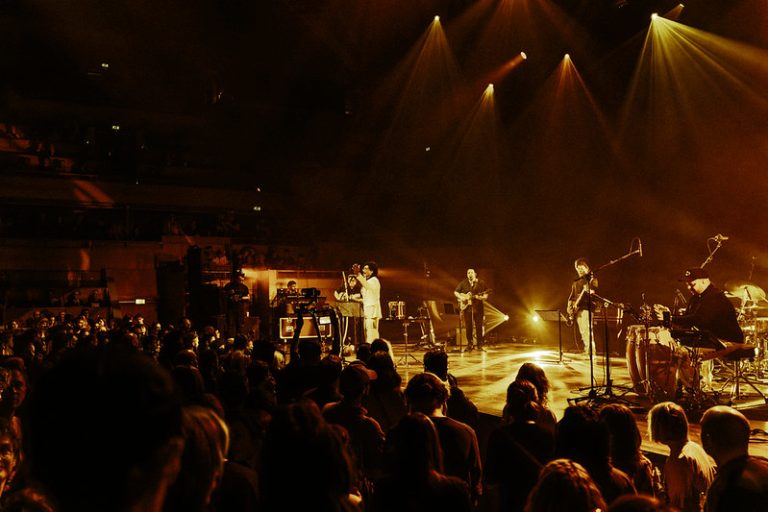
Beats Per Minute’s Jasper Willems once again travelled to Utrecht to celebrate sound in all its dazzling manifestations.
Utrecht is the ideal city for a globe spanning city festival like Le Guess Who?. Unlike Rotterdam, it’s soft and welcoming. Unlike Amsterdam, it doesn’t seal itself shut with that big smoke je ne sais quoi. And unlike The Hague, it keeps the enterprising to a practical limit, forgoing the whole ‘folie de grandeur’. (Note that we love Rotterdam, Amsterdam and The Hague unconditionally in both their flaws and merits).
Everywhere is easy to reach and – aside from dodging unbroken strings of cyclists that possess full autonomy over the town’s spidery network of canals – a fuss is hard to come by. Even when actively trying to court it. Utrecht has this unspoken way of telling you you’re gonna be okay. Bringing over artists from all corners of the globe to a place like it, naturally, the world becomes a whole lot smaller. And, with the risk of sounding like a total sap, you can indeed feel it in the air when Le Guess Who? arrives. Morbidly enough, it’s like being at the airport, except the drudgery of air travel is replaced by live music, art and culture.
As we precariously frolic up and down the escalators of Le Guess Who? central hub TivoliVredenburg – like a bunch of enraptured teenagers who just stumbled upon a treasure map – it’s important to be cognisant of the logistical clusterfucks the festival’s organisation has to untangle each year to make its programme possible. Addressing a crowd at the festival’s opening ceremony, artistic leader and co-founder Bob van Heur couldn’t help but empty all his clips on the realities of working against the oppressive agents of capitalism to keep Le Guess Who?’s mission afloat.
Believe me, it’s enough accumulated stress to post a million Ben Affleck smoking memes into a photo composite of the Ben Affleck smoking meme. The convoluted process to just get the artist visas of some musicians from non-Western regions in order – as touched upon in a 2024 statement by the festival – is illustrative on how much bureaucratic despotism a person can endure. On a more positive note, this world is a vast place – if one artist doesn’t pan out or swayed by a bigger payday – another singular act is waiting in the wings a phone call – or often times, an additional million phone calls – away.
It was a necessary reality check that inspires you to savour each experience and performance, knowing none of this stuff happens out of thin air. Colombian artist Lido Pimienta certainly doesn’t entertain the habit of phoning it in. Behind the sprawling multi-genre body of work – from cutting edge electronic pop to neoclassical – lies an incendiary punk rocker: lest we not forget, Pimienta posed as the Virgin Mary on her breakthrough LP Miss Colombia in fluorescent Wayuu threads. How cool is that?
Pimienta’s immense charisma and vocal talents (she even briefly brandished a fierce heavy metal growl) and percussionist Mas Aya carry the first act of this set at TivoliVredenburg’s Grote Zaal, rumbling its wooden foundations with deviant grooves rooted in porro, cumbia and bullerengue. Then, Dutch ensemble Flare Quartet, marimba player Tatiana Kolevaa and Owen Pallett join the duo on stage to render material from Miss Colombia and latest album La Belleza in newfangled, emotionally charged fashion.
It’s Pimienta’s formidable voice, however, that cleaves through these lush sonic intricacies like a giant solar beam – a voice anchored in tragedy, exile and estrangement, now gleaming in stratospheric joy. Later in the night at the Pandora hub, we catch Pimienta in a more supporting role for Aya’s high-wired mastery of rhythm.
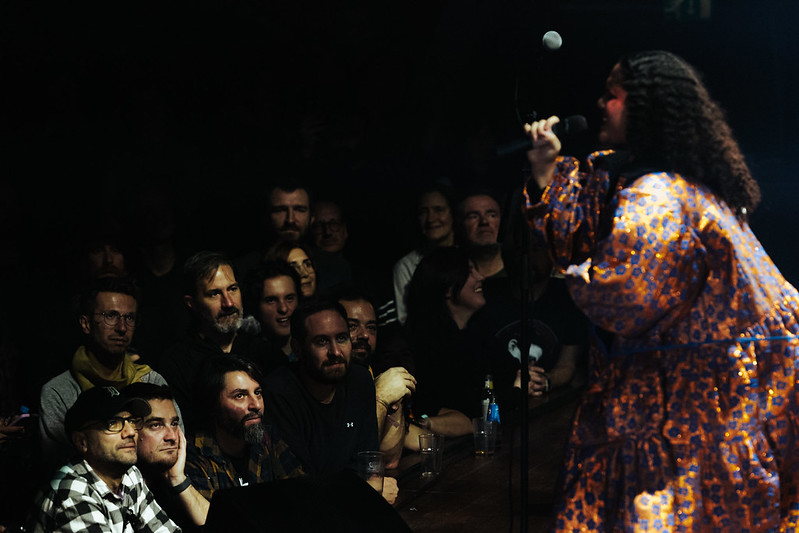
Lido Pimienta (photo: Lisanne Lentink)
Upstairs at Tivoli’s circular expanse Hertz, we meander into a performance by Lebanese artist Yara Asmar – who ventures in to similarly deep-listening purlieu as the late great Pauline Oliveros (Oliveros once graced this very same stage at Le Guess Who?). Asmar cradles her accordion with care, almost like a relic on the verge of dissipating into dust, the sounds emanating in the room feel long forgotten as soon as they are summoned. We often associate this instrument with nostalgic romance – but in the hands of Asmar, this outpour of yearning reverberates until its lofty notes turn acidic. It feels like revisiting an old flame… only find out they have passed to the other side – music like remnants of memory afloat in some imaginary slow globe.
Even higher upstairs, at Cloud 9, UK jazz ensemble Ahmed shaketh us wide awake with their chromatic free jazz, brimmed with atonal repetition, whilst collectively engineering the heft of a small inebriated orchestra. This band must have been forged in the clinking, clattering cupboard of material wonders abandoned by Moondog and later unearthed by Kamasi Washington. It’s kind of a comical contrast, by the way, to witness music that breathes such infantile chaos performed with such studious, straight-faced precision.
Every Le Guess Who? you just walk dead cold into a stunning performance you didn’t even plan to see. It makes one wonder what’s the point of planning things to begin with? The stunning Jacobikerk always seems to be at the heart of ‘what the fuck is this?’-ville – vocal ensembles from Epirus and Pakistani qawwali masters have previously treaded these sacred grounds.
Here, Merope – an ensemble comprised of Lithuanian kanklės player Indrė Jurgelevičiūtė, musician Jean-Christophe Bonnafous and Belgian multi-instrumentalist Bert Cools – is joined by American composer Shahzad Ismaily – in what struck less as a musical performance, and more like opening a well of souls. At magic hour no less, this music – a seamless coalescence of ancient and traditional means – never seemed to strain or be coaxed into familiar structures: eternally at ease in unabated continuum.
To reference this kind of music is a folly to begin with, but the reticent beauty of the Popol Vuh scores, or the later Talk Talk albums, did cross my mind. This is music that shifts your experience of time and space as a total and complete unburdening. Every time Merope flirted with some kind of build-up or crescendo, the music fluctuated like tranquil ocean waves lapping at your feet. When Jurgelevičiūtė started singing, and the lights change into a deeper blue, it felt like the entire Jacobikerk was lifted from its foundations into outer space. The transition from daytime to nightfall felt tactile under Merope’s otherworldly spells.
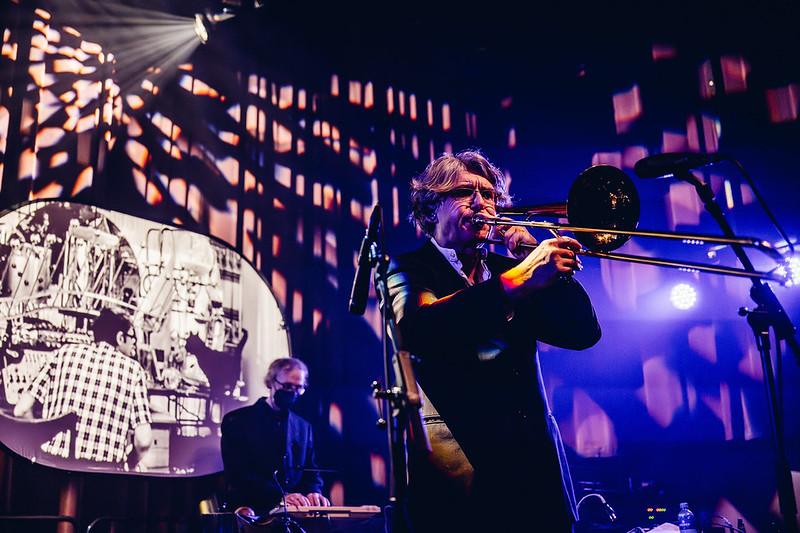
Pram (foto: Maarten Mooijman)
After gathering our bearings over drinks and snacks down the road, we catch a bit of Pram‘s set at the Pandora. Their whimsical, spooky psych pop is bolstered by some retro sci-fi imagery that would surely endear fans of War Or The Worlds and Isaac Asimov, and you can surely deduce why this bunch is often considered your favorite band’s favorite band. I mean, put a grimy hip-hop beat over Pram’s delightfully macabre compositions and you basically get Portishead.
Downstairs we catch a bit of Alabaster Deplume at the Ronda, and the saxophone player/freejazz poet already fully locked in the compulsive habit of dissecting the things often taken for granted, treating the soundcheck like just another part of the performance. During the actual show, we stood close to a young mom and her baby in the audience, and I couldn’t help but wonder that through this baby’s eyes, Deplume might actually come across as a harlequin-like figure out of a fantasy novel.
Back to the Jacobikerk, where Daniela Pes and IOSONOUNCANE summon up an electrical storm of the push-and-pull variety: especially during the sporadic vocal harmonies between the two, stolen moments of clarity in a realm where discord and confusion act as saboteur. In a facing-each-other Fuck Buttons type setup, the arpeggiated compositions they conjure together almost manifest like a wall between them – an invisible barrier their expressive singing attempts to pierce through momentarily. Though torrential and torrid, it felt challenging to crack the armor of the duo’s bewitching reciprocity from the outside listening in.
keiyaA‘s fascinating EKKO set proved that she stands firmly at the vanguard of alternative R&B music. This is a style usually anchored by big emotional beats and resounding vocal flourishes. Those expecting that type of performance will leave keiyaA’s performance either confused or flustered. Her music is a monolith of disarray and compulsion – lyrics straddling the unprocessed quality of text messages or torn-off pages of a diary entry. keiyaA’s work is visceral and keys in on her emotional state more so than tying things up with a clean narrative. She manipulates her vocals real time as she singing – warping and pitch-correcting – making the storytelling depth of her music implicit through sheer impulse.
Both DJ Haram and Aquiles Navarro dazzled at previous Le Guess Who? editions with high-octane sets. The former wowed everyone in 2018 with 700 Bliss alongside Moor Mother. During 2021’s COVID shortened edition, Navarro and fellow Irreversible Entanglements-bandmate Tcheser Holmes opened up a wormhole of recorded music’s entire history just between just the two of ’em. Safe to say expectations are high. Their dual closing performance at Pandora on Friday wasn’t of the crowd pleasing kind – instead treating the audience with a genre-blending voyage where Haram’s beats serve as celestial bodies between Navarro’s stargazing trumpet playing.
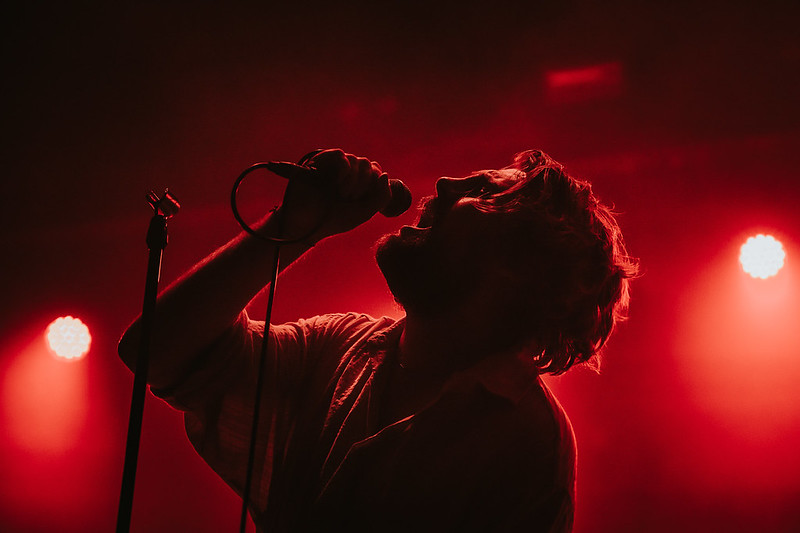
Gilla Band (photo: Maarten Mooijman)
At the boisterous afterparty at The Helling, we caught Gilla Band arrive exasperated yet satisfied from their secret performance at Ronda. The slight melancholy did briefly overcome us: one of the greatest live bands of the moment isn’t something you intentionally let pass by. But bewilderment ultimately wins out. Let’s face it, it’s the ultimate flex that Le Guess Who? can pull this type of shit with its audience time and time again. There’s a point to make in there too somewhere: something something something about ‘rewarding one’s own curiosity’.
You either plummet unthinkingly into the arms of a Sure Thing, or you are struck dumb by something wondrously unknown. It’s always a win-win if you allow it to be. These fickle Question Mark-gigs make you realise what it’s all about, especially in light of so many festivals marketing themselves on ‘who’s playing’. That’s only secondary to a notion far greater: the full, devotional embracing of one’s curiosity. To allow yourself to be surprised and be caught off guard in the best possible way.
That vintage punk spirit is very much omnipresent – not to mention multi-generational. The Raincoats-firebrand Gina Birch played a thrifty, entertaining and at parts poignant solo set at The Helling, closing off by bending the gloomy Joy Division-staple “She’s Lost Control” into her own cheeky cheerleader anthem “Causing Trouble Again”. In that particular track, Birch pays heartfelt homage to some of her fellow female revolutionaries – from Angela Davis to Ari Up to Ursula Le Guin. Sudan artist MAHA might join this list sooner rather than later, if her austere set at ACU was any indication. She bookended the gig with her heartfelt outcry to her warn-torn homeland.
MAHA’s performance was preceded by a freakishly loud set by Tonto, a masked drummer who has a coiled mask attached to the top of the stage. When Lightning Bolt’s Brian Chippendale put on the mask and became Black Pus to inspire people, I’m not sure this is what he had in mind. But as far as noisy catharsis goes, Tonto’s set did the trick, leaving a lot of disturbed faces in its wake. When visiting the merch table, we were actually relieved that the man behind the mask is actually not in as much peril as it appears on stage – his mom even made cutesy hand-sewn phone cases for him to sell.
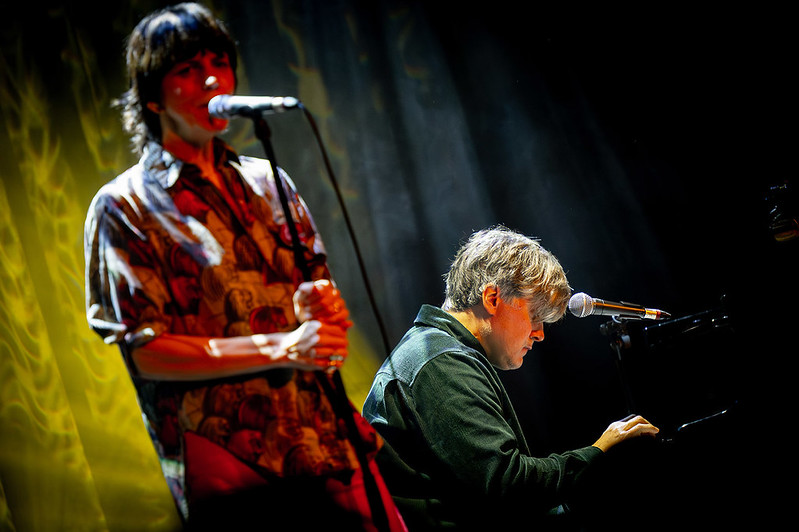
The Fiery Furnaces (photo: Tim van Veen)
The Fiery Furnaces performed De Helling with just the two Friedberger siblings, a setting that poetically split the room down the middle. It took some audience members to decide one song and and a half was quite enough to endure the duo’s eccentric pop vignettes. The other half, was univocally charmed and moved by Eleanor and Matthew’s musical performance. Count this one among the latter group: if most people were to perform repertoire as surreal and outlandish at this, joking and laughing would likely make an easy sell.
But fascinatingly enough, Eleanor remained steely throughout, almost defiant even, as the venue emptied to about one third of its capacity. Her older brother is hunched transfixed behind his piano – still looking very much like a flustered church boy practising for his first recital. The music’s insistence to not give into cheap emotion felt like an endurance test, with Eleanor’s thousand-yard gaze practically daring onlookers to call bluff. Truth of the matter is, that those songs are so firmly ingrained in the siblings’ system, you can’t possibly imagine anyone else writing them, let alone perform them.
The Fiery Furnaces Unplugged was indeed many, many things: part-avant garde pop surrealism that would probably have made White Album-era Lennon an instant fan of theirs, and part sullen cruise ship act. Even if it’s sad and cold at the bottom of the sea, those who remained counted their blessings for having their blueberries with them. A warm smattering of applause sent The Fiery Furnaces off – let it not be the last time we see one of the most inventive pop duos doing that thing only they know how to do.
Speaking of individuals who bring something indispensable to the world of music, legendary Brazilian musician Índio da Cuíca is the guy when it comes to mastering the cuíca, a high pitched percussion instrument that sounds a bit like a French poodle. After playing on many legendary samba records Índio has only made his first solo record, back in 2021, Malandro 5 Estrelas. It’s kind of baffling to see him only lead a band until now, because this guy is all charisma – coming out swinging with various cheeky cuíca impovisations (and samba dance moves). This includes a whoopy version of “Samba do Brasil”, a moment of collective recognition that gets the people clapping along. Then, on a dime, his entire backing band jumps in cold, immediately getting everyone moving. Spectacular stuff.
Like Índio, DJ Marcelle brings a similarly wholesome exuberance to her craft, working the entire Pandora into a jovial frenzy. Marcelle has been an underground legend for decades, and tonight we see her truly going the extra mile to go over and beyond of what seems like the accepted norm of niche-based raves. It’s chaotic, sprawling fun, using time-honored hardware to juxtapose all the past decades of dance music – from nostalgic sounds the cutting edge – like some kind of mad scientist. Oh, right, some bleating goat sounds are tossed into the cauldron for good measure, piling up the deliciously crackpot tableau. It’s like watching the Royal Rumble, but then presented as this flummoxing DJ set: each breakneck stylistic shift ramping up the vibe. Gloriousness.
Saturday’s Question Mark act Los Thuthanaka (Chuquimamani-Condori + Joshua Chuquimia Crampton) delivered one of the weekend’s loudest, most engrossing performances. It struck like a myriad of influences – from Andean folk, power electronics, The Residents-ish avant-pop, to the early, more primal Animal Collective material – compressed and scrambled into some kind of swelling digital maelstrom: overdriven to the point where everything becomes rabid and feverish – addled beyond recognition or context. Sometimes it felt a little gauche: these supple latin rhythms stuck in the too-small-cage of electronic geometrics, to the point where they start attacking each other like laboratory animals.
The duo execute this crushing madness with comically calm aplomb: I mean let’s face it, the guitarist doing the whole Billy Ray Cyrus-posturing over this type of bleeding edge music is really funny. Occasionally, Los Thuthanaka bookend another juggernaut noise incursion with a congenial hat tip. I get that this music has a probingly revisionist and incantational quality – and the means of how roots music is alchemised with high-end electronic sounds is without question original. But I felt a great chunk of the audience were simply content with extracting the music’s extremities to achieve some state of delirium – and that rung oddly hollow to me.
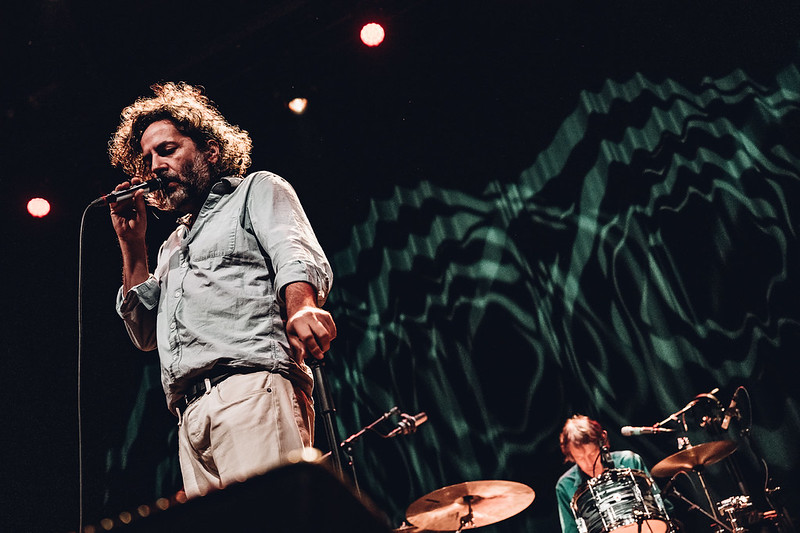
Destroyer at Le Guess Who?
“Did you realise it was hollow?” is exactly one of the perusals Destroyer‘s Dan Bejar seethes through his teeth with palpable dejection, during the festival’s final Question Mark performance. It remains a hoot to see the Steely Dan-esque inner city bluster of this immaculately tight band be such perfect strangers with Bejar’s scathing, shambolic lyricism, badgering listeners about a “comedy of souls, a plot thick with holes / In a windowless room on the outskirts of town overlooking the river” while an amorous serenade of brass and piano swoop up in a flourish like some magical technicolor rainbow.
Destroyer has played Le Guess Who? several times – back in those like early, early days, the festival was initially designed as a showcase for Canadian bands before it developed into the globe-spanning event it has flourished into now. Suffice it to say, we haven’t come much closer to deciphering their brilliance within that timeframe. While some question marks never dissolve into resolutions, it’s those question marks that inject that inner wonder that keeps us coming back.
Fittingly, a colossal Ronda-performance by Moin wraps itself around the onlookers like a warm blanket , emitting uncanny benevolence from such an apologetically loud band. Looming over the tremors and squalls of drums and distortion, a larger voice bellows, one that strikes like something close to divine. Perhaps a belief that our curiosity will always be honoured, if we choose to open ourselves up for it. In that respect, curiosity might be just be another expression of unconditional love – a sentiment Le Guess Who? implicitly bequeathed to us once more.