
In Christopher Nolan’s only good film, 2000’s Memento, the anterograde amnesia that protagonist Leonard Shelby suffers from means that he has to rely on unreliable aids – polaroids, tattoos, and hastily scribbled notes – in order to make sense of his world. These symbolic props act as a metaphor for the postmodern condition where objective truth is questioned and lived experience without recall is a less than perfect state. The tendency to record everything today – from concerts to scuffles in the street – is making memory a redundant human faculty. This, by the way, is a bad thing.
Attention spans may well be diminishing in the face of instant gratification achieved by the dopamine release that doomscrolling provides, but it’s the erosion of our need to remember that’s perhaps most damaging to a sense of valuable lived experience. It’s erasing our humanity, it’s as simple as that. Even time-faded memories are better than recorded ‘actuality.’ Boards of Canada understand this. I mean, there’s a track here, on their first album in 13 years, called “Memory Death,” so…
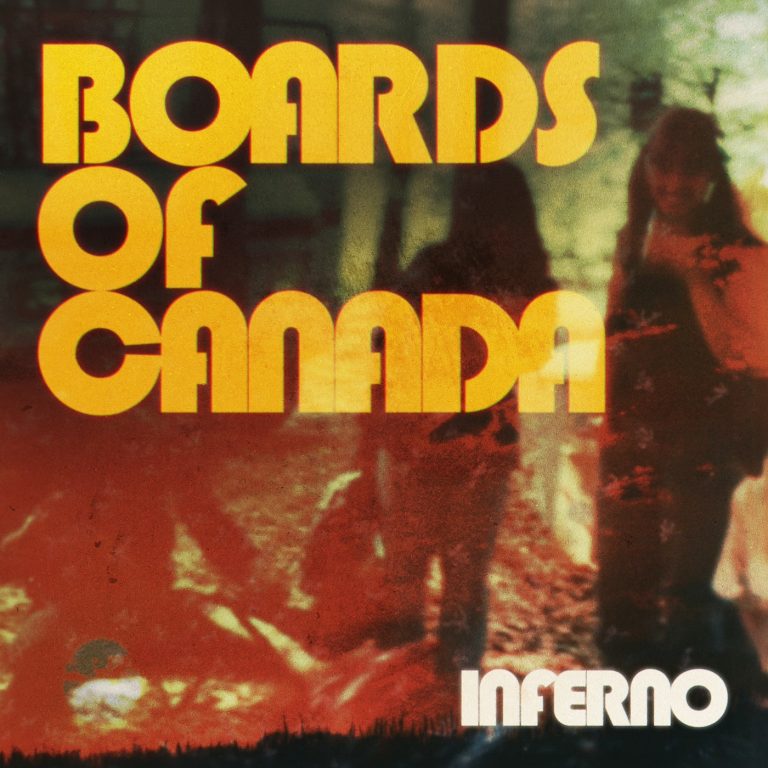
The Scottish duo’s work to date has centred on analogue warmth, nostalgic melodies, and the concept of memory as cocoon. There’s an amniotic fluid quality to their back catalogue that’s surprisingly missing here as Inferno has a much more clinical and driven feel overall. That’s not to say it’s cold – it’s anything but. It just feels more aware of the current state of things. It’s a record that is cloaked in their signature audio tones, yet it weirdly feels like a step away as it inhabits the here and now rather than some re-imagined past. Rather than existing as an outlier to contemporary culture, Inferno feels like the most prescient and political work that Boards of Canada have ever produced. Mike Sandison and Marcus Eoin have often felt like an anomaly existing within a liminal space of their own making, yet this record feels like a much more pointed statement of intent. This, by the way, is a good thing.
Anyone familiar with their previous albums will recognise familiar tropes from their catalogue here – lackadaisical beats, samples that sound familiar yet also alien, and a glacial pace to the arrangements that essentially leads each song absolutely nowhere. But there’s a spring in the step of Inferno that places it as the (*deep breath*) pinnacle of their output to date. There’s a clean sound to the production which foregoes their usual haziness, and as oxymoronic as it is, there’s a sense of purpose to the record’s meandering nature.
The voices across the record are entirely dehumanised: computers either proclaiming “I am God” (“Prophecy at 1420 MHz”) or failing to spell the word marvellous (“Age of Capricorn”), human voices with vocoders placed upon them to make them feel entirely performative and lacking in authenticity (“Father and Son”), and a narration about foetal development on “The Word Becomes Flesh” that is so devoid of any humanity that it feels like it’s sprung from the pages of Aldous Huxley’s dystopian masterpiece Brave New World. The record separates the organic from the organised; human coping is seen as more impressive than computer coding.
“Hydrogen Helium Lithium Leviathan” is the most quintessentially Boards of Canada-y that Boards of Canada have sounded since Music Has the Right to Children almost 30 years ago. It’s one of many high points on the record, but where this is reverential to the band’s past there are tracks on Inferno that feel like a departure, though not wholesale.
“Naraka” has a very assured feel to it, almost a swagger, which is contrary to their usual sense of introversion and anxiety. There are still pessimistic chords at the song’s heart, but they feel usurped by the urgent synth bass that is the track’s propulsive epicentre and the twinkling keyboard lines that cascade throughout. The vocal chanting – or appropriation of – are the warmest voices on the record. Where the lines of dialogue across the album feel distended and obfuscated by abstraction, collectivity brings focus. There is power in unity.
It’s difficult to discuss Boards of Canada without relying on cinematic references – Blade Runner, Silent Running, and Solaris are all present in terms of aesthetic association and visualisation, but where those masterpieces lean into pessimism Inferno remains achingly optimistic (perhaps despite itself). “Prophecy at 1420 MHz” – the lead single from the album – could well be the key that unlocks the intention behind the record as a whole and connects to the concept of science fiction. 1420 MHz is the frequency of the hydrogen line, or the “Wow! signal” that many believe points to extraterrestrial radio transmission communication first observed way back in 1977. This feels a long way from the post-apocalyptic tones on 2013’s Tomorrow’s Harvest as we’re looking up at the stars rather than down at the barren land.
“Into the Magic Land” has a childlike awe to it with simplistic patterns repeating and swelling, making it reminiscent of the all-too-often overlooked instrumental post-rock band Rothko, while “You Retreat in Time and Space” weaves a nostalgic, 1970s tinged aural tapestry where everything is just slightly out of focus and reminds you – for those old enough – of the tracking function on old VHS players. Album closer “I Saw Through Platonia” is probably/possibly/definitely the best track Boards of Canada have ever produced. Referring (perhaps) to Julian Barbour’s concept of a mathematical notion of a timeless landscape where everything is possible all at once (yeah… I’m not doing a great job of explaining this but no doubt there are tonnes of sexless TED Talks on this matter that you can probably find online – this is a band who are clear that “Music is Math,” after all), the track shimmies and shines before fading into nothingness/everythingness. It’s gorgeous, and if this is to be the last Boards of Canada release then it’s one hell of a bow and statement.
Inferno centres on the fragmentation and erosion of memory, on the concept of human performativity, and the notion of simulacra as pure distraction. Whereas a masterpiece such as William Basinski’s The Disintegration Loops plays on the concept of time as an incessant eroding factor, there is an optimistic core at the centre of this record that feels juxtapositional to much of their earlier work that places a focus on the past rather than the present. Here, though, Boards of Canada are firmly rooted as documentarians of the ruinous now.
There is, however, hope. If we lose the ability to remember, then we lose the ability to tell the stories of our lives – and that’s all we have as humans. It’s what it all boils down to. Stop filming and photographing, and start experiencing life like you’re meant to – be a series of tales, not a collection of images. As Maude Chardin said so pointedly and lovingly in 1971, “L-I-V-E – live!”
90%