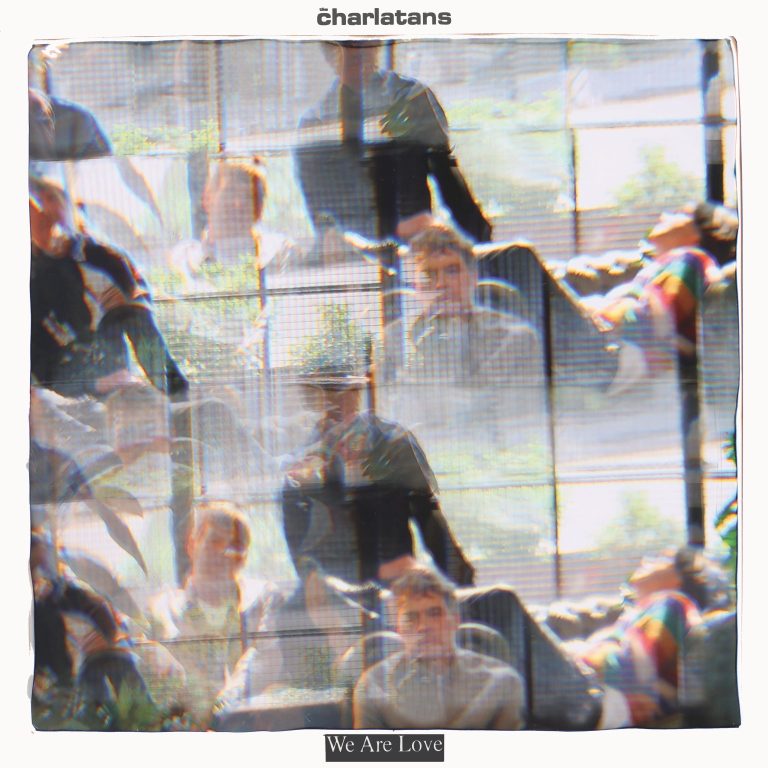

Grief is a funny old thing. It often ebbs and flows, with no pattern or rhyme and reason. It can sneak up and smother you, and it never really leaves. There’s no single right way to deal with it, despite what the narcissistic ‘well-being industry’ might tell us. There’s always a guilt to be felt when you’ve lost someone and you then experience joy, a sense that you should be forever in a state of mourning, self-flagulating pity and remorse at things left unsaid.
On their first album in almost a decade, The Charlatans (aka The Charlatans UK to some) deal with the well-documented ghosts and dark places that have been a feature of the their story. The band returned to Rockfield Studios in Wales to make We Are Love, the first time they’d been back to work there since keyboard genius Rob Collins died in a car collision driving from the studio in 1996.
Derrida’s concept of hauntology permeates the record, an idea that what has been lost (or what never was) still affects and often determines the present. As artists get older, there’s bound to be a sense of loss in their work as has been handled brilliantly in recent albums by Suede and The Cure, and We Are Love can be added to this body of work. Where the other two bands – understandably, perhaps – had elements of angst within their lyrics, The Charlatans channel their grief in a much more positive, perhaps pragmatic, manner.
The first verse of album opener “Kingdom of Ours” opines that “The curtain is coming down”, but rather than being a maudlin sentiment, there’s a sense of euphoria within the swelling music and the lyrics talk about the small, mundane things that deliver us from pain. With a recording team of Dev Hynes (aka Blood Orange) and Stephen Street behind the project, there’s a sense that the swirling keyboard lines in the background could be more prominent – a minor point, perhaps, but it’s a mixing decision that seems to misinterpret what the song is about.
The album’s first single, the rip-roaring “We Are Love”, felt like a return to form after the middling albums Different Days from 2017 and 2015’s Modern Nature. Those albums often felt tired, lacking in both direction and purpose, and felt like a band trying to catch past glories. Here, though, there’s a pop hook that’s eluded the band for way too long, and the double hit of the eponymous track followed by “Many A Day A Heartache” feel like a band reinvigorated, reenergised and it actually sounds like The Charlatans are enjoying making music again. For a band (sadly) firmly ensconced in the ‘heritage band’ label for many, these will be welcome additions to any live set, for sure.
By the time “For The Girls” arrives, there’s a clearer sense of what the band are trying to achieve on We Are Love. This track sounds like a prime cut from 1999’s Us and Us Only, and here is a band looking forwards whilst acknowledging the persistence of the past. Tim Burgess is clearly referencing elements of the band’s past with the lyrics “Just feels so wrong / When we don’t get enough / Like in a country song”; a not-so-veiled reference to “North Country Boy” (a terrible Charlatans song, by the way – sorry!) and issues the band faced with a fraudulent accountant who took loads of their money. Burgess then goes on to sing that “When the money rolls in / The hunger moves out” – he’s aware that financial success often leads to a dip in the desire to actually create rather than churn out material. An interesting confessional but again, the organ is just too quiet in the mix.
As someone once said “What is grief, if not love persevering?”* and love, unsurprisingly, is a key theme here. After all, love is the key, and if we don’t love then we don’t lose. The album regularly flits between the dichotomies of romance and death. “No matter where you are / There’ll always be a fire inside my heart” sings Burgess on “Deeper and Deeper”; a love song for the ages. In the middle of the heartbreak, there’s room for finding new love and for having your head in the clouds so much that you’ll never want to come back down. It happens. Burgess makes it clear that “It’s only ever about the ones we love” and in a world seemingly tipping over with manufactured hate, it’s a valuable mantra right now. Love not hate, people. Always.
For an album that has loss as its central theme, there’s a joy at the heart of We Are Love which is irresistible. “Out On Our Own” starts with a dreamy, Spacemen 3-style keys and bass intro that, honestly, could have been the whole song. It’s a song in three parts, but they often intertwine too much where a breath between sections might have been a better idea. It feels like Cerberus chasing its own tail at times, but it reaches a heady climax by its end and despite feeling skittish at times there’s more a sense of overlapping ideas leading to exuberant joy more than anything else.
There are, inevitably, some mis-steps on the album. While “Salt Walter” is a weird, hypnagogic track that’s of interest, it feels like an unnecessary interlude. If you’re going to audition for the job of writing the soundtrack to a whimsical Spike Jonze film about the bittersweet nature of childhood memories, then maybe send it directly rather than slapping it here. “Appetite” is another that doesn’t quite hit the spot, which is a shame as it has all of the constituent parts to be a cracker but it just feels flat.
The album closes on the double-header of “Glad You Grabbed Me” and “Now Everything” – the two most heart-on-sleeve tracks on an album filled with looking back. Burgess would never claim to be the best lyricist in the world, and even his most ardent devotees would find this an impossible position to argue, but the naivety of the rhyming couplets on “Glad You Grabbed Me” only adds to the sense of sweetness in the narrative drive of the song. He does seem like a really sweet guy, after all. The nostalgia-filled song is Burgess voicing his gratitude at The Charlatans taking him on from his previous band (the awfully named like The Electric Crayons), but the song still looks to the future rather than being the final act.
“Now Everything” is the most sonically ambitious song on We Are Love, and where “Glad You Grabbed Me” looked to the past, this song is firmly positioned in the present. Its funereal pace underplays its sense of positivity, and musically it wanders into psychedelic soundscapes towards the end that could – should – have been much longer.
Overall, We Are Love is a welcome return to form. Okay, they may never reach the heady heights of Between 10th and 11th again, but we should just be grateful that they still exist and are still looking to move their sound forward in ways that many of their ‘peers’ seem incapable of. It doesn’t always hit, but when it works it’s a glorious thing.
*The Vision said that in WandaVision, by the way – hell of a line.