BPM’s Jasper Willems revisits the experimental The Hague festival ’s 15th edition.
Systems are meant to be broken. You think sound gives a fuck about digital metrics? You think physics make way for algorithmic drives? You think vibration and frequency will politely stop existing in favor of artificial simulacra? Ha! When it’s all said and done, the laws of nature shall be undefeated.
In light of that statement, I suppose you could say ‘Where there’s sound, there’s free will’. The Hague’s Rewire is one city festival eager to work out the science behind this all – the seemingly never ending potential of sound harnessed by our very fallible, very human hands. Generally speaking, artists programmed at Rewire have a keen sense of how this power can be wielded in contained and public spaces alike. Its programming feels bolstered by the belief that sound can be a medium for transformation, for critical discourse or perhaps even a reimagining of our current realities.
At Paard, experimental hip-hop duo Armand Hammer – ELUCID and billy woods – light the match with a taut rendition of “Laraaji”, the arresting album opener of the duo’s latest The Alchemist-produced LP MERCY. Within the beat’s fractured silences, woods and ELUCID’s heady wordplay becomes the connective tissue, the latter orating dreams of “becoming ungovernable”, while the former goes just as deep in his lyrical pocket: ‘The world doesn’t turn anymore/Half burns/The other side will never thaw/ Burning books to keep warm’. Armand Hammer opt to swing away with the abandon of the great jazz masters: an open floor for woods and ELUCID to bypass any systems in the playbook with their firebrand lyricism.
Mandy, Indiana are similarly unapologetic in courting disarray: the quartet’s debut LPi’ve seen a way introduced their strangely cinematic, claustrophobic noise pop. Yet on their recent second album URGH, the band smashes those first cracks into the corridor walls. This progression comes with more clarity on what to convey on stage. The one song performed in English by French vocalist Valentine Caulfield, “I’ll Ask Her”, has a crystal clear message attached, the structural violence against women still remains largely unanswered for. Though even heavier and more abrasive than before, the catharsis of the band’s show at the Concordia ultimately eclipsed into an act of joy and revolt. Caulfield spends the final songs joining the crowd below in stirring movement; her raving mad cackle towering over both the sea of limbs and the racket guitarist Scott Fair, synth player Simon Catling and drummer Alex MacDougall discharged up on stage.
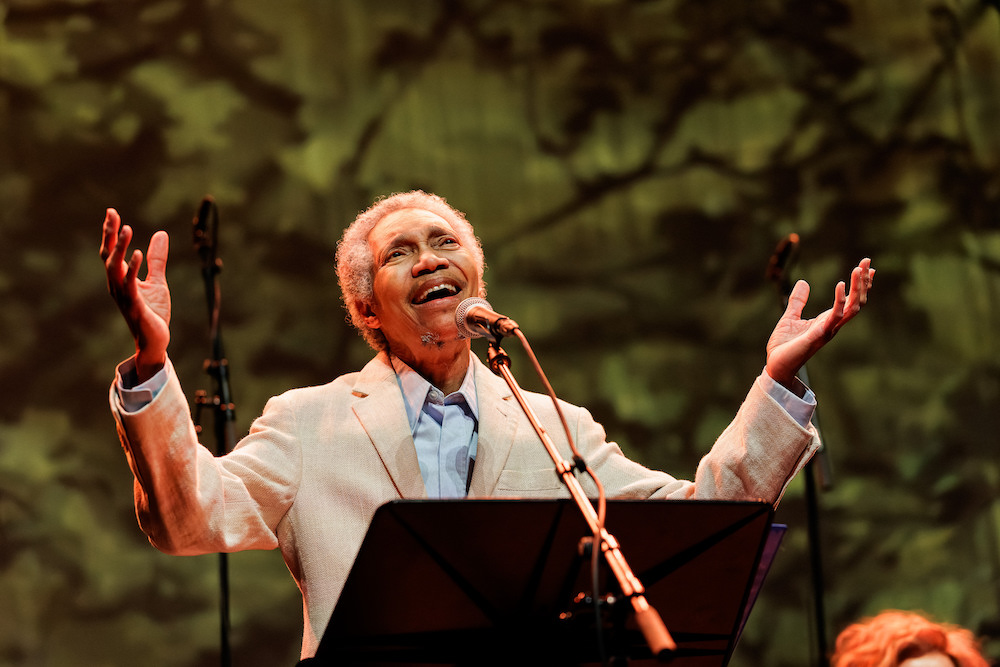
While Armand Hammer and Mandy, Indiana’s shows expressed the shellshock and the sprawl of coping with modern living, Beverly Glenn Copeland and his partner Elizabeth Copeland’s performance drinks holistically from life fulfilled. Glenn’s voice remains one of resonant wonder despite his current illnessnes, fluttering crisply through Amare’s concrete framework. His lost classic Keyboard Fantasies is a tryst between technology and spirituality, a shining example how these supposed opposites can form a nourishing synthesis. It makes one yearn to grow old when countless minutiae of moments blur into an outflow of experience. To a point where even the use of words in song feels obsolete.
Spoken language can either reduce or amplify sound, as inquisitively interrogated by Juana Molina in a fun live interview at Grey Space in The Middle. Some artists at Rewire use words to reframe the past in a virtuous bid to change the present. Alejandra Cárdenas is a familiar face at Rewire, having summoned storms with her guitar (under the moniker Ale Hop); as well as interrogating sounds not even above a whisper, as part of projects like The Paper Ensemble. At Nieuwe Kerk, Cárdenas is flanked by musicians Gibrana Cervantes and Ignacio Briceño to bring new project A Body Like A Home to Rewire.
The audience is treated with a downright stunning performance that strikes more like a broadcast than a concert. Zeppelin-esque blues licks congregate with kosmische synth tapestries, while Cervantes’s dirgeful violin drones evoke German experimental rockers Popol Vuh or early Godspeed You! Black Emperor. The focal point isn’t sound-based abstraction, but Cárdenas’s unambiguous poetry delineating the political unrest of her home country from various vantage points. Within the swirling compositions, each player enters the orbit of Cárdenas’s words like an invasive musical agent. It’s almost like turning the knob of an analog radio really slowly, hearing different music coalesce within the same signal. The only difference here is the absence of static obscuring the message conveyed above it all.
At Korzo on Sunday, M. Alberto’s RADIO VITO performance creates a similar monolith for political revolt, albeit more whimsical and frantic in its overall execution. A large projection screen depicting a documentary about the slave uprising in Curaçao against the Dutch colonists brings necessary context. Parallels are depicted between modern activist movements and the 1795 uprising led by Tula, who was inspired by Haiti using the power of language to break free from French occupation, M. Alberto and their band dovetail these narratives through free-jazz rhythms, rap and classical instruments: all of them coalesce in inteprid, restless fashion, expressing urgently how there are still many, many battles to be won. No dulcet pop anthems here to cut corners, for change often comes with pain and discomfort.
Then there are the artists who carve novel paths within the conventions of quote unquote traditional song. At Theater aan het Spui, My New Band Believe stretch their songs like silly putty, cutting out new sonic and emotional pathways by osmosis. At various intervals recalling Van Dyke Parks, caroline and Destroyer, the sheer joy in these four young musicians deviating and locking in has the crowd aghast in wonder. Inbetween songs, band founder Cameron Picton (formerly of black midi) quips that he’s pleased the crowd came to watch an “indie rock show” amidst all the adventurous sound-making – even though My New Band Believe don’t really sound like any indie rock outfit I’ve ever heard. Sometimes the best way to frame your adventurist streak is to treat it as something self-explanatory and not so super high brow.
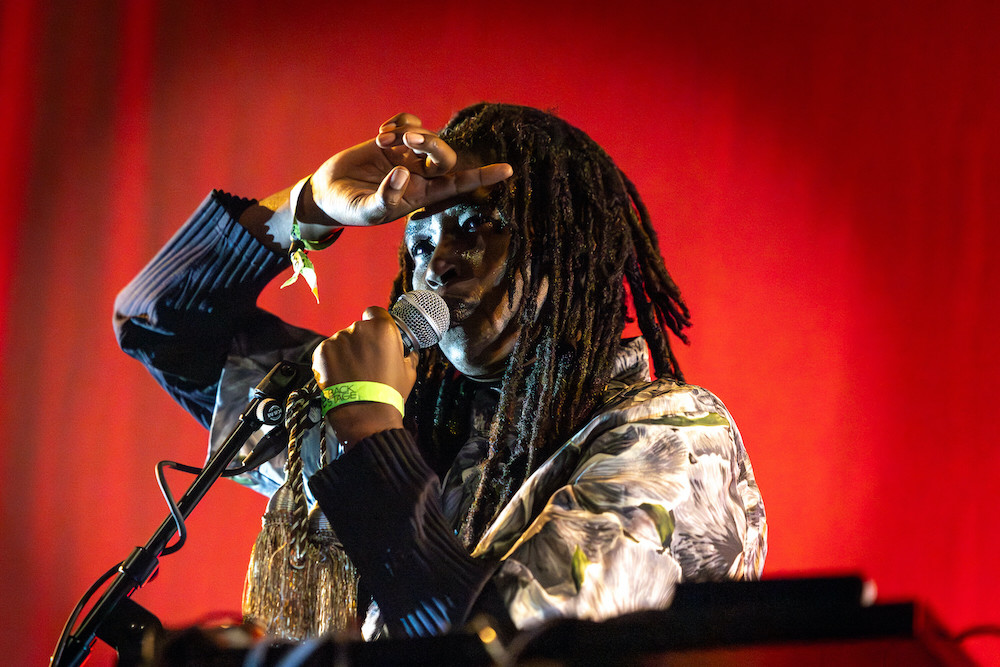
The alliance of post-metal behemoths Sumac and wordsmith/composer Moor Mother at Amare put the onus on pure, untethered expression over instrumental prowess. Like Picton, Moor Mother is keen to cut through the formalities early in what was a battering ram-like set at Amare. “Do your know what the fuck this is, a classical concert!?”, she incredules, and, as if knowing the assignment, the crowd gets hoovered up into the massive riptides of noise the musicians create on stage. Staggeringly, here’s often a similarly fractured, stop-start nature to this music as Armand Hammer performing “Laraaji” on Friday. Moor Mother’s fiery cross-examinations molding with Sumac’s blunt force to form a potent broadsword cleaving the bullshit in half.
Where some Rewire performances this year opted for confrontation, others assimilated something entirely forward-thinking from the junkyard of forgotten things. At Paard’s main venue, the siblings of Los Thuthanaka forge their own gleeful herky jerky version of ritualistic dance music, scrambling different folk and electronic elements into rhythms glitched between latin music’s gliding syncopation and engine-revving industrial. Whatever that thing is that they do, there’s really nothing quite like it; the perhaps unintentional ‘rock ‘n’ roll’-posing of the guitarist over this kaleidoscopic Katamari-ball of sound has a comedic effect that compels onlookers to ride their very particular wave within a euphoric haze. Right afterwards, WaqWaq Kingdom perform a likewise whimsical clash of futurism and folk, bolstered further by kooky psychedelic visuals.
A great highlight of Rewire 2026 unfolded at Theater aan het Spui, where ØKSE and billy woods put up an astonishing symbiosis of lyricism and musicianship. When arriving early in the set, it initially feels a bit of milquetoast, understatedly mismatched affair; woods’ subversive, penetrating lyricism levitating over the genteel Ezra Collective-esque grooves laid down by ØKSE. It initially felt like the two parties occupying their own lanes quite politely. Turns out this was merely the starting point, as ØKSE’s playing gradually burrows into a delirium worthy of the 2001 wormhole sequence: and woods in turn cutting up the sentient beats with some of his own material. A classical case of two different musical crafts coalescing like a potent double helix, breaking artificial schisms and evolving real time on stage. It was so spectacular that ELUCID ran on stage to drop a spirited verse of his own.

This set, and many of the aforementioned performances, seem to court the organic and physical again, which judging also from last year’s Rewire affair, appears to be a promising trend. If only to awaken from false dreams and promises, and relish submitting to a more sensory output. German industrial masters Einstürzende Neubauten are part of Rewire’s quest to introduce the current generations to game changers of yesteryear, following in the footsteps of influential figures Laurie Anderson, Patti Smith, and Meredith Monk. There seems to be an urgently ingrained directive within Rewire to positively mess with time: to show how it’s done in the past can help navigate those astray in the future. There is an implicit awareness here on how sound and music are good for far more than just being bread and circuses to amuse the masses: it can be an agent of true transformation.
Neubauten have been a guiding light in that sense: their use of discarded industrial materials creates renewal from ruin. The group’s performance at Amare isn’t at all interested in delineating the ongoing collapse of society with stark defeatism. Blixa Bargeld and his troupe bring something mystical and mischievous, with many songs ringing out like hymns: powered not by organs or bells, but by shopping carts, PVC pipes, broken machines and metal junk. “One day there will be grass growing over this city,” Bargeld sings over the group’s lurching, unbending cadence. From his lips, this doesn’t strike as a warning… but as an affirmation to take solace in.