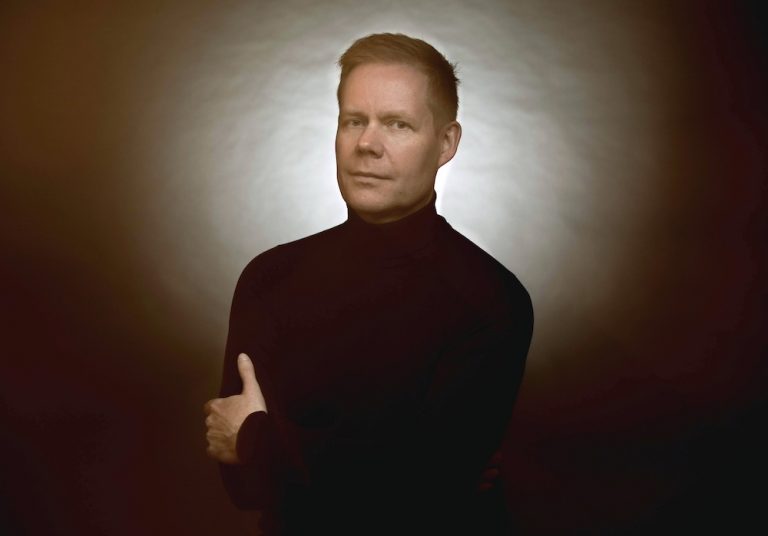

One of the most popular figures in the realm of contemporary classical, Max Richter’s minimalist works walk the line between post-modern sensibilities and accessible aesthetics. His latest project, Voices, exemplifies that combination. An hour-long work that first premiered at the Barbican in February and was recently given an LP release via Decca Records, Voices is a reflection on the Universal Declaration of Human Rights, the landmark U.N. document whose writing was spearheaded by Eleanor Roosevelt in the wake of the horrors of World War II.
Richter incorporates text directly from the Declaration into Voices, including readings by Roosevelt herself, actress Kiki Layne, and hundreds of crowd-sourced recordings, all set against a backdrop of piano, synths, choir, and what he calls an “upside-down” string ensemble. Richter is just as thoughtful as his music; I spoke with him about the Declaration, the tradition of protest music, and his process.
What drew you to the Universal Declaration of Human Rights?
Over the last 10 years or so, the rise of populist politics and increasing authoritarianism, environmental pressures, pressures of technology—all of these different things are piling up on us. There’s a lot of fires burning, and I feel like we’ve lost our way a bit. It’s easy to feel depressed and a bit hopeless, in some ways, so I was casting around for something hopeful. Looking back through history, there have been dark times before—the Second World War was probably the greatest disaster that we’ve ever managed to inflict on ourselves—but out of that comes the Universal Declaration of Human Rights. Eleanor Roosevelt convened this panel of thinkers, writers, philosophers, and artists, to write this blueprint for a future—a better future. And I thought that was an amazingly inspiring thing to do, and a very hopeful thing. So I decided that rather than try to make a piece which is focused on the problems, I’ll try to make a piece that is focused on the solutions.
What were some other influences on Voices, both musical and non-musical?
There is a strain of activism through music historically. It probably starts with Beethoven, with “Fidelio” and the “Ninth Symphony”, which had this humanistic vision of how people can get along with one another, which is a very beautiful and inspiring vision. And then in other music cultures: activist music of the 50s and 60s like Woody Guthrie and Dylan, and then the punk era, where music very much took a position. So it’s not new, this idea of a piece of music being a contribution to the debate in society. Voices sits within that framework in a way.
You’ve spoken about “music as a place to think.” How does that relate to your goals with this project?
One of the things we heard a lot after we premiered the piece in London at the Barbican in early February was people saying, “I knew about the Declaration, but I didn’t really know any detail of what was in it.” And I think that’s common. Everyone knows it exists—it’s one of those things that we know about, we learn about it in school. But actually having an opportunity to spend time with that text is incredibly valuable. Voices is structured as a series of episodes, where you have the article read, and then you have a musical space to reflect on what you’ve just heard. So it’s this alternation between data and feeling, in a way.
I’m very curious about the crowd-sourced vocal recordings—what inspired to use that approach, and what was that process like?
There are three kinds of readings on the record. First, you have Eleanor Roosevelt herself—when I found that recording it was just amazing, because she was there at the start, and she lit the fuse for the whole thing, so it was great to have her voice in there. And just the way she speaks feels very much of the past—it was 70 years ago, and no one has that accent anymore! And then she hands forward to Kiki Layne. I wanted Kiki to do the reading because I’d heard her readings in If Beale Street Could Talk—a beautiful film—and she pretty much narrates that movie. So I knew that voice, and I wanted her to do most of the narration, because her voice feels very young, and the Declaration is in a way about the future, about potential. So I thought she would be perfect for it.
And then, I wanted to embed the democratic ideals of the Declaration into the music itself, so therefore the crowd-sourcing. We put out the call on social media for people to just record on their iPhones part of the Declaration that meant a lot to them personally, and to send it in to us—and hundreds of people did. It was amazing! It was just wonderful to receive stuff from all over the world. Then I made a kind of sculptural landscape out of these texts for the music to flow through.
So it was really built from those recordings, in a way.
Yeah, absolutely.
I’m also curious about the idea of the “upside-down orchestra”—why did you choose to use that?
One of the things that I think a lot of us can relate to is this idea of our world being turned upside-down. I think that’s been going on in the last 10 years or so, and then of course now with the pandemic and the horrible events to do with racial violence, the murders of George Floyd and Breonna Taylor. So our world is in a mess, we’ve been turned upside down. I wanted to reflect that very directly in the music, so I just flipped the orchestra proportions upside-down. So it’s almost all basses and cellos, with a tiny little upper string group. I wanted to see if I could use that darker material to make something uplifting, something elevating and hopeful, and I set myself that challenge. I think that’s in a way what the Declaration does: it takes where we are, and shows a potential way for things to be better.
You’ve described past works (including Sleep and The Blue Notebooks) as “protest music”—do you consider Voices to be in that same vein?
Yeah, absolutely. Voices is hopefully sort of a catalyst—that’s how I see it. I think creativity can do that; it’s a part of our lives where we can ask questions, and provoke, and try to stir things up a bit. I was thinking the other day about that fantastic line from John Lewis, where he talks about “getting into good trouble.” I think creativity has to challenge us, it has to ask questions. I do think music can do that.
Even though this project has been in the works for 10 years, do you feel it’s particularly relevant to our present moment?
It probably does feel that way. I mean, had I released it at any other time, we’d probably say it feels relevant as well, unfortunately. It is a very challenging time, it’s a time when questions that we thought were settled and problems that we thought were solved have started over, they’ve come back to haunt us. It feels like history’s moving into reverse, in some ways. So yeah, I think a piece that’s about rights and social justice is going to be relevant, definitely.
When you premiered the piece back in February, did that process change your perspective on it in any way?
You always learn a lot when you play a piece live. Until then, it’s really just a theory, sort of a question: what if I were to write this piece, what would happen? Through the rehearsal and the performance, you experience it in a completely different way. There were a few things I got from it. First of all, within the performing community—it’s got a big orchestra, like 60 or 70 players—there was an incredible sense of wanting to deliver this text. It really felt like it lit a fire, and everyone was very passionate about being involved with it. And we had the same response from the audience. The two performances we did at the Barbican—this was two or three weeks before lockdown started here—I’ve never felt a vibe like that in a concert hall. It seemed like those words just mean so much to people, in a really fundamental way. And it’s one of those things that are kind of hiding in plain sight; it’s there, but we sort of forget about, getting busy in the day-to-day and getting distracted. But these are really fundamental things, and really common-sense things as well. It’s not esoteric or complicated to understand. It’s all basic stuff. But it’s just wonderful to be reminded of that.
Do you think that idea of these ideals being a common-sense and fundamentally accessible influenced the way you went about composing the music for Voices?
The composing process is always about trying to figure something out for myself, first of all anyway. I’m writing music that I’d like to hear, except no one else has written yet, so I have to write it—it’s that sort of dynamic. So I’m trying to understand what the question is, and then frame it as precisely as I can in the music. It’s almost like a set of inquiries into the world of that piece; that’s what composing is, really.
What other projects have you been working on recently?
I was supposed to be doing a new ballet for Covent Garden, with Wayne McGregor and Margaret Atwood. That was supposed to be this year, but it of course had to be postponed. So I’ll get into that—it’s an evening-length piece, so it’ll take some time. That will be late next year.
What’s been keeping you sane during lockdown?
It’s a strange time. In a way my life hasn’t changed that much—unlike a lot of my friends and colleagues in bands and orchestras, I’m not really playing live a lot. Those people’s lives have been absolutely switched off, basically. For me, I do mostly just sit in a room on my own, writing on a piece of paper, so it hasn’t hit me as hard. I’ve actually just really enjoyed getting back to books, playing the piano, things I never have time to do. And just spending time with family, very simple stuff actually, that’s been great. Obviously it’s a really difficult moment, and it’s asked us a lot of questions, but I do think there can be some positives too. For example, normally if I were releasing a record, I’d be on an airplane for a month, flying all over the place. And we’ve managed to do it without that, so that’s great. So I hope we can use this moment to reevaluate what the important stuff is, and not just go back to how things were.
How do you feel about the way the classical music world has been adapting to our circumstances?
People have been amazingly creative, and very resilient. We’re going to have to keep being creative and resilient for a long time, I think. It’s really difficult, because music performance is really fundamental to our culture—it’s a wonderful social glue, it’s a way for people to talk to each other, it’s a community thing. It really exemplifies all those things that the pandemic has gotten in the way of; all of the things that have been switched off by the pandemic, music is. So it’s very difficult. I think we’re going to have to be really patient. Different countries are trying to figure out different ways of supporting orchestras and venues and bands. It’s going to be tough, and it’s going to take a long time.
Now that Voices is released and this music is out in the world, what are your hopes for it?
My hope is that people will take the opportunity to reflect on this text, and to find a way to make it part of their lives, and carry that text inside them. That’s what the piece is all about. It’s very direct, it’s very plain-speaking music; it just presents these words, and that’s the aim of it.
Max Richter’s Voices is out now on Decca Records. Read our review.