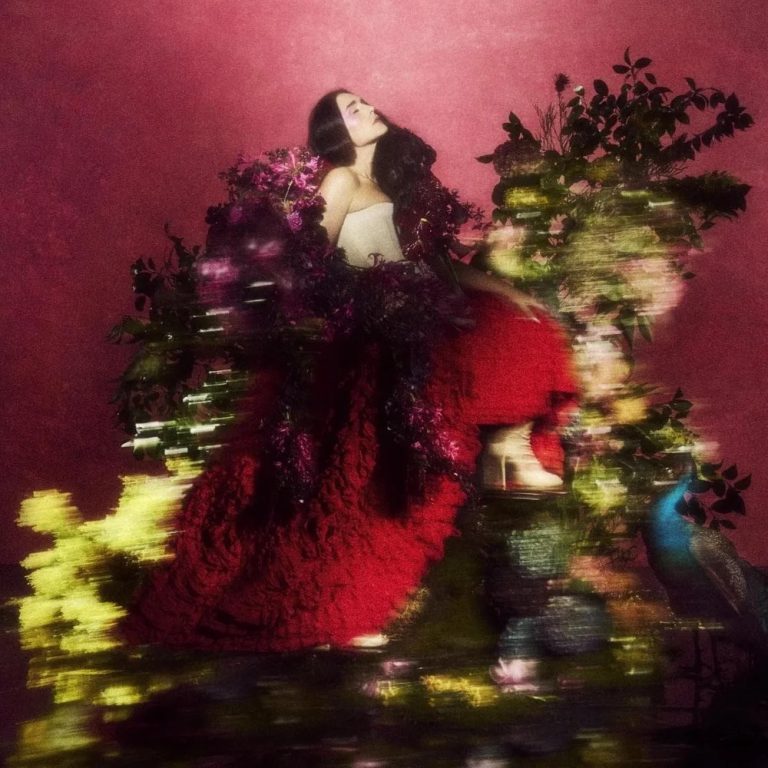

The evolution of singer Jessie Ware can perhaps be traced across her album covers. Her debut project Devotion features a monochromatic black-and-white picture of her, partially obscured by a light beam. Gradually… gently… colours begin to appear: the coastal town palette of Glasshouse; the editorial simplicity of What’s Your Pleasure; the faded pastel pink glamour of That! Feels Good! All these leading to her sixth studio album Superbloom featuring Ware, in a beautiful and sprawling red dress, head tilted upward with one high-heeled foot atop a chair, surrounded by a bright, vivacious spray of flowers.
Must we utilise our literary critical analysis? It is a pretty overt reflection of how Ware has treaded into brighter, bolder territory with each progressive album. Her lyrics have become more extroverted and cheeky; her sultry, soulful voice unfurling across euphoric and grandiose dance production as if made for the genre. Superbloom proves not an exception, but the new rule of Jessie Ware – a project exploring the fulfilment of love, attraction and sex with a greater emphasis on lush. In an age where love has been trampled underfoot by dating apps and toxicity, the singer implores the listener to bask in the glow of its radiance.
This mission begins with lead single “I Could Get Used To This”, which invites the listener into an Elysium of pleasure and “satisfying [your] every motive”. The subtle basslines, woodwinds and fluttering strings create a beautiful and groovy ode to self-love and encouragement (“It’s not impossible to bloom and grow / Cause everyone deserves their flowers”). As the key is raised towards the song’s last third, Ware shows off her belting ability with gusto. The album’s title track is even sultrier, slinkier and romantic as Ware paints a picture of glorious love with a standout chorus bolstered by a choir. “Let the flower in the rain paint the colour of June / Take me back to the place where we met, superblooming.”
Despite love being the core of this album, there are significant variations in both the production and lyrics. “Mr. Valentine” – undoubtedly the album’s most experimental track – is a frenetic and propulsive ode, pushing and pulling between coyness and exuberance. Through a distorted filter, Ware sings “Mr. Valentine won’t you be mine / Give a good knock on the door, step right inside.” The subdued nature of the verses only serve to make the explosive chorus detonate perfectly in the ears. It is one of Ware’s more chaotic tracks and as such, can be considered an album highlight.
There is, naturally, some more risqué tracks on the project delivered with Ware’s assertive flair. Songs like “Ride” – built on a sample of Ennio Morricone’s “The Good, the Bad and the Ugly” – are a bit more insistent and salacious. “I’m bad / Beautiful / Hold my hips / Watch me move” she intones over blipping synths and a smooth tempo. It features some of her more cheekier lyrics such as asking a man to “come be my cowboy” and to “ride my love” with some “giddy up”s naturally included. While it does not quite reach the dirty heights of, say, That! Feels Good!’s iconic “Shake The Bottle”, the production is darker and sexier.
On the flip side – yet still just as tongue-in-literal-cheek – is the campily erotic “Sauna” which could easily slot into What’s Your Pleasure? It features Ware delivering a breathy treatise on sweaty encounters (“I want the boys who seek the joy in every corner of the spa”) over pulsating (an appropriate adjective) synths and tasteful gasps. With an unsubtle chorus (“If you wanna last longer / I need faster, I need stronger / Take it to the sauna”) and her need for “a wood-chopping God-given love” that you realise the spa she is at probably keeps the curtains closed in their reception area.
For those who are quite miserable about affection and romance, this might prove a too idealistic listen that lacks the pitfalls many of us encounter. There are no toxic men call-outs as shown by the shimmering, dreamy (and, bragging the introduction of acclaimed actor Coleman Domingo) “Automatic” where Ware sings about being adored and satiated (“‘Cause he loves what he sees / No he ain’t ever problematic”). Nor is there that emotional unavailability in the declarative “Don’t You Know Who I Am?” (Answer: The love of your life) that ticks all the boxes for a dramatic disco tune. The portraits of love that Jessie paint do not yield even slightly to cynicism and as such, perhaps this can be considered one of the project’s significant drawbacks: a lack of danger.
The outlier on this project is the touching “16 Summers”, a complete breather from the humid dance floors and the only track that feels like a proper glimpse behind the disco ball. On this sweeping ballad, Ware contemplates and laments the notion of time passing: of children destined to not stay young forever, of whether love can truly stay strong as the years go by and even her own mortality (“It’s so easy to forget we’re all just passing through”). It’s quite poignant and Ware gives a vocal performance that brings chills and tears to the body. Although this ballad seems a bit misplaced on such a joyful album, it anchors the listener down to remind them that life – and therefore love – is a fleeting thing so enjoy it while you can.
Superbloom proves another ace in Jessie Ware’s hand, albeit one that for the most part stays within the dance-disco territory of her 2020s output. It is her sumptuous approach to this music, however, that elevates her: the stunning vocal performances, the intricate and magical production, the maximalist and unrestrained approach. Ware’s power is in her full embrace of what makes love so fantastic and the listener can feel their heart thaw, however reluctantly, against the onslaught of such warmth. We could get used to this.