
Any musician who has cut their teeth in a band or ensemble of any sort will be able to find some positive result of working with others – but there’s a lot to be said for just doing everything yourself. Hunkering down and being able to let an idea swallow you completely; knowing every single crevice and corner of the music like the back of your hand; not having to explain the impetus and reasoning behind every decision. At the other end you have a finished product that can bask in pride of not having had to tilt to anyone else’s vision. Plus you can take all the credit, which may not be the humblest outcome, but it’s still deserved.
Erik Hall is a team player (he was a jazz-studies drummer at the University of Michigan, is part of the jazz and afro-beat collective NOMO, and had a years-long collaboration with New York’s Metropolis Ensemble and Sandbox Percussion) but his affinity to minimalism takes him to his studio by himself. After discovering Steve Reich’s Music for 18 Musicians, Hall changed his focus and core interest in music; some years later he would record Reich’s piece all by himself, playing and recording each part and layering them upon each other. That 2020 record (which won the 2021 Libera Award for Best Classical Record) was followed three years later by Hall taking on Dutch composer Simeon ten Holt’s Canto Ostinato, which led to the aforementioned collaborations.
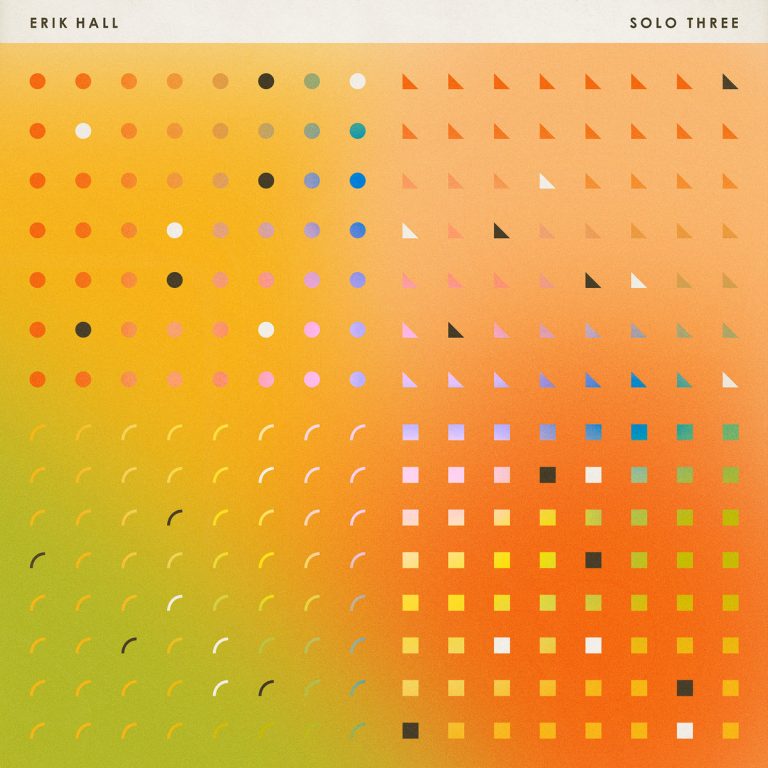
Seeing out this trilogy of work is Hall’s new record, Solo Three. There’s no singular focus this time round, Hall instead opting to take on four pieces from a range of musicians and composers. It’s his most compact record of the three and most varied in terms of tone; two longer pieces that run around a quarter of an hour are preceded by shorter ones that skirt the three and four minute mark. While it does mean there isn’t quite the same long-stretch locking in as with Hall’s two previous albums, it does make for listening that is easier to dip in and out of.
When Hall does stretch out on the longer pieces here, he hits his best stride. He takes Charlemagne Palestine’s “Strumming Music” and condenses it to a quarter of the original near hour-long run time. While it does feel like a more accessible entry point into the piece, it doesn’t lose any of the swell of Palestine’s version. Hall takes piano and guitar and locks them in seamlessly to create a soft thrum that bulges and gradually crescendos across the runtime. What sounds like the rubbery note of a horn or the scratch of some strings peek out of the wall of sound every so often; like with all of Hall’s music, there’s layers so interlocked here it’s hard to tell where one instrument ends and another starts.
While “Strumming Music” feels soft and welcoming, “Music for a Large Ensemble” is contrastingly complex and shimmering. Taking on another piece by Steve Reich, Hall interlaces electric guitar lines, piano, and synths to dazzling effect. Replacing percussive instruments from the original, Hall brings a different tone to the table, adding a sense of crystalline alarm to the piece. It latches on and folds you into the music again and again, the tricky rhythms refracting like reflective mirrors in a kaleidoscope. Like with “Strumming Music”, it can be easy to come and go out of focus with the music, letting it suck you in and then gently deliver you outside while it continues on; it’s busy minimalistic music that becomes ambient in its own way.
For the other shorter pieces, Hall doesn’t have the same time to swirl you through the musical machine, but they do offer intriguing, different palettes that help contrast against the pieces by Palestine and Reich. “The Temple of Venus Pt. 1” (originally by Glenn Branca) is velvety soft and airy, a springboard for the rest of the album. Elsewhere on Hall’s take on Laurie Spiegel’s “A Folk Study”, synths and keys create a spotty staccato texture, like raindrops falling onto pondwater. These small excursions still showcase the real talent of Solo Three, that being Hall’s ability to lock into a piece with precision while also bringing warmth to the music. It’s a technical feat too, especially when you start taking a moment to try to deconstruct and identify each layer of music happening (“Music for a Large Ensemble” in particular). It’s a testament to how productive working alone can be, and how rewarding it can be to create new worlds all by yourself.