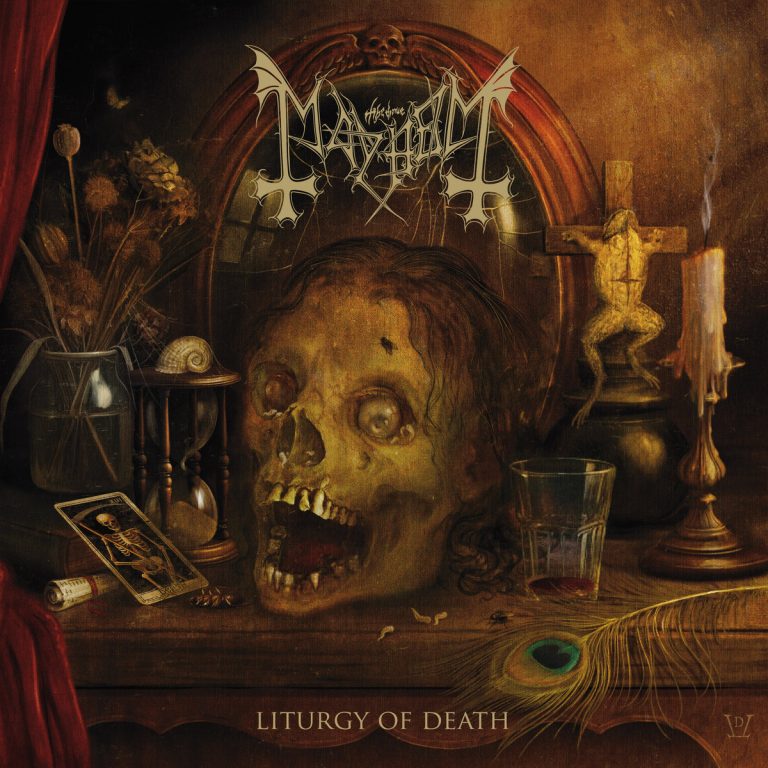

Mayhem, the black metal pioneers, are back with their seventh LP titled Liturgy of Death, and boy does this band know a thing or two about dead things. I won’t go into too much detail about the band’s notorious and mostly controversial history (which you can read on their Wikipedia page), but I feel I have to highlight just some of the band’s encounters with death.
Most of the notoriety spurred with some of the group’s earlier members: the aptly named Dead (vocals), Euronymous (guitar), and Varg Vikernes (bass). In 1991, Dead committed suicide in a remote Norwegian house and left a note which included an apology to “excuse all the blood” and some lyrics for a track titled “Life Eternal”, which the band included on their first legendary LP De Mysteriis Dom Sathanas. Upon finding his deceased bandmate, Euronymous proceeded to a nearby store where he purchased a camera, returned to his bandmate, and photographed his remains while collecting fragments of his skull. (There are rumors that he also gathered some bits of Dead’s brain, then cooked and ate them in a stew.) Euronymous was seemingly unshaken by Dead’s passing, and tried commercializing it by using the photographs he took of the body for the cover of a live bootleg album titled Dawn of the Black Hearts and selling pieces of the skull fastened onto necklaces (some of which have sold as recently as 2018). Two years later, Varg Vikernes stabbed Euronymous 23 times to the head and chest, and was sent to prison shortly thereafter (yet Varg’s bass playing can still be heard on the band’s first record).
All of this happened before Mayhem’s first album was even released. I will not get into the church burnings, their previous neo-Nazi rhetoric, and how they used real human remains and animal heads stuck on spikes as props during live shows. But all of this is to say that there may not be another metal band in history whose controversy overshadows their trailblazing legacy as much as Mayhem’s.
But these heinous acts remain (supposedly) in the past. The band’s current members, which include Attila Csihar (vocals), Ghul (guitars), Hellhammer (drums), Necrobutcher (bass), and Teloch (guitars), have recently released statements indicating their wholehearted change of ideology, stating via Wikimetal that, “Neither the band nor any of its members tolerate racism, Nazism, homophobia, or any other ‘hate crime.’ Although some contrary statements have circulated in the past by individual members, this is far in the past and has never been an official stance of the band. Any form of judgment based solely on a person’s background, skin color, sexual preference, or anything else over which they have no control is an act of weakness and is rejected by the band.”
Yet the pre-order page on Bandcamp for Liturgy of Death heralds the record as “a long-awaited 40th anniversary celebration, tracing the band’s legacy since their formation in Oslo in 1984”, and I am not so sure that Mayhem’s primordial legacy is one to be celebrated.
Nevertheless, Liturgy of Death proves the group has reestablished themselves into something that reaches far beyond Mayhem’s unholy heritage. The record feels much more assured of itself compared to the group’s previous release Daemon, fixating and philosophizing on the idea that we should all embrace death and its “pristine persistence”.
Instrumentally, Liturgy of Death returns (mostly) to Mayhem’s 80s and early 90s sound and structure, which should please most post-millennial Mayhem haters. But on tracks like “Propitious Death” and “The Sentence of Absolution” I do hear some of their previous progressive influences creeping under the surface. The lead single “Weep for Nothing” perfectly showcases the group’s ability to switch between crushing riffs, blast beats, and atmospheric breakdowns at a relentless pace. At the same time Csihar’s impressive vocals shapeshift constantly, often descending into a maelstrom of demonic laughter and shrieking.
Perhaps the most compelling aspect of Liturgy of Death is its philosophical musings. Its dialectic approach oscillates between the fear of death and its everlasting bliss, which is most clearly represented in the killer final three tracks. “Ancient spirits whisper venomously / manipulating from the depths below / their voices cold and empty / in this realm of endless misery” Csihar shouts on “Realm of Endless Misery”, giving his best Mola Ram from the Temple of Doom impression. Next on “Propitious Death” he pleads, “Oh pristine persistent / almighty passing / oh, majestic Finis / entomb me now.”
The final track “The Sentence of Absolution” is the record’s true liturgy of death. The first brief seconds of Brownian noise put us directly at death’s door before we are struck with an explosive, chugging riff and the realization that “Nothing is more deceptive / nothing is more insidious than human life / the greatest bliss is to never be born.” It is a bleak takeaway message from a band that has suffered from even bleaker moments.