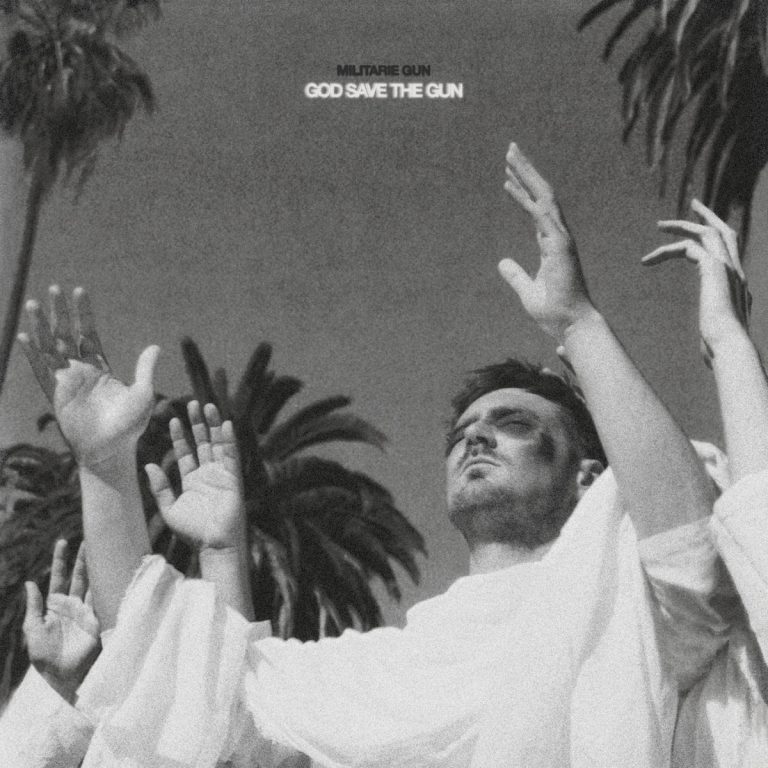

The process of recovery never has, and never will, manifest with clarity or a clean arc. It’s often a messy unraveling that gets muddied by multi-step processes and, in a loop that tightens, loosens, and sometimes strangles those caught within and just outside its spin. Inside this loop, Militarie Gun‘s God Save the Gun reaches out a desperate hand — just trying to grab onto something stable. Anything.
Less a record about reprieve or redemption, God Save The Gun is so much more focused on the exhausting work of merely staying upright — the restless mornings, the fake smiles, the rituals that start to feel like relapse disguised as feigned discipline — it can all feel futile. Now, frontman Ian Shelton is no stranger to conducting frustration, especially through the means of overheated shouts into oblivion and a post-hardcore sound that leans heavier, but never has he done so with this kind of vulnerability and clarity. Here, he sounds less like he’s screaming to get out and more like he’s realizing he’s going to have to live here as a cohabitant with his demons.
While not ignorant or dismissive of the very merits of just being a better person for yourself and others, this is an album that treats self-help and multi-step programs with cliches and punchlines that’ll make you chuckle. It’s self-deprecation at its most hilarious, yes, but harrowing too because Shelton, in more than one way, convinces himself that it all leads to the same destitute dead end.
He can often be found drowning his hurt self out, choosing hedonistic anesthesia as a way to deaden what needs to be confronted (“Thought You Were Waving”). He doesn’t scrape out the rot either. He just paints over it — like in “Paint”, where every new coat feels doomed to flake off anyway. And if the coats of paint are not working, why not try self-immolation on for size, instead of going through some hokey means of betterment, like religion, again (“Burn My Life Down”)?
“Things have not been great / In fact, they’ve been bad,” he directly acknowledges early on, and from there the record spirals through every shade of trying — sincerity, half-sincerity, denial, humor, relapse, surrender. It all comes together to form, ironically, the sound of someone in the middle of unbecoming to see what’s inside, to see something new.
The music mirrors this unraveling. God Save the Gun still moves with the urgency that’s defined Militarie Gun from the start, but the edges are a bit different now — brighter and less jagged. The guitars don’t grind so much as shimmer against restraint, the drums punch but with more purpose and emotive precision. It’s pop-leaning hardcore that still sweats — the kind that hums through the gray and refuses to sit still. They’ve expanded their scope: synths creep in, melodies swell, and the hooks land so big they feel like catharsis stumbled into, punchy like the loud headers on a brochure for a new treatment center — you know, the one that’ll finally do the trick this time.
For all the underlying pessimism of this record, there’s an unyielding amount of hopefulness — sincere or insincere. While the title reads like a provocation, it’s also a proper prayer. Shelton writes as though he’s stuck in his own 12-step program: confession, relapse, confession again. The god here isn’t an overseer but a witness to toil—someone to keep the cycle from collapsing in on itself. Each track feels like a gnarled, half-serious hymn for the self-destructive: a plea to stay, a dare to endure. Its salvation isn’t found in change, but in the promise that you might still want to.
Shelton doesn’t preach recovery or dramatize relapse; he narrates the oscillation of it all. Some days you wake up and convince yourself to smile (“Wake Up and Smile”), and some days you stay behind — maybe for good — because it hurts too many people that you merely exist. And with the latter, we get a song like “I Won’t Murder Your Friend”, where humor and heartbreak can be found hand-in-hand once again, in the most extreme, because if you don’t hold both with equal grip, you’ll crush yourself. Thus, there’s an unspoken kindness underneath all the self-loathing — a recognition that trying again counts, even when it doesn’t look like progress.
For a band that’s always sounded like momentum incarnate, these songs don’t explode as much as they do ache. They vibrate with the energy of holding on. It’s not a reinvention, it’s a recalibration of a band whose leader is learning that volume and vulnerability can occupy the same breath, just as much as searing self-hatred and compassion do. God Save the Gun finds holiness in just surviving, in that unrelenting loop that keeps spinning no matter how much you want out — it’s asking to stay, and in that staying, that stubborn, trembling faith that maybe tomorrow won’t hurt as bad, it finds something akin to grace.