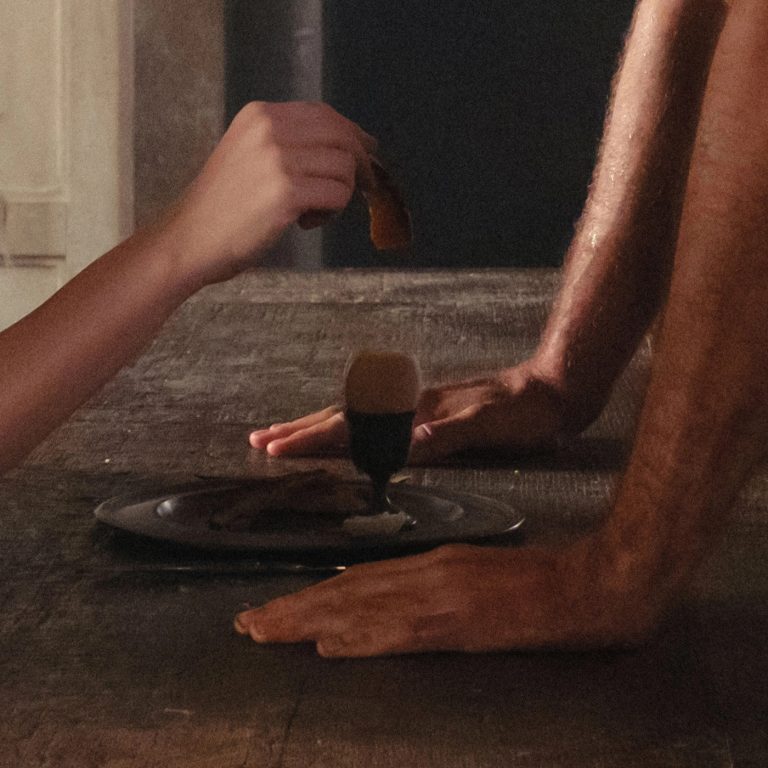

The way that we read text says a lot about who we are. We might be inclined to project our own wishes onto what somebody else intended, completely missing the point. Or, in turn, through our own experience, we possibly connect with a deeper meaning that the author only glimpsed within their subconsciousness. Art is, after all, mostly intuitive – we don’t know every element that expresses itself, even when we think we are fully in control. As a filmmaker, this makes the adaptation of classic material all the more interesting – something old suddenly says more about the present, and how we elect to mystify the past, or ridicule it. So for a second, let’s talk about Wuthering Heights…
Emily Brontë only wrote this one novel, before she died at just 30 years of age. Stretching multiple generations, it could be read as a saga, touching upon ill-fated romance, socio-politics and faint ghost story. It’s clear cut, but then also obscured by its multiple perspectives and many allusions. It could be as much about race and class, as it is about the futility of true love. A tale that is ghastly, unpleasant and deeply beautiful. Emily Brontë herself is a mysterious figure, somebody who isolated and fasted, suffered from anger issues and is speculated to have been neuro-divergent. Even on her death bed, she rejected treatment, with her final words being “If you will send for a doctor, I will see him now.” Utmost determination, or terminal folly?
The many adaptions of Wuthering Heights depict unique angles on this spirit. There is the famous Peter Kosminsky one, starring Ralph Fiennes and Juliette Binoche, which most people see as the most legitimate one, as it includes the oft-omitted later generation. Luis Bunuel, Yoshishige Yoshida and Jacques Rivette adapted the material to their respective home countries, which showcases that the material ultimately transcends the British country side… though a 2003 adaptation by Suri Krishnamma that attempted to set it at an American high school proved that it can’t be torn from its setting within a gothic context. Maybe that is why the most passionately received adaptation is Andrea Arnold’s 2011 take, which hinges on the academic discourse surrounding the heritage of lead character Heathcliff and casts him as black. It is especially earthy, carnal and lush, using Arnold’s sensual imagery to highlight the experiential nature at the centre of the love story. Obviously, it divided upon reception, but nonetheless proves the strong validity of this text, and might well be the best of them all.
And now, Emerald Fennell is trashing the material. Gathering brutal reviews, the director uses her style of tame perversion and perfume-advertisement cinematography to focus on horniness over sensuality. Fennell is good at “moments” of melodrama and derogatory moralism – it’s the reconfiguration of pop culture through the lens of the privileged white British upper class, with all its perceived demons and fetishes located on the surface: the struggle merely exists within our Freudian urges. I’m not gonna trash Fennell further – others are already doing that for me.
But it’s important to applaud her for the choice of commissioning Charli xcx to write the soundtrack to this: the musician is a much more nuanced and subtle artist, especially as she’s been cleverly burying her depth within club sounds: myths of neon nights, if you will. So immediately, there’s a lot of questions attached to the hiring: will we get a Charli xcx album of all bangers? Will this be an instrumental record, with only one or two vocal tracks, to play above the credits and poignant wedding scene? And really, what would the material even be – just plain accompaniment, or something more elaborate?
And then, we got the magnificent “House”, featuring John Cale’s gut-churning contribution. “I was thinking, ‘What is this place?’ / I thought it would be perfect / I thought, ‘I want it to be perfect’ / Please, let it be perfect!”, he croaks over stabbing violin lines, mirroring the grim determination of Nine Inch Nails’ “Something I Can Never Have”. The track builds into a noisy finish, part post-industrial pop, part anti-techno. Reconnecting with the book’s original framing, it seems to harken back to Heathcliff as a mad, old man, Wuthering Heights now the landscape of tormenting phantoms, the implicit violence of heartbreak seared into the atmosphere. An instant standout.
Charli xcx did not initially conceive the commission as an album – Fennell had asked her for one mere song. But in the wake of burnout, Charli found inspiration within the film’s script, expanding the project quickly into a fully-fledged concept album, where the lead motifs of self destructive love were central. So not a soundtrack – and this is important – but a reflection of an outside narrative through the eyes of a musician known for her edgy, somewhat demented, cocaine-fuelled electro glam. The project she’s delivered is closer to Patrick Wolf, Bat for Lashes and Nine Inch Nails than Kate Bush, Death Grips and Madonna. It is a spirited re-telling of lust, self-harm, obsession, co-dependency and anxiety.
“Dying for You” showcases this approach, connecting romance with a central motif of self-harm: a person that keeps self-immolating, only to read love as a means of vindication, as the accompanying strings are edited to mark sharp cuts, the bass a quickened heartbeat. “Cause you’re the poison I drink, I drink you twice to be sure / And then I find the highest building, just to fall on my sword / I’m losing gallons of blood, the river’s turning to red / I got a smile on my face, I bleed even more”, she sings, before the chorus explodes into full ecstasy. The track could fit on Patrick Wolf’s Wind in the Wires, one of the 2000s’ most underrated albums. “Out of Myself” meanwhile seems closer to Wolf’s most recent work. A mini-epic that is lead by immense strings and stuttering beats, to express tender self-realisation: “ I’m begging to you on my knees / Please rub the salt in my wounds / I like the person you turn me to / You take me out of mysеlf”. The song has the rousing euphoria and hypnotising composition that immediately makes your day a little brighter.
“Chains of Love” – the second single – is in line with the Jack Antonoff ballads in the Taylor Swift canon: deeply emotional, with a strong addition of 80s keyboards and a heart-wrenching sentiment of being imprisoned by one’s feelings, while Charli moans over the chorus. In a way, Wuthering Heights showcases how abstract mainstream pop has become – a song like “Seeing Things” would have been regarded as avant-garde a decade ago, with its strange, minimalist piano lines, distorted vocal samples and abstract, tense dynamic, more suited to fit on a Bat for Lashes album. And speaking of her, “Eyes of the World” – the collaboration with Sky Ferreira – could have fit on the gothic Bat for Lashes concept album The Bride. It is an immensely sinister track, equating the love we project onto people as a ghost that co-exists atop our body. Ferreira’s biting, snarly delivery adds the right sense of gloom and aggression to really make the track stick.
Maybe that’s why the most disappointing song here – the wedding-themed “Altars” – feels just like a straightforward electro-pop cut, ca. Midnights-era Swift. “My Reminder” is catchier, gifted with a brilliant vocal melody and clever build-up, tho the composition here is a little too simple to make it one of the stronger tracks on the album.
Surprisingly, the two songs that rely solely on string compositions that come across as almost direct references to classical pieces – “Always Everywhere” and “Wall of Sound” – end up more genuinely memorable and successful (I suspect they might also be the most personal of the songs here, but that comes down to interpretation).
And then there is the immense closing track “Funny Mouth”, which has hints of Tears for Fears (ca. The Seeds of Love). With a strong vocal melody and a tense composition that continues to swell and build up, intercutting string sections with cyberpunk glitches, it stands as one of the best tracks Charli has done, also reaching back to “House”, hinting at the cyclical nature of the source material.
Like the house of its source material, Wuthering Heights at times seems to stand all on its own. It’s a curio within the Charli xcx discography, as it abandons coke-fuelled hyperpop for a more introspective and elaborate atmosphere, spiking this complex sonic landscape with painful, obsessive, horny narratives that suit the musician perfectly. But it also feels brief at just 12 tracks, with most songs clocking in (somewhat typical for Charli) below the 3:30 mark. I wish there would have been an even more daring commitment to length and emotional growth – the equivalent of what the reference artists I named – Trent Reznor, Patrick Wolf, Natasha Khan – have perfected, crafting a true opus.
In the case of Wuthering Heights, the album sometimes feels as if Charli committed fully to her concept, but didn’t allow herself to branch out even further, reach higher, express – or even abandon – more. It is a symphony, but not quite an opus. Yet as it stands, this might actually be her most successful album: re-imagining herself as bravely as she has many times, but shedding the fur coat. And in that, this is likely a more valid, lasting and, surprisingly, necessary adaptation than Fennell could have managed. Happy, belated, Valentine’s Day!