
A little over half a year ago, I wrote about clipping.’s Dead Channel Sky, a paranoid and acidic dive into the broken landscape of the United States through the lens of cyberpunk pessimism. While I was a little ambivalent over how successfully the concept was translated, what resonated with me was its idea of cultural fracture. We already live in the cyberpunk realities of Blade Runner, Minority Report and Ghost in the Shell – we merely haven’t fully adapted our personal aesthetics to fiction. The collision of analogue nostalgia and messy digital chaos, which translates into a vulnerable and cozy melancholia, seems to evade us – maybe because we are still two years away from those technological breakthroughs translating into our conscience, or simply because we are still too optimistic that things will return to ‘normal’.
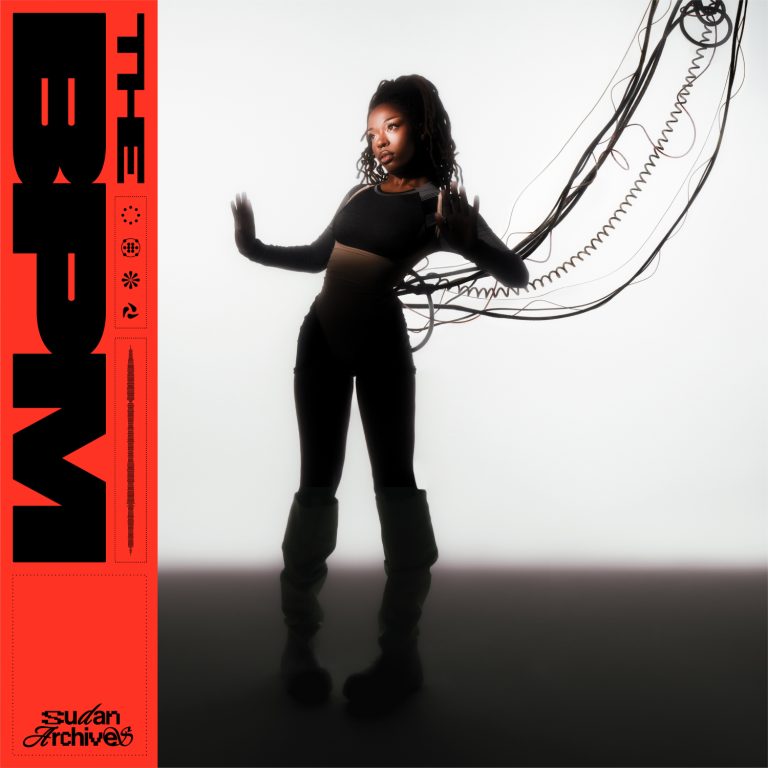
The more I ponder these thoughts, I find myself looking back at some standout albums that came at the end of the Covid era: Kelela’s Raven, which ended up our album of the year, or Liv.e’s Girl in the Half Pearl, which would be deserving as a close runner up to that award. These records suggested a future that was liberated, existing in a fluid dream state. Made by two bisexual black women, it reshaped ideas of intimacy, dance, dream… in short, these were statements akin to political manifestos. This idea of a future marked by emancipation of the body is central to Brittney Parks’ new album as Sudan Archives, The BPM (and we appreciate her tip of the hat to our website).
All jokes aside: dance music is often not taken seriously by those who don’t participate in it. It’s unapologetically physical and often married to transgressions of societal norms. If we move in darkness as a collective, we become united by passion – that’s something very dangerous, both to society’s status quo (look at how many religions avoid collective dance in favour for stillness), but also ourselves if we aren’t careful or the spaces don’t take care. Both of those factors demand a somewhat utopian thinking of dance as exploding outwards, so coming from the clubs but entering the everyday life – something many British acts have hinted at (Underworld, The Future Sound of London and Burial for example) but that American artists still grapple with.
Parks attacks this membrane by consciously investigating the sounds connected to her familial history. With her parents stemming from Michigan and Illinois, Parks recorded in Chicago and Detroit, the birth places of techno and house music. Additionally, she crafted a persona that she calls ‘Gadget Girl’, suggesting a marriage of the corporeal and technological – she herself understands this as her ability of personal expression through instruments, such as her electric violin and iPad as a young woman.
This is all a bit heady, but The BPM is a surprisingly fluid experience: the jagged edges of occasional trap clanking and warm house beats merge effortlessly with her skilled and expressive violin playing and sensual vocal delivery. Especially the first half effortlessly succeeds in nailing a vibrant club energy that opens itself to sensual deliveries and cinematic drama. “DEAD” steers confidently towards a massive climax halfway through the song, then leads into an invigorating breakbeat with violin section. “COME AND FIND ME” is perfect neo-soul with a house edge and a hint of Prince, while the flirtatious “TOUCH ME” bursts with impressive use of percussive elements and a greta vocal melody.
The stretch of “A BUG’S LIFE”, “THE NATURE OF POWER” and “MY TYPE” fully committs to its club influences, providing a brilliant marriage of diverse styles, hot bass lines, infectious beats and cool disco swag. Especially the 80s influence on “A BUG’S LIFE”, with its jazzy piano notes and background vocals during the chorus is an absolute banger. Lyrically, Parks investigates black identity struggle, sexual innuendo and political liberation, finding significant emotional hooks for those who dare to delve deeper, beyond the dance constructs. The vocal focus shifts into the foreground on later tracks, such as the cyberpunky, horny rap track “MS. PAC MAN”.
On first sight, certain tracks feel rooted in the certainty of current trends, but gradually open up to more complex structures and intelligent, expressionistic approaches. A good example of this is “DAVID & GOLIATH”, whose rich samples and manipulations give way for a gradually developing sonic narrative. “A COMPUTER LOVE” at first seems almost referential of the aesthetics familiar from Yeule or Poppy, but reveals some very unique layers in how break beats contrast Parks’ voice, while the violin enters as backdrop for the filtered computer vocals the Gadget Girl seems in dialogue with. The strange, eerie techno of “NOIRE” almost seems retro, harkening back to acts like The Presets, but then bursts open with vibrant instrumentation and sweeping synth layers. A lot of this might be due to the compositions Parks used as the basis of most tracks, which oscillate between classical and jazz styles. Closer “HEAVEN KNOWS” is a good example of this, with its composition having an almost sacral character, while the piano line is pure jazz. These are gorgeous musical developments that speak of vast ambition and immense talent.
Yet The BPM is not without a few minor issues. At 53 minutes, it flows a little unevenly and feels slightly too long – some of the tracks, such as the atmospheric “LOS CINCI”, seem like speedbumps to what could have been a more organic progression, mirroring the album’s club roots. Following the clean sheen of the first half, the second feels intentionally experimental in nature. Here, Parks observes individual characters and their strange behaviours. That is an interesting shift (possibly unintended, but still clearly expressing itself), dividing the already long album into two halves, losing a bit of conceptual clarity. Where Raven accelerated structure to elaborate on its visionary approach (using diffusion to dive into naked emotion), The BPM can be playful to a fault, exhausting itself a little.
This leads to the album being the weakest of the three Sudan Archives albums: while the previous efforts of Parks’ could be played on constant repeat, I found myself taking breaks after “COMPUTER LOVE” hits. There is no ambient section, no break from the floor. Still, The BPM is stellar in terms of craft and execution, finding gorgeous, clever and elaborate compositions at every turn. But the question also arises if the album would have better functioned as a two-disc project, with the first half further losing itself in the damp, dense atmosphere of a nocturnal club, while the second investigates the machine-bodies of citizens in a future megalopolis. That would have allowed for a cleaner division, but also some gentle reprieve. But this is, again, a minor observation. As it stands, The BPM allows Parks to showcase what a massive talent for writing and composing she has, removed from any constraints or genre terminology. A daring statement of intellectual and rich dance music that demands attention.
83%