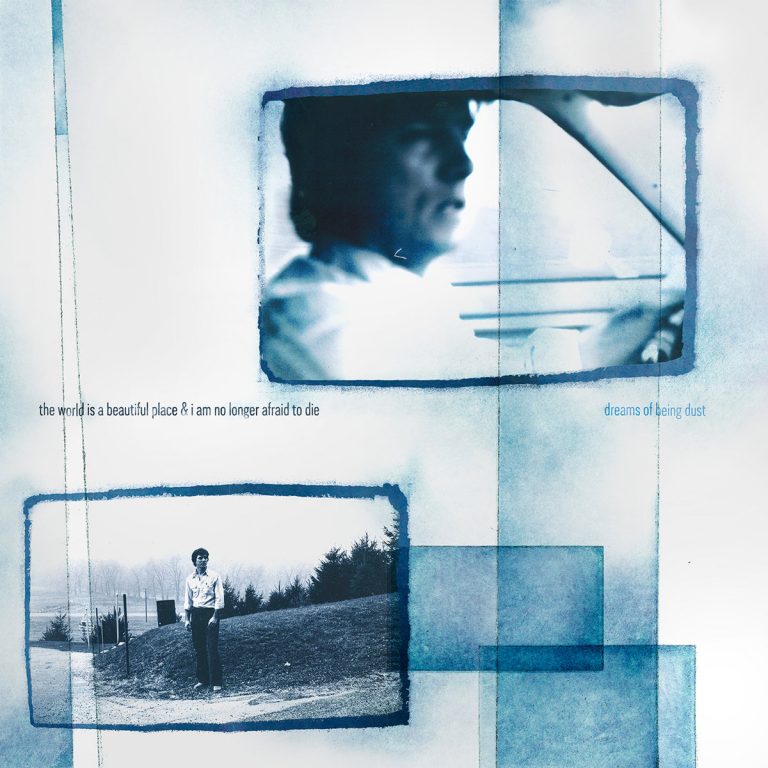

Having outlived many of their since-disbanded scenemates, The World Is A Beautiful Place & I Am No Longer Afraid To Die’s (TWIABP’s) latest album especially embodies the bombasticism conveyed by their sentence-length name.
Initially grouped with other late 2000s emo revival bands, their use of expansive songs and detailed arrangements have tended to be the connective tissue of their career thus far. In this sense, Dreams of Being Dust is no aberration. However, while inspiration from Sunny Day Real Estate earns mention in the press material, there is less explicit reference to TWIABP’s aforementioned sonic origins — aside from an album cover that appears to deliberately evoke second-wave emo bands.
Although the group is still billed as a six-piece experimental post-rock outfit, bandmember Chris Teti explains: “But with this fifth album, we just said ‘Fuck it.’ We’ve done the post-rock thing for multiple albums, and that’s totally cool, but I feel that live it was shifting a little more aggressively already, and I never want to settle.”
If Illusory Walls could previously be described as their “hardest-hitting” effort, then Dreams of Being Dust seems downright brutal by comparison, resulting in a dark, seismic work described as “a violent record for violent times.” Mirroring the emotive trajectory of pandemic-era anxieties to the present’s concentrated strife, TWIABP’s newest album contains brooding, sci-fi-esque songs that draw increasingly on styles like metalcore and prog, combined with a wide-eyed scope evoking the space rock of Failure (another band mentioned in the press material). The thematic gesture of the album’s title hits immediately on the opening track.
Dreams of Being Dust aims to reflect the staggering, formidable nature of contemporaneity by looking to new sonic palettes for resonance, producing songs charged with veritable grief, ferocity, and passion on part of the group. As a sonic pivot, the result comes across as purposeful, no holds barred; Cave In emerges as another point of comparison.
Take “Beware the Centrist”, for instance. Down to the titling and lyrics, the track’s forceful post-hardcore is the least sweeping or oblique of the tracklist, raging about “Overwhelming states / With underwhelming responses” before closing with a Latin phrase that translates to “Save yourself from hell.” When the structural terrain is expanded, TWIABP choose to adopt a shinier veneer aided by crisp production, cyborgic vocal harmonies, and metallic riffs on songs like “Dimmed Sun” and “Oubliette”.
Around the album’s midway point, though, the above-expressed goals of capturing our social antagonisms begin to feel increasingly mediated (and hampered) by the studio’s presence. “Captagon” is similarly grandiose, another semi-fantastical track with metaphor-laden lyrics. Despite simmering with an undercurrent of biting intent, the album begins to resemble something overtly polished, smoothed-over in favor of clarity despite the convoluted, intriguing musings of TWIABP’s vocalists. Dreams of Being Dust is not a “confused” work lacking identity, but it is dubiously effective in its overall approach.
Part of this listening fatigue stems from one’s sonic proclivities — a deference to TWIABP’s emo past over their progressive metal future, for instance. Take a track like “December 4th, 2024”, which explicitly refers to the murder of UnitedHealthcare CEO Brian Thompson. Its crushing guitar walls are stellar, but the inclusion of racing synths envelops the number with a stand-in attempt at futuristic evocations. This is divorced from a stated desire to evoke “the now” which, owing to a rapidly rotating newscycle, almost feels dated upon arrival anyways; “Debt from the treatment of a sprain from a sinkhole / The aldehyde smell of cash rubbed in every wrinkle” is a solid refrain though, for what it’s worth. Continuing on, “Auguries of Guilt” registers as a noteworthy tale about environmental degradation and the writing of history by its victors; unfortunately, the attempt at resplendent presentation feels similarly overwrought.
It is not the case that the sci-fi overtones here are incapable of aiding or conjuring up these grounded insights. However, the attempt to gaze at the stars — sonically more so than lyrically, to be sure — for a sense of size when the enormous weight of social reality’s ceaseless disaster already presses down on listeners feels like a misstep. The musical signifiers all point to something high-concept rather than lived experience. It is an attempt to capture the unreality of a dizzying, horrific infinite-scroll of catastrophe broadcast before us. The overt normality of this senseless routine seems to instead demand increased subtlety (playing-wise) and reference to the everyday.
Beyond this, the consistently solid instrumental writing often is bogged down by the above-mentioned production choices, veering into cheesy territory emblematic of bygone eras of heavy music. “Dissolving” wields these tendencies most effectively, but even here it’s a little hard to completely dig the pinpoint, engineered harmonizations.
TWIABP have a vision, no doubt, but the extent to which you can see Dreams of Being Dust through their lens depends on the enjoyment one derives from their inspirations, channeled outside of their usual wheelhouse. If that does not happen, you might find yourself cast into the stratosphere with a quickly-depleting tank of oxygen.