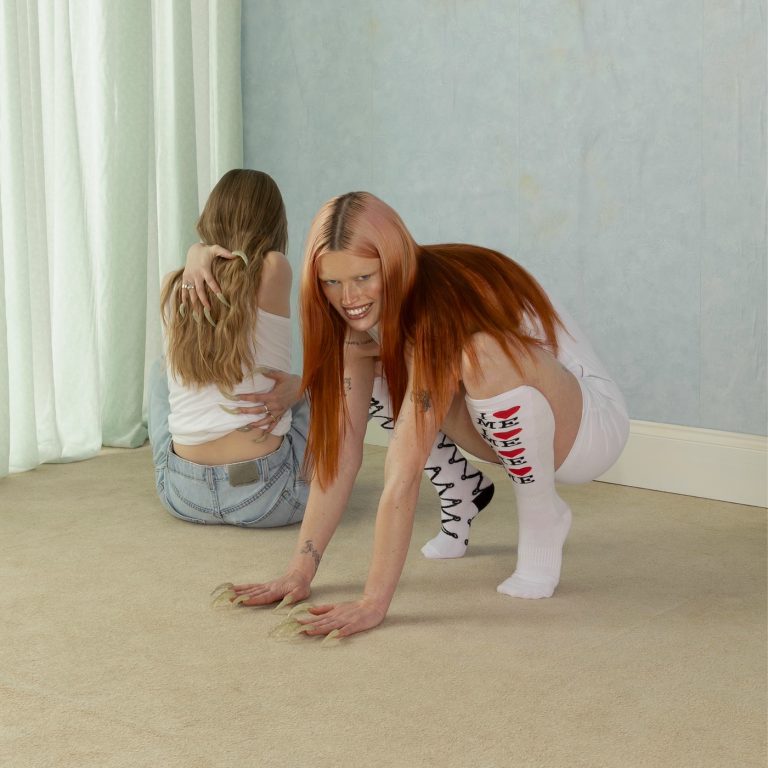

On their 2022 self-titled debut, Wet Leg opened with a track that compared being in love to a mental illness. It was a sardonic, if not bleak interpretation of a study by Italian psychiatrist Donatella Marazziti, but at the time, for the Isle of Wight band, this was par for the course. Their debut made a name by a wit so dry it was practically sandpaper, while also embracing that goofy edge that other acts might steer clear of showing too much of. Where some would hint at a joke, Wet Leg would double down on the bit and turn it into a whole song; their breakout single “Chaise Longue” was, after all, just a deadpan three and a half minute dick joke set to a catchy indie/post-punk riff. For Wet Leg to liken love to a mental illness was their way of keeping the world at arm’s length and maintaining that breezy and aloof countenance.
But now Wet Leg are actually in love – more specifically singer/guitarist Rhian Teasdale is – and the tone is notably different. The opening track to their second album, moisturizer, has her calling for emergency services because their new affinity has left them so breathless. In a moment of orgiastic bliss she pants towards a confession: “I’m in love!” The album comes with a series of pronouncements, be they shock (“Love struck me down / The fuck am I doing?”), gooey sentimental confessions (“I’m thinking ’bout you every minute, еvery hour”), or raunchy and explicit come-ons (“I can make you beg, can make you wet like an aquarium”). Call it a concept album or a record with a fixation, but where their debut felt a little more like a grab bag, moisturizer feels more cohesive.
Old habits die hard though, and we still get doses of the Wet Leg we know: see the scathing indictments of men with the bristling and needly “catch these fists” and the dead-eyed “mangetout”. Concentrated against a collection of love songs, it adds a certain ire to the delivery; it’s like Teasdale is annoyed with men for impinging on her personal space, but also for bringing her down from cloud nine. But other habits wriggle back into the mix too. In-jokes that were obviously the result of a playful recording session are just funny-once lines that bring a wince with repeated listens (“I’ll be your Shakira, whenever, wherever”; “Limousine, racking up / Ketamine, giddy up”). Meanwhile the punchline of “mangetout” suffers from being predictable from the title alone – but is at least saved from being trite thanks to Teasdale’s precise and smiteful delivery.
Now a five piece after touring members Ellis Durand (bass), Henry Holmes (drums) and Joshua Mobaraki (guitar, synth) officially joined the ranks, the band have a bulkier sound that helps drive home the heavier moments, pad out the softer songs, and add a collegial feel. Holmes’ drumming on “catch these fists” is agitated and infectious, Durand’s sleazy and oily bass on “CPR” adds a strut to the album’s opening moments, and band co-founder Hester Chambers traces wiry guitar lines on “pond song” like she’s drawing a chalk outline of a body. The dreamy “11:21” feels like it consists of mostly vapour, and as Teasdale swims between high and low voices, the perfume-like allure becomes more entrancing; it’s perhaps the most surprising turn on the album and consequently one of the most memorable moments.
Come the final track “u and me at home”, the band paint a picture of domestic bliss (“When I’m with you, it’s all okay”) before rallying around for a singalong chorus. For all the affections Teasdale covers across the album, it feels like one of the clearest and most enjoyable instances; where the stakes are at their lowest and there’s no performative showboating on display. Sure, the cultural references along the way (Jennifer’s Body, Big Brother’s Davina McCall, The Demon Headmaster, The Princess Bride) are fun and funny, but sometimes Teasdale inserts them with a clunky eagerness instead of loving care. And while it could be argued that it shows everything is coming from the same place, that she also relies on repeated bits and similes (“sweet and sour”; “giddy up”) makes her writing seem shallow where it shouldn’t.
However, the love is undeniably deep – overflowing, perhaps – and moisturizer is a proud and expressive declaration of both a newfound queer identity and queer endearment. That it sometimes misses the mark due to its rose-tinted vision is hard to be too miffed at; “I’ve never been so deep in love,” Teasdale professes. This time round, it’s no joke.