
Now it’s dark. 2:22 in the morning. The fever has vanished, but a burning inside continues. Doesn’t matter if your eyes are shut or open. There’s images that come together, materialize from your deep within your unconscious mind. Shapes – colours – names – faces – feelings. It’s all bathed in monochrome red: the colour of blood, the colour of love, the colour of the forbidden. The black dark becomes the screen of our unsaid thoughts, of things within us we’ve never known existed. The film, opens…
Two towers fall, and New York is gone. There is now a NEW New York, which somehow evaded the present to return to the past, the myths of CBGB’s, of The Velvet Underground and Talking Heads. It announced itself to the world one afternoon, when five kids in vintage clothes and All Star Chucks played their song “Last Night” on MTV. After the death of alternative rock, marked by the split of The Smashing Pumpkins, the sudden appearance of The Strokes heralded the start of the indie rock era, dominating and influencing mainstream music from the underground. It struck like lightning: there’s more going on here, other musicians to see, bands to sign, records to sell!!
And then, the towers fell, and America was covered in dust. Within this twilight, four young men headed to a studio, to restart the recording of their debut album as Interpol.
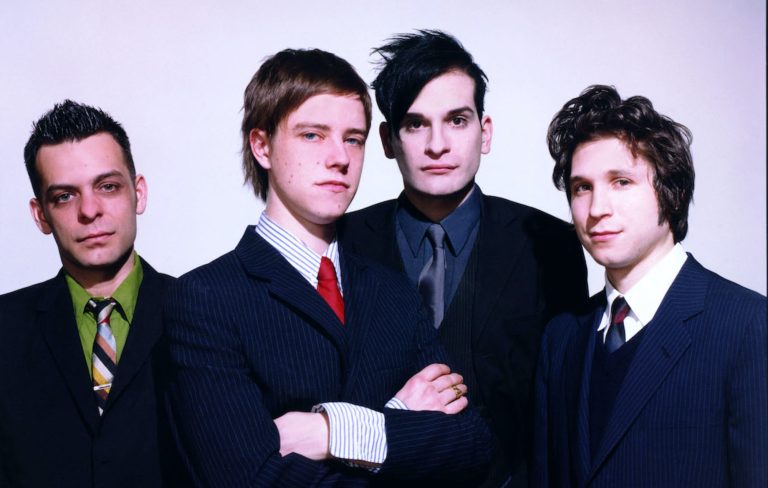
The four piece was born at NYU, when guitarist Daniel Kessler approached Carlos Dengler – or D. for short – in a class on WW1 to complement his shoes. It’s only logical to realize what had made those two men gravitate towards each other was their sense of sharp, sartorial fashion, all black suits and ties, something Carlos D. attributes to the then current Mod trend in the city, and his own taste for Suede and Pulp, as well as British post-punk of the 80s. Kessler had a drummer, but lacked anyone else – thus Dengler, a natural guitar player, was quickly hired to play a nearby bass. Singer and fellow NYU student Paul Banks was familiar with Kessler from a stay in France and joined soon after, while Sam Fogarino – a decade older than the rest and an experienced musician down on his luck – was recruited at a vintage clothing store.
It was Fogarino’s entrance that locked the band in, a moment Dengler later likened to having John Bonham join. All of a sudden, the everything made sense, the music became something more. The band’s rise accelerated, with a UK tour that climaxed in a Peel Session recording and sold out London gig leading to an offer by Matador, whom the band signed with. Then, the dust exploded.
The songs had been written before that initially bright early autumn day, but as all four agreed since, the change in atmosphere precipitated by the horrific events became traceable within the 11 tracks that would eventually make up their debut album just as much as the place chosen by producer Peter Katis to record: his house in Bridgeport, Connecticut. To those unfamiliar: Dengler summarized the environment with “stripmalls and dilapidated houses“ – too much greenery for the urban dandy. The four slept in the house and recorded in the attic. Banks was happy to exit New York, so long as he had enough alcohol, with Fogarino the only driver and thus beer delivery runner whenever he or Dengler decided they needed to refuel.
Maybe the consumption is to be blamed on the volatile energy that materialized during the session – especially Fogarino remembers a lot of tensions regarding minute details, which leads to the overall impression of perfectionist visionaries all pushing and pulling at the same time. There’s myths of the band dumping reels and re-recording most of it, Banks so unhappy with his vocal performances he wanted them totally drowned out in the background and Dengler butting heads with pretty much everyone in the studio at some point. Maybe without Katis, we never would have gotten this album, recorded on a $900 budget.
It’s impossible to summarize this record. It seems to exist all of its own volition, following strange dynamics and an inner logic that holds it together at every second, that beats blood through its veins like a living organism. Had somebody else made it, they would call it a concept album – it often seems like some hidden Hubert Selby, Clive Barker or William Burroughs story hides inside of it. Interpretations vary. It would be easy to read it as the story of a man abandoning his relationship (“Obstacle 1”) after meeting a new woman (“Untitled”) and after a brief phase of struggle with loneliness and insecurities (“NYC” to “Say Hello to the Angels”) embracing his new lover (“Hands Away” to “Stella…”) until that passion, too, runs dry (“Roland”) and there’s nothing left but routine and the mourning of the loss of love (“The New” and “Leif Erikson”).
Another more obvious one – related to the trauma of those towers – is the theme of relation between an urban cityscape of brutalist warehouses and fuming subway station entrances to sex, love, violence and cruelty. This strange mix of tenderness and sadism is what seems to be the record’s secret of universality. It works as both a porno, a thriller, a snuff film, and an arthouse experiment in the vein of Wong Kar Wai’s Chungking Express.
But as cinematic as it is, Turn on the Bright Lights remains – most of all – a dreamscape. It unites elements that are divisive, is both female and male. It sounds of Television’s Marquee Moon, Joy Division’s Unknown Pleasures, Placebo’s Without You I’m Nothing, Slowdive’s Souvlaki and Talking Heads’ Fear of Music all at the same time. It is at times shoegaze, at times punk, then drifts into dub or metal. There’s secrets in it, too, like the fact “Hands Away” is meant as a gay bondage love song by Banks, or that there’s the sound of a bottle opening in “Stella…” – things unseen.
In all of that, it creates a New York that does not exist like this, which only forms in images within our mind, as we find ourselves in total darkness, with nothing but the elemental quality of those eleven songs: unkempt, sludgy, echoing, played in gigantic warehouses and underground caverns, cinemas and smoked out clubs, between a concentrated drummer, a guitarist that moves like a Flamenco dancer, a bassist that demands an arena and a humble vocalist, a cigarette in his mouth, barely moving, eyes closed. They will be like this, forever: playing the best rock record of a decade, the document of an era of excitement and anxiety.
It’s 3:33. Soon, the darkness will vanish, only to return.
~John Wohlmacher
01. “Untitled”
“A sentimental longing or wistful affection for the past” is how the New Oxford dictionary defines nostalgia: that tender wash of feel-good neurochemicals that our sense of identity depends on in order to recall personal history. Memory-making peaks by the age of 30 so all approaching 50 can appreciate the importance of a vicenarian record.
“Untitled” was written and performed as a show opener and became the lead track on Interpol’s iconic 20-year old debut album, Turn on the Bright Lights. It perfects what became Interpol’s sound: simple layers of Daniel Kessler’s familiar, droning Epiphone guitar melody, then cymbals, drums, Carlos Dengler’s bass line followed by the Joshua Tree-slide guitar all perfectly placed to incubate Banks’ vocal. Just as special 20 years later, that long lost friend will: “surprise / sometime / will come around”.
~Kristy Sawyer
02. “Obstacle 1”
Perhaps the word “catchy” is an odd adjective to ascribe to Interpol’s music but through the layers of deadpan glaze covering their tracks, Interpol frequently deliver lyrics and melodies that drill their way into your cerebral recesses. “Obstacle 1” – one of the most definitive tracks in the band’s discography – proves such a track that is queasily anthemic as a lamentation to heartbreak, the inexorable dread of time passing, and futile denial. It is always to Interpol’s credit that they subversively twist their darker subject matter into something delicious to the ears.
From the off-kilter, harmonious dynamic of the two guitars and the steady drumbeat, this track is musically less about showing off and more about matching the miserable lyrics. There’s a certain cynical sluggishness to the track as the unique voice of lead singer Paul Banks laments a lost love (“I wish I could eat the salt off of your lost faded lips”). His vocals start off muted before becoming more desperate and emphatic. “We can cap the old lines / Make playing that nothing else will change,” suggests Banks in an attempt to, perhaps, get back to a good place with his interest. The spiralling occurring in the track also results in one of the band’s most iconic lyrics: “She can read / She can read, she’s bad!” Banks repeats, amplifying a common hobby into something fundamentally her.
Yes, this is already quite sad, situating the listener in the post-breakup frenzy but things really peak in the chorus. The guitars switch into a more aggressive, cacophonous rage, as Banks spins the subject matter of romantic dissolution into an existential dive: “Oh it’s different now that I’m poor and ageing / I’ll never see this face again.” This is already horrific enough to make the listener stare in the mirror, checking for new lines in their visage, until Banks adds: “You go stabbing yourself in the neck.” His vocal performance is incredible – gasping between lines as if the garrotte wire of realisation has offered him a moment’s respite.
This track is a brilliant piece of multi-faceted anguish that is ironically timeless and stands out on Turn On the Bright Lights. It’s hard to know what “Obstacle 1” really is: the first shattering heartbreak you experience or physically witnessing your own deterioration? Or: why not both? The icy charm of their Turn On the Bright Lights album is in encapsulating particular kinds of anguish and presenting it with a certain, addictive flair. The title of the track, though simple, really acknowledges a harsh truth about existence: from the moment you first encounter an obstacle, be prepared for the next one, and the next one, and so on, and so on.
~JT Early
03. “NYC”
Interpol’s debut, Turn On the Bright Lights, arrived approximately 11 months after the events of 9/11. Reconfiguring the bleak tones of Euro-post-punk, the band crafted a sequence that brimmed with post-millennial angst. On the pivotal third trac, “NYC”, droney guitars and drums that slightly drag undergird mournful verses and punk-operatic choruses. “The subway is a porno / the pavements they are a mess,” Paul Banks laments, depicting the American cultural capital as a ravaged underworld. Reverb-soaked backup vocals add a funereal vibe, the song unfurling as an elegy to a mecca interred in the ashes of the Twin Towers. Guitars build in intensity; spacey keyboards are introduced. We’re swept into a trance. Life as we know it is over and yet… there’s a mysterious equanimity to the piece that brings to mind the closing of William Styron’s Sophie’s Choice: “This was not judgment day – only morning. Morning: excellent and fair.” That is, the song never completely collapses into fatalism, instead integrating a sense of malleable grief and hard-boiled faith. Faith in what? People? Art? The regenerative nature of life itself? While it’s debatable whether Interpol ever revisited the heights of their debut, there’s no question that Turn On the Bright Lights is a creative landmark, “NYC” one of its most enduring tracks.
~John Amen
04. “PDA”
The most abrasive and immediate gem on TOTBL, this song does that wonderful thing of submerging dark subject matter behind the catchiest of hooks. The song’s protagonist is the biggest kind of arsehole. A full-blown narcissist who twists the language and opinions of others to suit their own needs, the song is clear about who is responsible for the breakdown in the relationship that the lyrics centre on. It’s his fault, yet he always looks at the role of others as a means of excusing his own appalling actions, highlighted most bitingly in the lines “You cannot safely say while I will be away / That you will not consider sadly / How you helped me to stray.” This guy, huh?
The clever opening line might even have you convinced that he’s the victim, the one left behind, as there’s a certain degree of deliberate ambiguity in the line “Yours is the only version of my desertion that I can ever subscribe to” (admit it, you sang that in your head when you read it). And that’s what he wants you to think. Of course, he’s wrapped his conceited tale up in a banger of a tune, and that’s the mask these narcs hide behind. All gloss and shimmer behind a darkness that lies within their heart. Is there a creepier lyric than “You’re so cute when you’re sedated”? I doubt it. And yet you’ve still cut some rug to the song, and that level of duplicity is what makes this such an ace track as the dichotomy between tone and subject matter perfectly resemble the song’s main character’s internal drives and impulses. Still, many people excuse the behaviours of others if it’s hidden behind charm. Now do you get why “PDA” is all levels of ace??!
~Todd Dedman
05. “Say Hello to the Angels”
Nervous and erratic, but contagious too, the infectious paranoia of “Say Hello To The Angels” is especially felt in context of the weighing grey cloud that the rest of Turn On the Bright Lights casts upon the listener. But by itself, the track is almost like the black sheep amidst the record’s consuming dreariness. Between Carlos’s frolicsome bass, Daniel’s vicious guitar stabs, and what is easily Sam’s most vicious display behind the kit, “Say Hello…” grabs your attention and throws you in every direction with its various spiraling out-of-control sections.
But to talk about the song without mentioning Paul’s inimitable vocal performance, one which harkens to that of Ian Curtis on “Transmission”, would be a crime. With desperation, urgency, and a bit of lustful energy, Banks’ tweaked-out delivery befits the unquenchable thirst and insatiable energy that encompasses his every uttered word, even when he opens up the song with a line as beautiful unraveled as, “I want your silent parts, the parts the birds love.”
“Say Hello…” will never be considered within a list of the band’s most quintessential moments. But the cut made and continues to make the most impressionable mark upon those who’ve struggled to be charmed by Turn On the Bright Lights. How? “Say Hello…” doesn’t take time to enrapture you in sonic dramatics and abstract poetry, like “Stella was A Driver…”, nor does it enchant listeners in a devastating sway, like “NYC”. “Say Hello…” leaves its trace because it grabs you by the throat, pushes you backward, and kicks you in the face as you catch your fall with its sonic twist around.
This approach envisions an entirely different band, albeit only in isolation. But when placed within the masterful entirety of Turn On the Bright Lights, the album’s fifth track is the seamless, ultimate jolt of energy needed, sandwiched right between the excitable (but not as excitable) “PDA” and the downbeat beauty of “Hands Away”. Who knew black sheep could romp around and rock this damn hard?
~Kyle Kohner
06. “Hands Away”
Before the hands were slow, they were moving away. While the future song from Antics sounded poised with alarm, the centre cut from the Turn Out The Bright Lights is much murkier and full of dread. Half channeling Ian Curtis and half the 1922 version of Nosferatu, Paul Banks murmurs with a darkly homoerotic edge to his words. “Will you put my hands away? / Will you be my man?,” he asks, and it’s not so much scene setting as it is a pool of dark water to slip into. The guitars synchronize and double before shimmering keys overlay them. Sam Fogarino’s drums chime with a heartbeat for the song, his hi-hats and cymbals hitting like a faraway ironmonger hammering out the edges of a weapon.
It’s moody and taut, but also unravelling, like slicked back hair losing its straight edge from an oncoming thunderstorm. The full storm might not arrive by the song’s end (leave that for another song on the album), but it’s enough warning to keep you indoors. Keep those hands slow, but more importantly, keep them away.
~Ray Finlayson
07. “Obstacle 2”
As cold and isolated as Turn On The Bright Lights undeniably sounds, there’s also a desperate and passionate human heart beneath it all – and “Obstacle 2” is the point at which it starts to beat through the surface. It’s not a particularly healthy or loving heart, though.
You can tell Banks is in a frisky mood as he drops some of his fruitiest lines – “friends don’t waste wine when there’s words to sell”; “I feel like love is in the kitchen with a culinary eye” – but with his excitement comes a lasciviousness that has a sharp, narcissistic edge. Singing directly to his new object of affection, Banks acts as though he’s in love, opening the track by singing: “I’m gonna pull you in close / gonna wrap you up tight / gonna play with the braids that you came here with tonight”. While this introduction suggests a deep passion, “Obstacle 2” soon reveals a completely one-sided, self-centred scenario. “If you can fix me up girl, you’ll go a long way” he admits and, as Interpol deliver a haywire rocker, he injects the poisonous admission “I’ll stand by all this drinking if it helps me through these days”. By the time “Obstacle 2” descends to its burnt-out finale, Banks is repeating “it took time, then I found you” – but this is not a man finally finding his star-crossed lover, this is a predator who finally has his prey in his grasp.
~Rob Hakimian
08. “Stella was a Diver and She was Always Down”
All across Turn on the Bright Lights, Paul Banks’ lyrics function as a Rorschach test for the listener. The poetic ambiguity and outlandish, occasionally awkward, turns of phrase lend themselves to armchair psychoanalysis and speculative interpretation. That’s part and parcel of the appeal of Interpol’s music. One could spend pages upon pages unraveling the levels of referentiality and in-built lore of this album’s shadowy world, but it truly excels in the intimate, symbiotic relationship between artist and listener on a moment by moment basis.
“Stella Was a Diver and She Was Always Down” has always struck me in a peculiar manner. It functions as an outlier in so many ways. There’s the cumbersome title on a record so streamlined it has two songs called “Obstacle”, not to mention the fact that, whilst being surrounded by precision engineered post-punk bound together by an aesthetic so coherent it’s virtually monochrome, “Stella…” is free-wheelingly loose-limbed: a multi-part epic, if you will, which barely makes sense while you’re listening to it. But the more time you spend with it, the more you realise that the incongruity of it, its very incoherence, is what makes it the singularly most disturbing track on a record that doesn’t exactly shy away from darkness.
First things first, the song opens with a goof: Banks announcing the name of the song with a mouthful of crushed ice, making him sound like a two bit Elvis impersonator. A character study of a woman plunging into drug addiction and being sexually preyed upon whilst at her most vulnerable might strike you as a strange moment to exhibit your sense of humour, but here we are. That seeming lightness returns later in the song, but its opening minutes are spent setting the scene for our heroine, providing insight into her mental state, her disassociation from the world around her, and depicting addiction as an airtight sea (to go along with the copious oceanic imagery across the record as a whole) which she dives down into, or rather is sucked down into, given her lack of agency. The musical mise en scene reflects the oppressiveness and feeling of descent: Carlos’ nervy basslines carry the melody whilst ringing guitars feel like tinnitus. There’s an uncomfortable closeness to the sound.
The song’s catchiest moment describes the moment Stella breaks away. Has she found release or fallen into a drug-induced stupor? Or does she die, by overdose or suicide? Let’s hope not, because the next section sees a shift in perspective: the narrator is no longer an impartial observer, but a participant. Suggestive sexual imagery, Banks’ best impression of achieving climax, a musical explosion into a reprise of the chorus, and the subsequent handbrake turn into a weirdly jovial yet nocturnally animalistic lounge jazz section, wherein Banks’ narrator twice describes Stella as his “catatonic sex toy”, paint what to my mind is a very clear picture hidden behind layers of libidinous murkiness. Beyond the inarguable musical thrills it delivers, “Stella…” reaches Blue Velvet levels of darkness where death and sex are intertwined, tangled in black seaweed in the ocean’s depths.
Like I said, Interpol’s music is a Rorschach test. Fun, huh?
~Andy Johnston
09. “Roland”
Interpol’s music, and more specifically their lyricism, has always had a knack for developing alternate histories, of channeling fans’ perceptions through the charred remains of post-punk into parallel timelines inhabited by countless interpretations of phrases and narrative complexities. What does this mean? Why did it end like that? These are questions we’ve all asked at one time or another when listening to the band’s various works. Turn On the Bright Lights is especially susceptible to this kind of personal examination – just look at “Roland”, a visceral and volatile examination of intimacy and abandonment. Or maybe it’s about Jack the Ripper. Who really knows?
Beset by guitars so jagged that you’re liable to need a tetanus shot after listening to it, the song is a striking encapsulation of Interpol’s overarching aesthetic: impenetrable lyrics awash in craggy guitar riffs, percussion that erupts and collapses like a black hole, and voices that call out from the darkest corner of the darkest bar in Manhattan’s East Village circa 1977. You may not always know what those voices are saying, but you sure as shit know that they’re not talking about anything good. There’s a hedonism inherent to Interpol’s craggy rhythms and musical ideology, and “Roland” makes the case that you can experience decades of ill-advised decisions in the span of just three and a half minutes.
~Joshua Pickard
10. “The New”
Like all songs of Interpol’s debut album, “The New” exists in a nocturnal twilight, but in contrast to most of its siblings, its superficial narrative is almost brazenly prosaic. Opening with a back and forth played on top of the guitar strings, it immediately conjures the horrific image of Poe’s Pit and the Pendulum: a swinging razorblade, somewhere above the narrator, that slowly echoes through the night’s quiet darkness. Then the image shifts, and Carlos D’s bass leads us to Banks, as he chronicles a relationship that has turned from excitement to routine. It’s the words you say after midnight, your partner awake with eyes open, things you can only say into the void, every second haunted by the unseen reaction: “I wish I could live free / I hope it’s not beyond me / Settling down it takes time / One day we’ll live together / And life will be better / I have it here, yeah, in my mind / Baby, you know someday you’ll slow / And baby, my heart’s been breaking”. It’s incredibly simple poetry, lacking the symbolism of “NYC” or surreal imagery of “Roland”.
As Banks expresses himself, there’s a sense of sombre longing and mourning to him that completely evades romantic notions: by now, it’s all just by the numbers. “I gave a lot to you / I take a lot from you too” Then his voice rises: “You slave a lot from me / Guess you could say I gave you my edge”. People usually don’t talk about those moments – and they won’t write them into song. These things are too intimate, they exist within a realm we segregate from our eyes, and, left for our ears to hear, every line burnt into our memory as when somebody cut them into our flesh. And that’s when the song all of a sudden transforms, morphing into a violent onslaught of dueling guitars and thundering drums. Somewhere, Banks whispers “How am I doing?” – it could be (as so often on the record) an artifact of the recording itself, or it could be a sinister hint at something else, a half dreamt moment, a whisper in sleep. And then he launches himself into a high pitched howl: “You’re looking alright tonight / I think we should go”. Does this suggest a party, or is the couple – as suggested on the follow up track “Leif Erikson” – planning to sail their life boat into the night? The instruments build further and further, seemingly unable to stop even when they song slowly fades out. Sounds that penetrate chests and necks, strings detuning, heartbeats fading.
“The New” leaves more questions than it answers – intentionally so. It’s Turn on the Bright Lights’ prog track, their Pink Floyd moment. Part of it is Roger Waters anxiety and lurid Clive Barker eroticism, while musically it’s uniting Christian Death’s “Cavity” with Placebo’s “Narcoleptic”. It’s cryptic in its clarity, violent in its emotional nakedness, and as beautiful as a strange, dark shard of glass found on a street, illuminated by moonlight, splatters of blood shimmering on its surface. It’s an emotional snuff film – and it hides things! Yes, the aforementioned whisper of Banks is one such element, but another is that the title “The New” is merely descriptive of it being ‘the new song’ during the band’s sessions, but accompanied by the dramatic composition, both become a cinematic unit.
And within that, there’s more that’s left unsaid, a spell conjuring things from within us: memories and fears and turmoil and anger. And somehow, it just feels wrong to engage with it. For many Interpol fans, it’s the song that moves them the most, the one that still makes them cry, the one they can’t look away from. It’s there where the song reveals links to Barker’s eroticism of the blade: alienation plays as much of a role as does a foreboding sense of transgressive action. “You slave a lot from me” – “I gave you my edge” – “Someday, you’ll slow” – “I wish I could live free”. And so, as contrasting to “Roland” and “NYC” as it seems tonally, it exudes the strange veneer of “The Midnight Meat Train”, where gory killings, lurid obsession, and dying love meet at the intersection of a subway platform – uniting the themes of the previous songs in texture and emotional resonance: dying love and the allure of physical violence.
Yet this interpretation is only glimpsed through the darkness of this strange construct, which at times seems to communicate with itself, all by itself, a metallic dialogue of instruments and fragmented lines spoken to somebody absent, or unresponsive. Just as Yes attempted to imagine alien landscapes, prog-rock always had this fascination with encountering the cosmic other, and “The New” fits this idea perfectly without becoming a slave to boring clichés. It remains inexplicable, a puzzle that seems to change the environment surrounding us. Like Banks’ protagonist, we are caught in the darkness, lying down with our eyes open; as somewhere above us in the darkness, something still is moving.
~John Wohlmacher
11. “Leif Erikson”
The closing track on Interpol’s debut album Turn On the Bright Lights is an equivalent of an open ending. The album explores themes of love, lust, loss and fear of the discrepancy between feelings and the way they are expressed and perceived by others. “Leif Erikson” in a way sums it all up on one track in form of a somewhat cohesive story of a relationship, which is elevated by Paul Banks’ eloquent poetry.
The story on this track could be read in at least two ways: it is either an end of the relationship, or an attempt to salvage it. The track title is the name of a Scandinavian explorer who is believed to have been the first European to sail to North America, approximately half a millennium before Christopher Columbus. His name in the track title symbolises the traversal into unknown territory and a sense of wonder/hope mixed with a sense of fear. Those are the feelings closely akin to those we feel when we anticipate that our loving relationship is nearing its end. Or it could be a reconfiguration of that relationship which evokes similar feelings. It is believed that Leif Erikson first settled in Newfoundland, which, if taken apart into three words, also seems to reinforce the notion of beginning a new stage in one’s life.
Paul Banks uses marine themes in his lyrics quite often, and “Leif Erikson” is no exception. On surface level, it must be owed to the fact that Interpol are a band from NYC, a city surrounded by water. Banks uses these themes as portrayals of the nuances and difficulties of life: being at sea is at once a time of inner balance and harmony with nature, as well as is among the most trying experiences. After all, the sea is utterly indifferent to the one sailing it, and does not possess intentionality in putting one through intense hardship. To succeed at traversing sea, one must reconcile these conflicting notions, which can be seen as a metaphor for interpersonal relations. Paul Banks’ character on “Leif Erikson” realises that it is reconciliation that is needed, the coming together of the joys and sorrows of love. However, success in this endeavour is not set in stone — it will not necessarily ‘feel good’. Reconciliation could bring the two people closer together in pure happiness, or break them up in the most hurtful way possible. This is why we hear thoughts such as “we did everything right, but still could not stay together”. Some might scoff at this and say that this person is delusional, and that there is no way of doing everything right and failing — the rational approach. But is it really impossible to do everything right and still end up shipwrecked?
~Aleksandr Smirnov